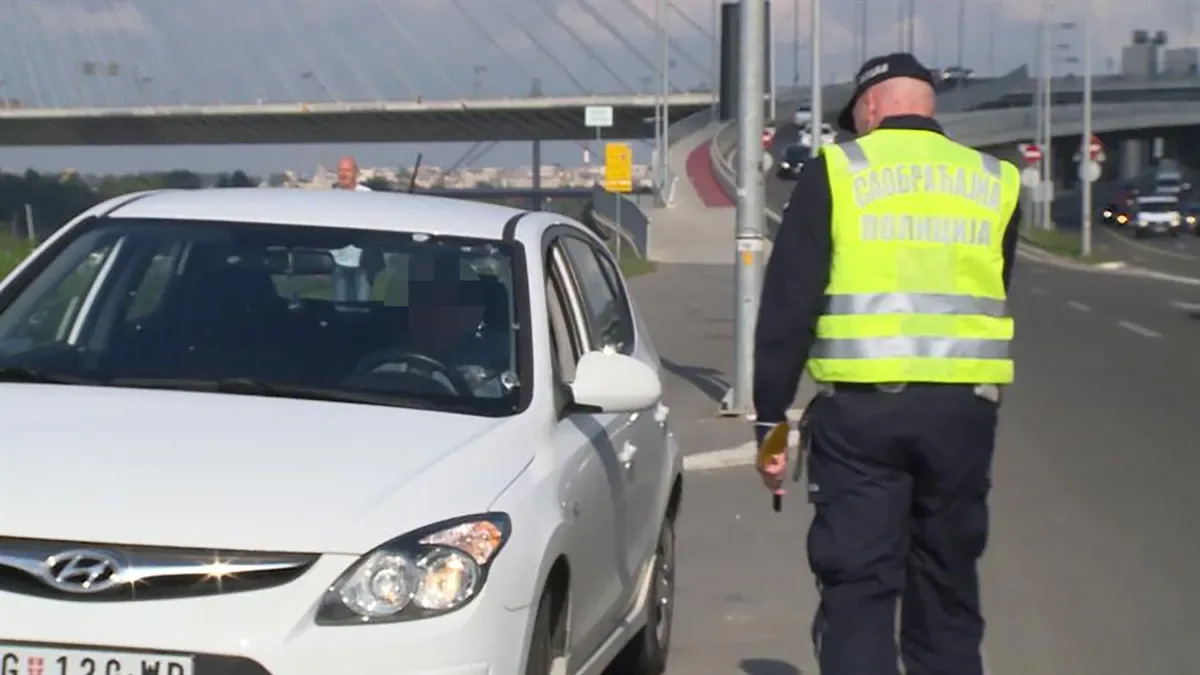
1,500 Speeding Violations Near Crosswalks in Three Days
Serbia's traffic police recorded more than 19,000 speeding violations in the first three days of the ROADPOL campaign, about 1,500 near pedestrian crossings. About 25,000 vehicles were checked.

In the first three days of a stepped up traffic crackdown across Serbia, police clocked more than 19,000 speeding violations. About 1,500 of those were recorded in pedestrian crossing zones, meaning stretches where a driver meets a pedestrian with no physical barrier between them. The figures were released on August 6, 2026, by Serbia’s Interior Ministry.
The crackdown is part of an international operation run under the umbrella of ROADPOL, the European traffic police network, and it runs through Sunday, August 9.
“Officers of the Traffic Police Directorate, within the Police Directorate, uncovered more than 19,000 speeding violations,” the Interior Ministry said in a statement.
What the three day snapshot shows
The ministry’s statement adds up to the following tally for the three day period:
- about 25,000 vehicles were checked
- roughly 4,300 other violations were found on top of speeding
- 254 drivers were pulled off the road for driving under the influence of alcohol
- 19 drivers were pulled off the road for driving under the influence of psychoactive substances
Combined, 273 drivers unfit to be behind the wheel were taken off the roads in three days, or about 91 a day. Speeding violations average out to just over 6,300 a day, more than 260 for every hour of the operation, night hours with light traffic included.
The ratio of the numbers is what stands out in this snapshot. Against roughly 25,000 vehicles checked, about 8,300 a day, there are more than 19,000 measured speeding violations plus another 4,300 violations of other kinds. Radar speed checks also catch vehicles that were never pulled over, so the two figures do not describe the same set of drivers, but the proportion holds: officers on the ground are logging more violations than they can process as stops.
Why are pedestrian crossing zones measured separately?
Because a driver’s mistake there turns into an injury or a death the fastest. The stopping distance at 50 km/h and at 70 km/h differs by a length measured in tens of meters, and a pedestrian who has already stepped onto the road has nowhere to go. That is why the 1,500 violations singled out here, though they make up just under eight percent of all measured speeding violations, carry the highest risk in the entire statistic.
Under Serbia’s Law on Road Traffic Safety, speeding is punished on a sliding scale, from fines for minor violations up to a driving ban and the driver being taken off the road for the most serious categories.
Same pattern as near Merosina
This figure is not an isolated data point. In late July, on a stretch of road near Merosina, police stopped a motorcyclist clocked at 234 km/h and confiscated his motorcycle, which at the time stood as a single extreme case. The three day snapshot now shows the same behavior as a mass phenomenon. The ROADPOL operation was designed precisely to expose that scale, not a single outlier.
The Interior Ministry has appealed to drivers to show extra responsibility and patience over the coming weekend, since the summer tourist season and a heavier lineup of music festivals are expected to push traffic intensity higher.
For people heading to festivals, police advise against getting behind the wheel after drinking alcohol or using psychoactive substances, and instead recommend alternative transport or making sure the driver is someone who has not been drinking.
Traffic police have announced they will keep up the stepped up activity on speed limit enforcement and on detecting other violations that endanger road users through the end of the operation. A final tally, covering all seven days, is expected after Sunday.