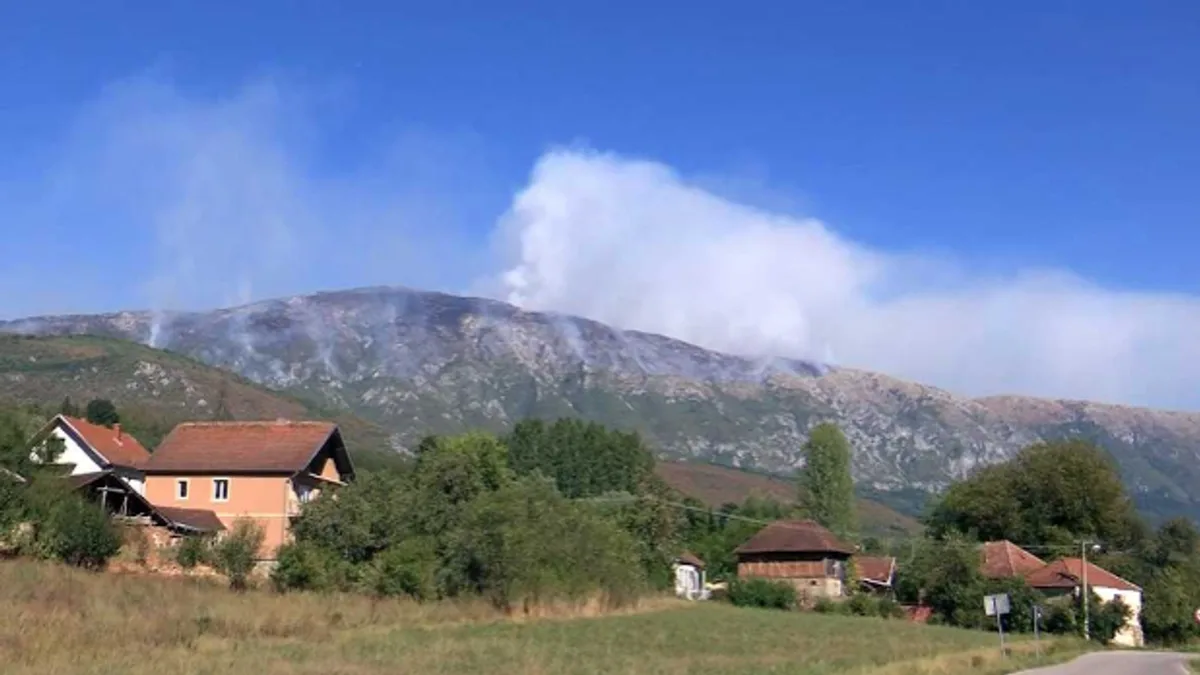
Dacic on Serbia's Wildfires: Three Hotspots Remain
Serbia's interior minister gave the first numbers on the wildfires: of 64 hotspots in the Deliblato Sands, three remain, and 435 new firefighters are on the way this year.

Serbia’s Interior Minister Ivica Dacic gave the first concrete numbers on Wednesday for how far firefighters have pushed back the wildfire in the Deliblato Sands: of the 64 hotspots recorded on August 8, three remain. Appearing on Pink Television, he also announced that the Interior Ministry (MUP) is hiring 435 new firefighters this year and acquiring at least 40 firefighting vehicles.
In the same appearance, he opened a political dispute. Dacic argued that certain actors are politicizing the firefighting effort and pointed back to the major wildfires of 2007 and 1996, when, in his account, a far larger area burned and the opposition did not use it for political ends. In a single statement, Serbia’s wildfires were framed as both an operational matter and a party political one.
From 64 Hotspots to Three, but the Fight Isn’t Over
The fire in the Deliblato Sands has been burning since August 5. It has affected roughly 2,000 hectares, and the minister specified that only 27 percent of the burned area is forest. About 150 firefighter-rescuers were deployed at that fire. The Sands cover 35,000 hectares in total, and the fire is now confined to three spots.
On the terrain, Dacic said:
The Deliblato Sands is terrain that is extremely unsuitable for firefighting, and the maximum possible effort is being put in. And what matters is that of this burned area, only 27 percent is under forest. Most important of all, there have been no human casualties, not a single house has burned down, and all inhabited places are safe. People are safe.
On Tuesday, 22 fires were active across Serbia, with two considered central: the one in the Sands and another on Stolovi, near Kraljevo. On that mountain, more than 200 hectares of grass and low vegetation has burned, on terrain with cliffs and slopes as steep as 75 degrees, where ground crews can do almost nothing. The MUP’s Kamov Ka-32 helicopter got backup from a military Mi-17.
The minister gave no timeline for when the firefighting would end.
The fight continues. It won’t end that quickly, simply because we don’t have the conditions that would help us, meaning there’s no rain.
How Many Firefighting Helicopters Does Serbia Have?
Eight. The helicopter unit does not formally belong to the Sector for Emergency Situations, but all of its aircraft can be used for firefighting. Four large helicopters were deployed at the two biggest hotspots.
When I was minister before, up until 2014, we only had two helicopters used for firefighting, with a capacity of one and one and a half tons. Now we have two Kamovs, and each Kamov carries five tons. We have two Super Pumas, and each Super Puma carries four tons. We also have several H145 helicopters, each carrying a ton to a ton and a half.
The comparison with 2014 is what the minister typically leads with in appearances like this, since the difference is measured in tons of water per drop, not in the number of aircraft.
What the 435 New Firefighters Actually Mean
The figure has to be read against the situation we described earlier: one firefighter for every 1,865 residents, with an estimated shortfall of around 3,000 people in the system. The new 435 hires cover roughly a seventh of that gap, which makes it a step, not a solution.
The Sector for Emergency Situations has carried out more than 21,000 interventions this year and saved more than 700 lives. The previous year was busier, with over 39,000 interventions and 1,400 people saved.
Gratitude and Politicization
The part of his statement that drew the most reaction concerned how the public treats the people on the ground.
I’m not sure there’s much gratitude, in the sense that it gets politicized. We’ve seen some of the comments. Everything gets politicized here, everything is based on some kind of hatred. I want to thank the citizens who fought the fires, the Serbian Army, and the public companies that helped. Of course, there’s also Srbijavode, Vojvodinavode, and Vojvodinasume, the volunteer firefighting societies, the Serbian-Russian Humanitarian Center, and so on.
Serbia has seen 500 fires in the past four days. With no rain in sight, the count of three remaining hotspots in the Sands stays vulnerable to a single strong gust of wind, and the argument over who gets to speak about the wildfires in Serbia is running alongside the effort to put them out.