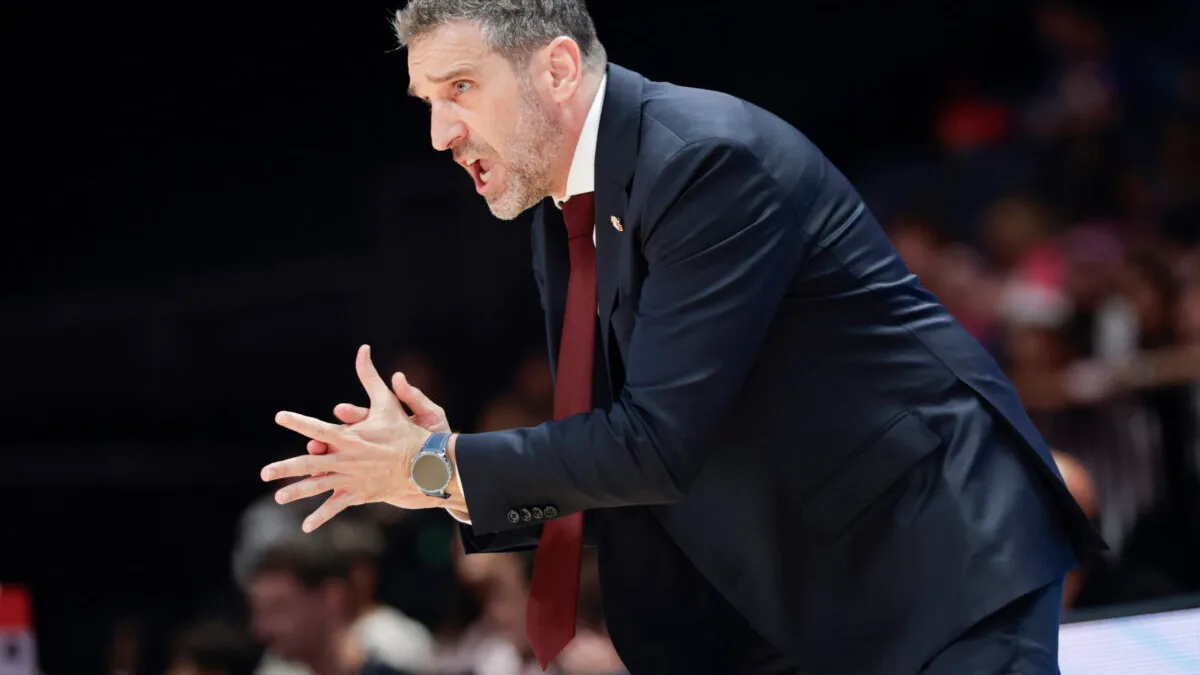
Zvezda concede 108 to Virtus, Navarro apologizes
Crvena Zvezda lost 84-108 to Virtus at Belgrade Arena, the most points ever conceded at home in the EuroLeague, and coach Ibon Navarro took responsibility.

The arena was emptying before the final buzzer. Sport klub reports that fans began leaving Belgrade Arena with seven minutes to play, while Kurir says in its headline that the exodus started five minutes from the end. The difference of a couple of minutes hardly matters, because the reason is the same: on Tuesday, November 24, in front of about 15,000 spectators (Mondo’s estimate), Crvena Zvezda lost to Virtus Bologna 84-108 in round 14 of the EuroLeague.
One quarter was enough to show how the night would go. Virtus opened the game with a 12-4 run, and Zvezda, as Sport klub notes, led only at 2-0. It was 50-41 for the visitors at halftime and 78-61 after three quarters.
How bad is this defeat?
The numbers look worse than the score. Virtus scored 108 points, the most any visiting team has put up in Zvezda’s home arena in EuroLeague history. The previous record belonged to Valencia with 106 points in Belgrade, Mondo reports.
The 24-point margin is the second biggest home loss for the red-and-whites in the competition. Only the defeat against CSKA in November 2017 was larger: Zvezda lost 59-85, a deficit of 26 points.
By quarter, it went 17-23, 24-27, 20-28 and 23-30. The referees were Mehdi Difala, Marcin Kovalski and Eduard Udjanski.
How did Virtus take the game apart?
The third quarter decided it. Navarro called a timeout when Derek Alston got hot, but as sd.rs writes, that was only a preview of what followed: after the break Trent Frazier, Wendell Moore and Kessler Edwards hit three-pointers and the visitors went up by 22. Sport klub adds that the Spanish coach grabbed his head when Nwora left Moore alone for a three in a routine pick-and-roll.
Edwards is the most striking example. Through Tuesday evening he had shot 5 of 27 from three-point range this season, and in Belgrade he hit all four of his attempts and finished with 15 points. Seven Virtus players reached double figures: Edwards and Alston with 15 each, Kar, Moore and Dijara with 13 each (Dijara also had 9 rebounds), Frazier with 11 and Dijuf with 10.
Zvezda shot 6 of 22 from three, or 27.3 percent. It lost another battle under the baskets: Mondo reports a 44-30 rebounding edge for Virtus, while Sport klub has it at 44-27, with 15-7 on offensive rebounds. The visitors played without the injured Davide Cazarin and Bobi Klintman, and Chris Jones, doubtful because of injury, played anyway and finished with 6 points and 6 assists.
Among the hosts, only Chima Moneke with 20 points in 29 minutes, Jared Butler with 17 in 17 minutes and Jordan Nwora with 12 points and 7 rebounds reached double figures. Mondo warns that the box score does not show their mistakes on defense. Sport klub writes that Butler’s and Nwora’s points mostly came when the game was already decided.
What did Navarro, Kremer and Butler say?
At the post-game press conference, Navarro offered an explanation that did not dodge anything:
“I think it’s clear that from the first moment we lacked freshness, energy, a lot of things. I think the management of our last 48 hours was not the best. We had to play with the best energy, and we played with the least energy.”
He then put the responsibility on himself: “It’s not 2, 3 or 4 players who were bad, it’s the whole team. The management of the whole team was not good, we did not prepare the game well. We did not do what we had to do, and that is my responsibility.” Asked what should have been different in preparation, he said: “Maybe we shouldn’t train.” He apologized to the stands: “We can only apologize to the fans, but they know this is not us.”
Navarro described his halftime message like this: “That they have to find energy and be fresh. If they can’t be fresh, they have to find that energy mentally.” He added that no player had any energy.
David Kremer showed how hard it was to explain, saying after the game: “I can’t speak for the whole team, but it’s clear we could have changed some things.” Asked why this happened, he answered: “I don’t know. These are all excuses. We have to be better, find mental toughness.” He finished with: “We have to learn from this, it happens.”
Butler summed up the whole game in one sentence: “A bit lethargic, a bit unsure and probably… unmotivated.”
Why fatigue, and not just a bad day?
Before this game, Navarro said Zvezda was the priority and the national team came after Virtus. It was the first home game in more than three weeks, and Zvezda had played four straight road games before it: Athens, Madrid, Milan and Barcelona. The team came out of that run with two losses and two wins, so it entered the Virtus game at 8-5.
Sport klub adds a caveat here: fatigue is a real explanation, but for a first home game after so long the team “simply has to be hungrier.” Mondo points out that Zvezda had been near the top of the EuroLeague in defense, so conceding this many points also means a drop on that list.
What awaits Zvezda in December?
Zvezda is now 8-6 and in seventh place, with the same number of wins as Paris and Barcelona, so it has fallen out of the top six. Virtus is 6-8. The loss also ended Zvezda’s five-game winning streak against Virtus.
The schedule is tough. Three straight road games come first: Fenerbahce on December 3, Valencia on December 10 and Panathinaikos on December 16. Home games against Besiktas on December 18 and Baskonia on December 23 follow, and the year ends with a trip to Paris on December 30. The first chance to answer is Fenerbahce, on December 3.