Fiscal Council: Serbian Food Prices Near EU Level
The Fiscal Council links 1.4 billion euros in yearly farm subsidies to food prices at 96.6% of the EU average, and proposes a three-phase agricultural reform over ten years.

Food prices in Serbia reached 96.6 percent of the European Union average in 2024, while gross domestic product per capita, the standard measure of real living standards, sits at just 51.8 percent of the EU average. The Fiscal Council of the Republic of Serbia published the figures on August 31, in a report titled “Serbian Agriculture Between Stagnation and Reform: Production, Prices, and Farm Policy.”
The gap between those two numbers gets at the core of the problem the Council describes: the general price level in Serbia runs at around 60 percent of the EU average, but food sits much closer to European levels. Since households spend roughly 30 percent of their budgets on food, that gap falls hardest on the most vulnerable.
The state spends around 1.4 billion euros a year on agriculture once budget subsidies, fuel excise refunds, and local payments are added together. That works out to 1 percent of gross domestic product in direct budget subsidies, or 1.5 percent once every other form of support is counted. The problem, the Fiscal Council notes, is not the size of the sum but its structure: about 80 percent of the money goes to direct, output-linked payments, such as milk premiums or fuel rebates, while investment in modernizing the sector is marginal.
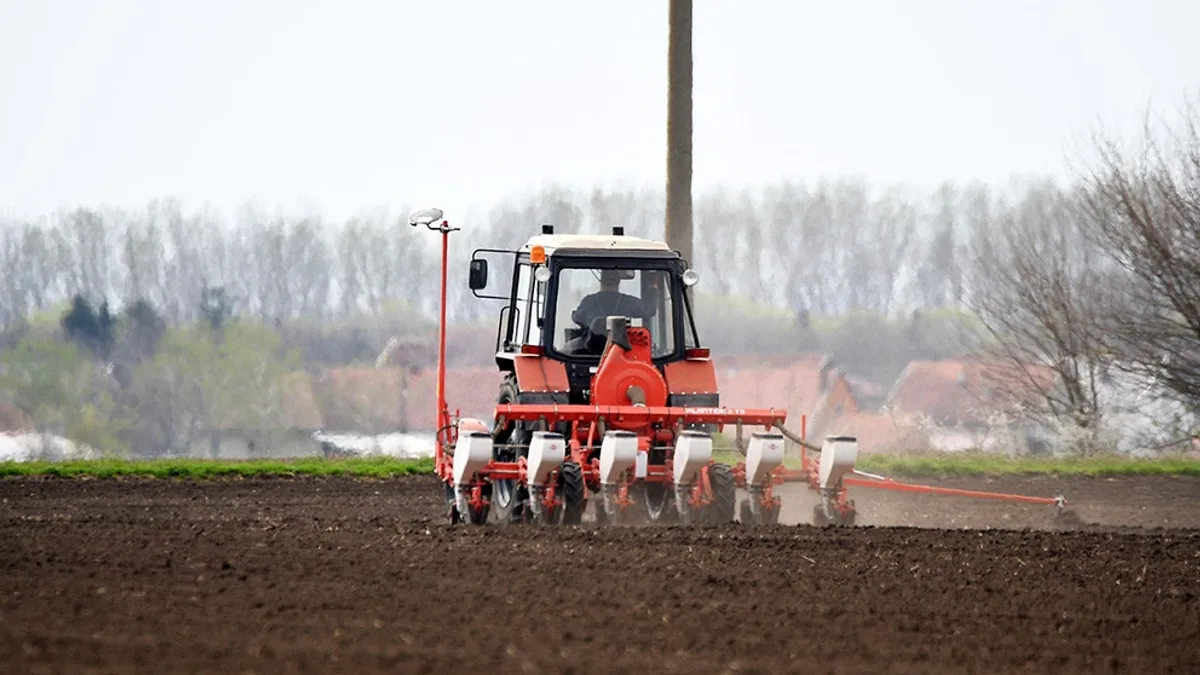
Serbian agriculture is currently in poor shape, the Fiscal Council concludes in the report. Output in the sector has essentially not grown over the past 10 to 15 years, while the rest of the economy expanded by around 40 percent over the same period. Labor productivity in agriculture stands at a third of the EU average, milk yield per cow is roughly half, and yields per hectare run about a quarter lower. Machinery follows the same pattern: 90 percent of tractors and three-quarters of combine harvesters in Serbia are more than ten years old.
The sector also lacks workers. Nearly half of all farm holders are older than 65, and the volume of agricultural labor fell by more than 20 percent between the two most recent censuses. Irrigation systems cover just 6 percent of farmland, and earlier irrigation plans have been only 30 percent realized. Legislation adds further instability: farming regulations changed 34 times between 2023 and 2025, making long-term investment planning difficult.
The Fiscal Council proposes a three-phase reform over the next ten years, without raising the total agrarian budget. The first phase, lasting one to two years, introduces a basic payment of 18,000 dinars per hectare as stable income support, along with supplementary support for the first 10 hectares of land, aimed at small and medium farms. The second phase, spanning three to five years, extends that support to 20 hectares and gradually phases out the flat payout of 19 dinars per liter of milk, which EU and World Trade Organization rules do not allow, in favor of incentives tied to milk quality. In the third phase, from year six through year ten of the reform, at least 25 percent of the total agrarian budget should go toward investment.
At the same time, growth in the productivity of primary agricultural production would need to be matched by better functioning across the entire food supply chain. That means greater transparency in prices and margins, a stronger bargaining position for farmers, and the development of shared logistics infrastructure, the Fiscal Council concludes in its analysis.
Part of the problem, according to the report, lies outside farming itself, in the cost of inputs. We covered this earlier: in “Urea at $800 a Ton: Food Getting Pricier in Serbia by 2027,” we flagged the rise in fertilizer prices. The Fiscal Council now backs that link with a figure of its own: mineral fertilizers in Serbia grew 95 percent more expensive between 2020 and 2025, against 60 percent on average across the EU, while traders and processors pass on every rise in raw material costs quickly, but pass on falling global prices slowly and only in part.
The Fiscal Council warns that redistributing subsidies alone will not change conditions on the ground without building the institutional capacity that is currently missing: an electronic land parcel identification system (LPIS) and an integrated control system (IACS), along with fully staffing the Agrarian Payments Administration and the Veterinary Directorate, both of which run with up to 25 percent fewer employees than their approved staffing levels. Only once those preconditions are met, the Council assesses, does room open up for agricultural reform to directly lower food prices on the domestic market.