Cernavoda Reactors Still Down: Power Prices Top 250 Euros
Both reactors at Romania's Cernavoda nuclear plant have been offline since August because the Danube doesn't carry enough water for cooling, and reports disagree on when they will restart.

Both reactors at Romania’s Cernavoda nuclear power plant have been offline for more than a month: the first unit was shut down on July 28, the second on August 13, together taking between 1.3 and 1.4 gigawatts of baseload generation off the grid. The cause is a persistently low Danube, which isn’t carrying enough water to cool the reactors. Romania’s Ministry of Energy has pushed back its next assessment of the situation to sometime after September 15.
Nuclearelectrica’s technical director, Emil Makovei, says current conditions on the river still don’t allow the plant to run safely: “Conditions on the Danube still aren’t sufficient for the plant’s safe operation.”
Sources disagree on how long Cernavoda will stay dark. On September 9, the outlet serbia-energy.eu reported that Romania wouldn’t restart either reactor for at least another ten days, pushing a return to service past the middle of the month. Two days later, on September 11, energetika.news reported that a restart realistically wouldn’t come before the end of September, since the ministry isn’t making its new assessment until after September 15. The gap between the two reports shows just how unsettled the situation on the ground is: in a single week, the timeline slid from “another ten days” to “by the end of the month.”
Running at full capacity, Cernavoda covers about a fifth of Romania’s electricity output. Its absence is felt most in the evening, when solar generation drops off and the grid is held up by coal, gas, hydropower, other renewables and imports. Imports during those hours stay under 2 gigawatts, mostly from Hungary and Bulgaria, while evening peak prices in Romania and neighboring markets have repeatedly topped 250 euros per megawatt-hour. The same regional system also feeds the market Serbia is tied to, so the higher cost of lost baseload capacity in Romania spills over into neighboring power exchanges, not just onto Romanian consumers.
The risk grows as winter approaches. Romania’s summer demand reaches 7.5 to 8 gigawatts, while its winter peak, recorded on January 19, 2026, hit 9,235 megawatts. If Cernavoda stays offline through the winter months as well, a larger share of that demand will fall on imports and on fuel for thermal power plants, whose price depends on a market Romania doesn’t control.
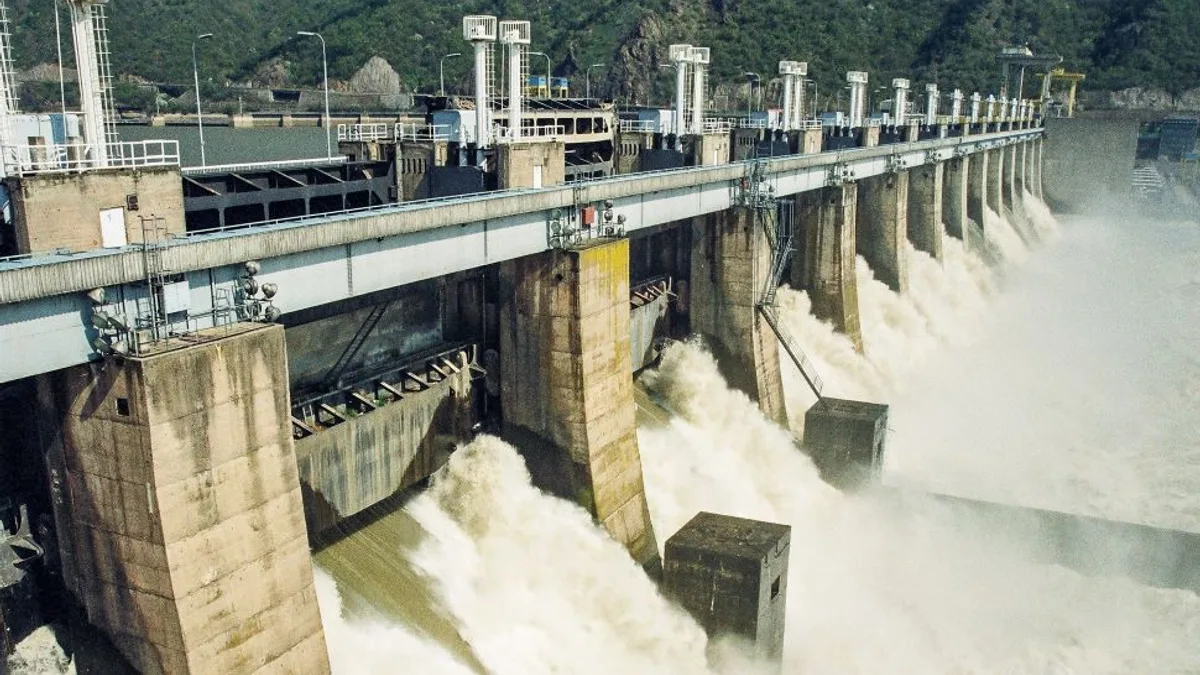
To increase the flow of water reaching the cooling system, crews are building a cross-channel diversion structure on an old arm of the Danube and dredging the riverbed, while the state-owned Hidroelectrica is releasing extra water from reservoirs on the Olt river. Alongside these measures, Romanian authorities have already weighed emergency steps, including temporary support for thermal power plants, while they wait for water levels to rise. Similar hydrological constraints hit Hungary’s Paks and Bulgaria’s Kozloduy nuclear plants in August too, though Kozloduy has since recovered part of its lost output, while Cernavoda remains the toughest case in the region.
The uncertainty over a restart date is also spilling into forward power markets: traders are pricing in the risk that the date keeps slipping, that hydrology stays poor, and that flexible thermal plants won’t have enough spare capacity to cover evening peaks. That’s especially sensitive because nuclear output is normally a stable, cheap source that doesn’t move with the weather, while hydropower is exposed to the same drought at the same time, so the two risks end up overlapping in practice instead of offsetting each other. Even a partial restart of one of the two units would, by that same logic, meaningfully improve Romania’s position in the market, but as long as there isn’t enough water for safe operation, the system stays exposed.
The next turning point is the date the ministry itself has flagged: the assessment after September 15, which will determine whether at least one of the two reactors comes back online before the end of the month, or whether Romania heads into winter with both reactors still down.