Cibuk 2 Wind Farm Goes Online Near Kovin
Masdar of the UAE and Finland's Taaleri Energia have launched the 154 megawatt Cibuk 2 wind farm near Kovin, bringing the Cibuk complex to a combined 312 megawatts.

The 154 megawatt Cibuk 2 wind farm has officially gone online in the municipality of Kovin, southeast of the existing Cibuk 1 plant. RTS and B92 give the opening date as September 14, while Novosti and Energetski portal report the ceremony took place on September 15. With the new project, the Cibuk complex now has a combined installed capacity of 312 megawatts.
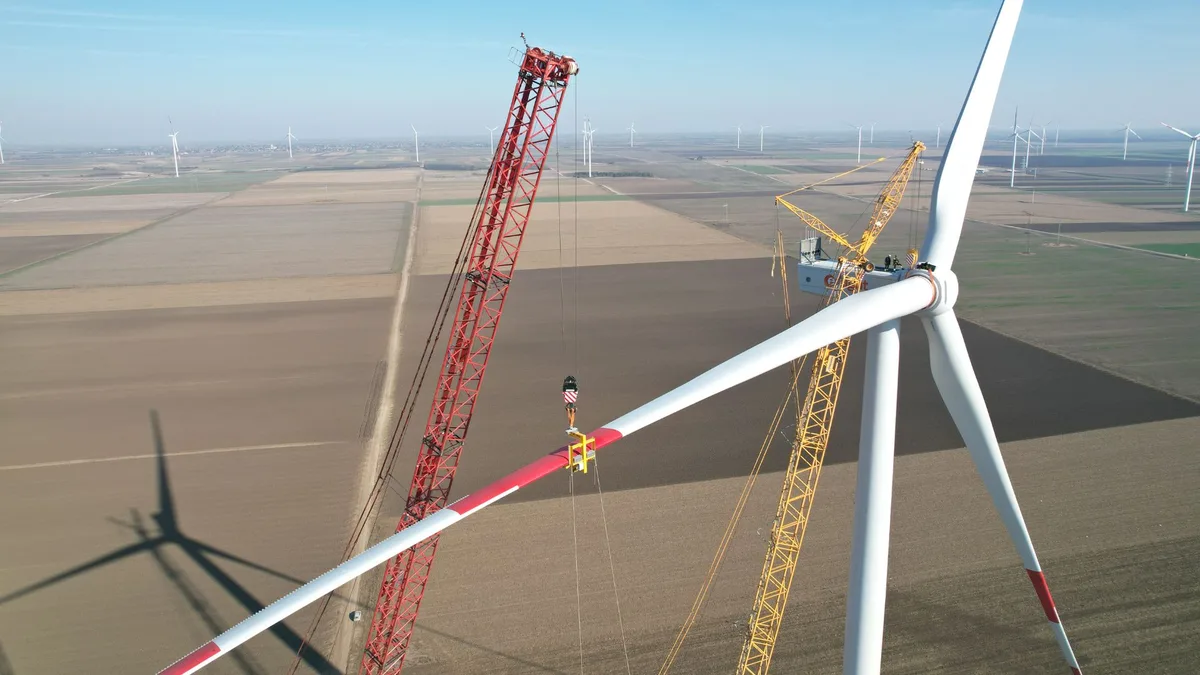
The park sits between the villages of Bavaniste and Mramorak, about 40 kilometers from Belgrade, spread across 4,750 hectares. It consists of 22 wind turbines made by Nordex. Even after construction, more than 99 percent of that land is still farmed, according to both RTS and B92. Construction began in 2024, with trial operation running through 2025 before the project was officially commissioned last week.
Investors and project value
The project is owned by Masdar of the United Arab Emirates and Finland’s Taaleri Energia. Energetski portal reports the ownership is split 50:50, with domestic company New Energy Solutions serving as development partner. According to a Masdar statement carried by Energetski portal, the value of foreign direct investment across both Cibuk 1 and Cibuk 2 exceeds 500 million euros.
More than 1,000 people worked on the construction of Cibuk 2, including employees, subcontractors and project management staff. Novosti and Energetski portal report that most of the workforce came from the Southern Banat region.
How many households does Cibuk 2 supply?
Here the sources disagree. RTS, B92 and the body of the Novosti article state that both wind farms combined, Cibuk 1 and Cibuk 2, can supply around 178,800 Serbian households with electricity. Novosti’s headline attributes that same figure to Cibuk 2 alone, which does not match its own article text. Energetski portal offers a third figure: Cibuk 2 on its own, with annual output of 336,000 megawatt hours, is enough to supply around 80,000 households.
Caretaker Minister of Mining and Energy Dubravka Djedovic Handanovic said at the opening, held at the St. Regis Hotel in Belgrade, that Cibuk 1 and Cibuk 2 together account for nearly 25 percent of Serbia’s current total solar and wind capacity, and that state power utility Elektroprivreda Srbije is already drawing electricity from both plants.
A target for 2030
“The goal is that by 2030 we have around 3.5 gigawatts from wind and solar, meaning that every second megawatt hour produced comes from clean sources,” said Djedovic Handanovic, adding that the target cannot be met through public investment alone and will require strong participation from the private sector.
She said Serbia’s total renewable energy capacity grew from around 400 megawatts to more than 1.3 gigawatts over the past four years. Two rounds of auctions, she noted, contributed to that growth, attracting nearly 1.5 billion euros in investment across 17 new power plants with a combined capacity of 1.2 gigawatts.
Masdar CEO Mohamed Dzamil Al Ramahi said Cibuk 1 together with Cibuk 2 forms the largest wind energy hub in Serbia and the Western Balkans. “Thank you to all our partners and the citizens of Serbia who supported our project,” Al Ramahi said at the opening, according to B92.
The opening was also attended by Taaleri Energia CEO Kai Rintala and UAE Ambassador Ahmed Hatem Almenhali.
Emissions impact and next steps
The investors say the wind farm will cut annual carbon dioxide emissions by approximately 311,200 tons compared to coal-fired power production. They also expect annual reductions of about 12,700 tons of sulfur dioxide, 1,470 tons of nitrogen oxides and 512 tons of fine particulate matter.
Energetski portal reports that beyond the Cibuk complex, Masdar is developing an additional portfolio of projects in Serbia with a combined capacity of more than 200 megawatts, spanning solar plants, wind farms and battery energy storage systems. The company, according to the same source, views its experience with Cibuk as a foundation for further expanding its portfolio across Central and Eastern Europe.