Serbia Poverty Risk at 19.6%, Threshold 45,674 Dinars
Statistical Office: 19.6% of residents fell below the poverty line in 2025, while Caritas Serbia reports more requests for food instead of money.
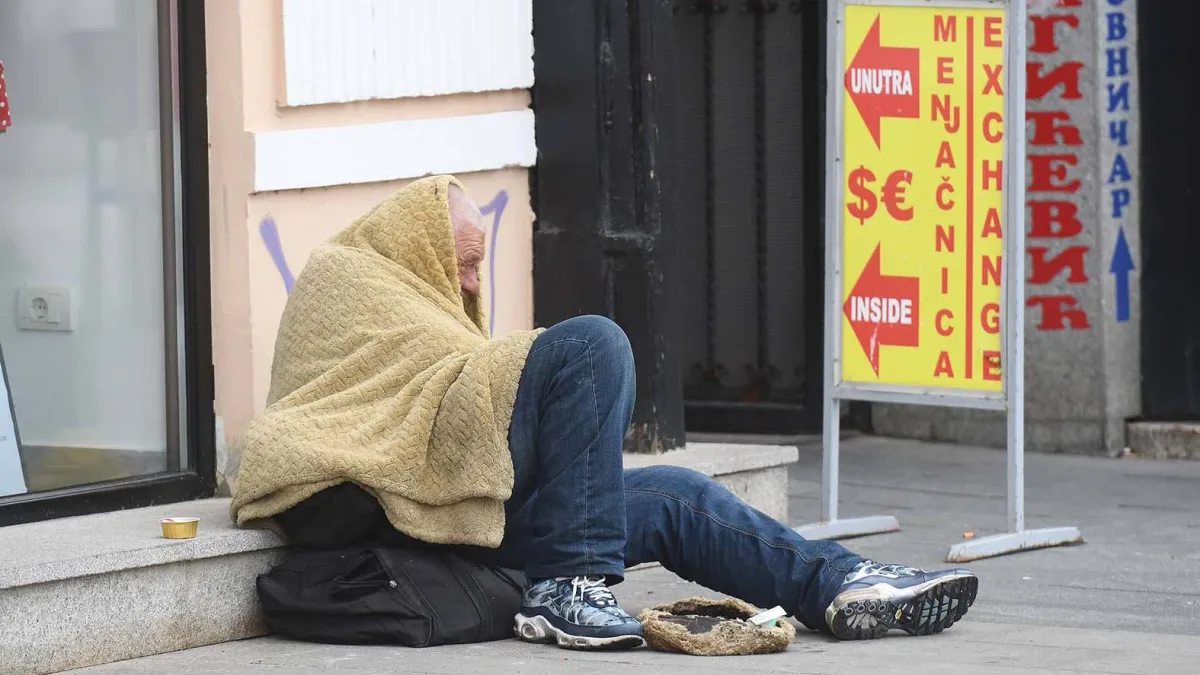
Some 19.6% of Serbia’s residents had an income below the at-risk-of-poverty threshold in 2025, 0.1 percentage points less than a year earlier, according to final figures from the Statistical Office of the Republic of Serbia. The rate of risk of poverty or social exclusion stood at 23.2%, down 1.1 percentage points from 2024. The numbers arrive on the International Day for the Eradication of Poverty, October 17, together with a warning from Caritas Serbia that people increasingly ask for food rather than money.
In brief
- At-risk-of-poverty rate in 2025: 19.6%. Risk of poverty or social exclusion: 23.2%.
- Average monthly threshold for a single-person household: 45,674 dinars (about 390 euros).
- The unemployed are at risk in 49.9% of cases, employees in 4.8%.
- The Law on Social Protection from 2011 has not been replaced by a new one.
How high is the poverty line in Serbia?
The average monthly at-risk-of-poverty threshold in 2025 for a single-person household was 45,674 dinars (about 390 euros). For two adults and one child under 14 it was 82,213 dinars (about 700 euros), and for two adults and two children under 14 it was 95,915 dinars (about 820 euros). Euro values are converted at an approximate rate of 117 dinars.
The at-risk-of-poverty rate measures the share of the population whose equivalized disposable income falls below that threshold, so it does not mean everyone counted lives in the same conditions. The indicator of risk of poverty or social exclusion is broader: it also counts severe material and social deprivation, as well as life in households with very low work intensity.
Who is most exposed?
The gaps between groups are wide. Among the unemployed the risk rate is 49.9%, among pensioners 23.4%, among the self-employed 13%, and among employees 4.8%. The unemployed are therefore at risk about ten times more often than people with jobs.
By age the picture is similar: the rate is 25.8% for those 65 and older, 21.4% for people aged 55 to 64, and 14.9% for those aged 25 to 54. Single parents with dependent children are hit hardest, with a risk rate of 41.3%.
What does the living standards survey show?
The Statistical Office’s Survey on Income and Living Conditions (SILC) records that 85.9% of households have some difficulty making ends meet. A little over half report some difficulty, one in five says it is hard, and one in ten says it is very hard.
The specific deprivations look like this:
- about 36% of households cannot cover an unexpected expense of 29,000 dinars (about 250 euros) from the household budget
- 36.3% cannot afford a week of vacation away from home
- 14.2% cannot afford a meal with meat or fish every second day
- 9.3% cannot heat their home, nearly one household in ten
Absolute poverty: no official measurement since 2021
Absolute poverty in Serbia has not been tracked since 2021. For that year UNICEF reported a rate of 8.9%, or 607,572 people. An estimate suggests that about half a million people could be living in absolute poverty today, but that is an estimate, not a measured figure.
Serbia and the European Union, south and east versus Belgrade
According to Eurostat, the European Union average for people at risk of poverty or social exclusion is 20.9%. Serbia’s 23.2% is 2.3 percentage points above that average. Within the country the gap is wider: the region of southern and eastern Serbia records 30.9%, while the Belgrade region records 15.4%, half as much.
The 2011 law and requests for food
Zarko Sunderic, director of the Center for Social Policy, says Serbia has no concrete strategy for reducing poverty and that the Law on Social Protection, passed in 2011, is outdated. A new law has not been adopted.
“Circumstances have changed since then. We have seen gaps in how the law is implemented, as well as some European Union-inspired provisions that should be added. But that new law has not been passed, and the question is why.”
On amendments to the law, Sunderic says: “Ministers change and say they have started on amendments, but at the end of the term, the law is not passed.”
Caritas Serbia offers a different testimony, from the field. Slobodan Milosevic says the organization has faced more and more people asking for food and basic necessities over the past two years. He did not give the number of requests.
“They used to ask more often for financial help, and now they increasingly ask for the most basic things, which says enough about how hard the situation is for many people.”
Milosevic warns that one-off aid does not solve the cause. “We can give someone a food package, but that does not solve their problem,” he says, and then explains the goal:
“Because the goal is not for someone to depend on food packages for years, but to help them live with dignity and, as far as possible, independently.”
This year’s theme
The International Day for the Eradication of Poverty has been observed since 1993, after the United Nations General Assembly declared October 17 a day devoted to ending poverty in 1992. The date goes back to October 17, 1987, when people gathered in Paris to honor victims of extreme poverty, violence and hunger.
This year’s focus is “A Safe Home for All,” aiming to highlight the link between poverty and housing insecurity. According to United Nations estimates, more than 2.8 billion people worldwide face some form of inadequate housing, and about 826 million live in extreme poverty.