A century of a young diplomat's portrait: Beljanski among friends in Novi Sad
The Pavle Beljanski Memorial Collection in Novi Sad opens Beljanski and Friends, marking the centenary of the portrait Young Diplomat with a parallel display of portraits and self-portraits by nine artists who remained part of the collector's circle.

Paris, 1926. Pavle Beljanski, twenty-seven years old, secretary at the Yugoslav Royal Embassy. A small studio in the ninth arrondissement, near the Saint-Honore market. Across from him stands the painter Branko Popovic, with whom he is then in the kind of friendship young men built quickly in the years just after the Great War.
That meeting produced an oil portrait titled “Young Diplomat” (Mladi diplomata).
A century later, the painting is more than a document. It is the prehistory of Serbian collecting itself. Beljanski went on to spend the next four decades methodically assembling Serbian modern art from the first half of the 20th century, and after his death left the collection to Novi Sad, where the Memorial Collection that bears his name opened in 1961.
A two-tier exhibition
“Pavle Beljanski and Friends” was opened by curator Jasmina Jaksic Subic. The concept is simple, but rare in Serbian galleries.
Two parallel lines:
- portraits of Beljanski painted by his friends
- self-portraits by the same nine artists
This gives the visitor a double reading. How the painters saw themselves, and how they saw their common friend. As an interpretive arc, it is the kind of staging that almost never appears in permanent displays.
Nine names, nine looks
Alongside Branko Popovic, the show presents the work of nine artists who maintained long friendships with Beljanski:
- Sava Sumanovic, whose 1932 portrait of Beljanski normally hangs in the permanent collection and now appears alongside the painter’s own self-portrait
- Milena Pavlovic Barili
- Petar Dobrovic
- Marko Celebonovic
- Toma Rosandic
- four women artists whose research the curator has deepened in the last few years: Beta Vukanovic, Zora Petrovic, Ljubica Cuca Sokic and Olga Olja Ivanjicki
The show’s particular value lies in the first-time publication of documentary material from the Beljanski estate. Correspondence with Sumanovic from the 1930s. Letters with Ivanjicki from the 1950s. A diary entry by Celebonovic about a family dinner in Belgrade in 1937.
What these documents show is that the friendships were not only artistic. They were a serious living network, and such networks do not happen by accident. They are the slow result of a relationship to artists held with the kind of attention Beljanski sustained for decades.
What a single portrait can be
“Young Diplomat” is recognisable in its palette as Popovic’s work of those years. Olive green and brown, with minimal red accents on the tie.
Beljanski in the painting is not idealised. An elongated face. Faint shadows under the eyes. An expression that settles between cordiality and the youthful self-confidence of a career diplomat in the making.
Popovic caught in him what was probably already arriving: the capacity to be a friend to artists without wanting to be their rival. Beljanski stayed a collector and never became an artist himself. For Serbian art history, that division of roles turned out to be a fortunate one.
The self-portraits by Sumanovic (1928), Pavlovic Barili (1937) and Ivanjicki (1966) set up a portrait line tracing half a century of Serbian modernism. Each carries an open self-analysis the portraits of Beljanski never quite take on. Portraits of the same man painted by different hands turn out to be more interpretive than documentary.
The old museological wisdom, that a painter sees more in himself than in his model, gets its quiet illustration here.
Venue and context
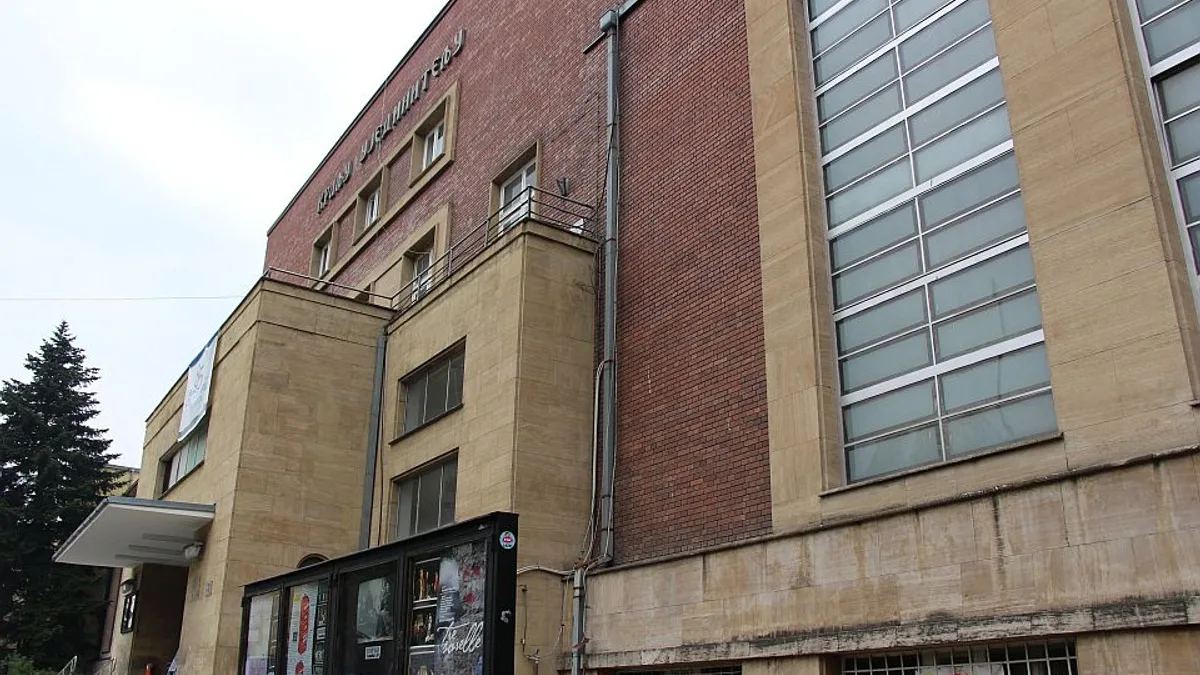
The Memorial Collection sits on Gallery Square (Trg galerija) in Novi Sad, in a building designed by architect Ivo Kurtovic and opened in 1961. The permanent display is free every Sunday.
The current exhibition occupies the ground-floor hall, which earlier in the month held a photography show titled “Reflections”. “Beljanski and Friends” takes over that space as the regular visiting program.
Practical information:
- admission is free
- the exhibition runs until June 15
- opening hours: Monday to Friday 10 to 18, Saturday 10 to 14, closed Sunday
- a panel discussion on Serbian portraiture from the first half of the 20th century is announced for the run
Why a centenary is worth a train ride to Novi Sad
Belgraders tend to travel to Novi Sad for a concert or a play. Few take the train purely for an exhibition. “Beljanski and Friends” is the kind of show that can shift that calculus.
It demonstrates what Serbian collecting can be when it is led seriously: with method, with a sustained relationship to artists while they are alive, and with the slow, patient looking that gives any artistic inquiry its depth.
Without excessive promotion, with a strong selection and a careful attitude toward documentary material, the exhibition sustains the standard Novi Sad’s institutions have held for decades. For Beljanski’s legacy, that is among the most important things that can be done.
What do you think: does a good collector, through the collection, say more about an era than the artists themselves say through their work?