Zorba the Greek returns to the main stage: Theodorakis in Kostyukov's choreography
The National Theatre announces the return of the ballet Zorba the Greek to the music of Mikis Theodorakis, choreographed by Konstantin Kostyukov, with four performances in the first half of June.

- The ballet "Zorba the Greek" returns to the Main Stage of Belgrade's National Theatre.
- Four performances are scheduled for June 11, 12, 15 and 16, 2026, beginning at 7 p.m.
- The music is by Mikis Theodorakis, the choreography by Konstantin Kostyukov.
- In 1994 Theodorakis granted the Serbian National Theatre rights to perform the work without fee.
There is a moment in the final act of the ballet “Zorba the Greek” that does not change with the performers. Zorba teaches the Englishman to dance the sirtaki, on the shore, one step at a time, slowly catching the rhythm. The dancers stand in a line, hands on shoulders, an ending to the choreography that looks as if it happened by accident. It did not. Mikis Theodorakis wrote this final sequence out of the joy that others had at last heard the music he knew to be folk and to which he had given form.
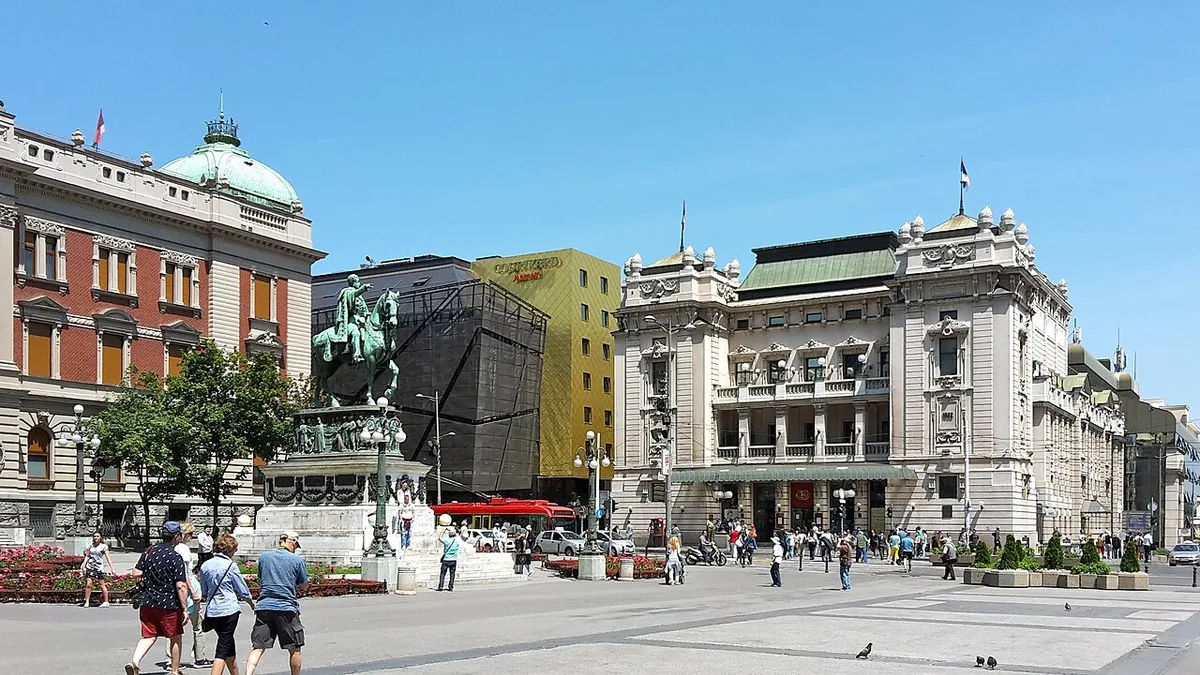
In June this scene returns to the Main Stage of the National Theatre in Belgrade. Four performances are scheduled for June 11, 12, 15 and 16, 2026, beginning at seven in the evening.
Theodorakis, who became a Serb
The bond between Mikis Theodorakis and Serbian theatres is not a marketing story. The 1990s were a period in which the Greek composer openly stood with Yugoslavia under sanctions, a stance that cost him several professional collaborations in Athens. In 1994 Theodorakis granted the Serbian National Theatre in Novi Sad the rights to perform the ballet “Zorba the Greek” free of charge, and sent over the orchestral score without payment.
This is a gesture rarely encountered in cultural diplomacy. The consequence was that Theodorakis took a place in the repertoire of Serbian theatres that few foreign authors hold. His “Sirtos”, “A Place in Paradise”, “Zorba” and “Antigone” have been part of the regular programme for decades.
Kostyukov’s choreography
Konstantin Kostyukov is a choreographer who has been collaborating with the National Theatre for the past fifteen years. His version of “Zorba the Greek” was first performed in 2014 and has become one of the theatre’s most popular ballet productions. The reason is a combination of two approaches a choreographer rarely brings together:
- classical ballet technique in the main solo passages
- elements of Greek folk dance in the ensemble scenes
- acrobatic elements in the duets between Zorba and the Englishman
- visual elements that rely on physical scenography rather than projections
A combination of this kind was earlier present in Serbian theatres in Hadzi Pandzovic’s choreography for “Blood Wedding” in the 1980s, but afterwards almost disappeared.
The Kazantzakis novel that gave the ballet its form
The novel by Nikos Kazantzakis, “The Life and Times of Alexis Zorbas”, published in 1946, describes the meeting of a young Greek intellectual and an older country labourer on the island of Crete. The young man arrives to take over his father’s mining concession; Zorba becomes his worker and, in the end, his mentor in a world he had lost in books.
Adapting the novel to a ballet was not an obvious move. The novel is almost without action in the classical sense; it is built from conversations and inner monologues. Theodorakis’s score translates that interiority into a melody repeated in different variations, which gives the choreographic structure a language that follows a psychological state rather than narrative action.
Theodorakis wrote in his autobiography that he composed “Zorba the Greek” at a moment when it seemed to him that Greece should musically acknowledge everything its oral tradition had already known, but had not entered the concert halls.
That autobiographical note has become a guiding key to understanding the ballet, which is not an adaptation but a double introspection.
What the June run brings
The cast for the June performances has not yet been announced. The National Theatre says the run will feature the principal soloists of the company and a refreshed set after last year’s pause.
The performance lasts two hours with one interval. Tickets are on sale at the National Theatre box office and through the official website. The Main Stage seats around a thousand, which over four performances means four thousand spectators will once again try to learn the sirtaki that closes the show.
Is there a piece of choreography in the Serbian repertoire that runs deeper than a ballet that has stayed in it for twenty years?