Netflix Star Joins Heartefact Rehearsals in Belgrade
Andrej Nosov has started rehearsals at Heartefact House on a coproduction with Sweden's SWEETS/Kontrar, starring Nils Veterholm of Young Royals. The premiere is set for October in Stockholm.

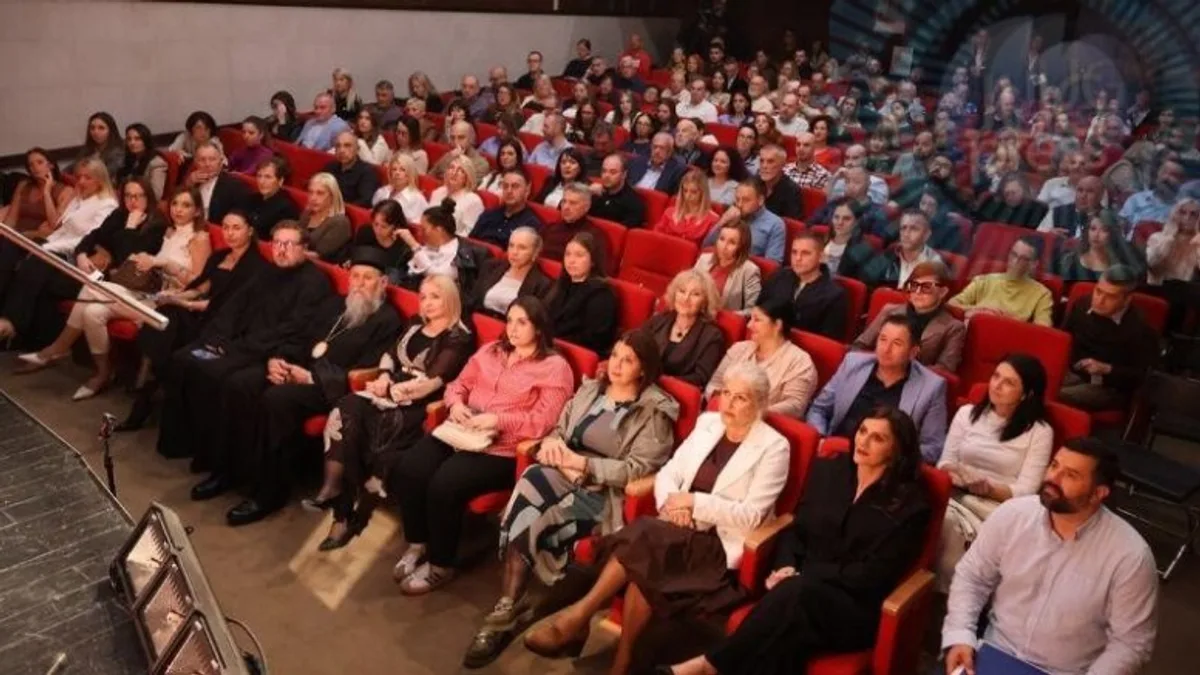
An empty rehearsal room. Two armchairs facing rows of empty seats, two men holding pages of script, a bowl of fruit between them. That is the only image Heartefact House has released this August from inside its own workspace. In one chair sits Andrej Nosov. In the other, Nils Veterholm, the Swedish actor international audiences know from the Netflix series Young Royals.
The play the two men are building has no title yet. It does have a coproducer, the Swedish theatre company SWEETS/Kontrar, it has a creative team, and it has a schedule: the premiere is set for October in Stockholm, with Belgrade performances to follow before the year is out. Sofija Dimitrijevic is the dramaturge, Vladimir Pejkovic composed the music, Nadja Vukorep designed the lighting, and Marija Milenkovic is in charge of movement direction.
The Actor Who Arrived Before the Script
Nosov does not work from a finished script. His plays grow out of a research process built around the actor, which in practice means the material gets written in the rehearsal room, out of whatever Veterholm brings to each session, and the directorial approach and dramatic arc only take shape once it becomes clear what this particular performer can do. The method is nothing new for Nosov, but it carries more risk than usual here, since working with a foreign actor means building a shared working language before building the play itself.
Veterholm is a casting choice that carries two separate biographies in one person. He is a member of the ensemble at the Royal Dramatic Theatre, Dramaten, in Stockholm, Sweden’s national stage and the institution with the country’s strictest acting standards, while also being the face of a streaming hit followed on social media by an audience that never sets foot in a theatre. At the Stockholm Film Festival in 2025 he won the Rising Star award, one of the most significant honors given to young actors in that country.
Last season Nosov won the Ljubomir Muci Draskic directing award for his play Njih vise nema (They’re Gone), and Heartefact spent that same season on the road: its productions played or toured in New York, Milan, Brussels, Stockholm and Siena. A house that in Belgrade operates out of a hall with only a few dozen seats has for years behaved like the repertory hub of a city twice the size.
Why Is a Swedish Star Performing in an Independent Belgrade Theatre?
Because the collaboration started in the opposite direction from what one would expect. Heartefact’s partnership with the Swedish stage began with the play Umetnost i novac (Art and Money), which premiered in November 2025 and saw Vanja Ejdus and Milica Stefanovic working with Swedish director Freja Halberg on the relationship between art and capital. That production played in Stockholm this past February and has stayed in regular repertoire. The new coproduction continues the same channel, only with the roles reversed: this time a Serbian director is leading a Swedish actor.
The money follows the same route. The project is backed by the Swedish Institute through its Political Loneliness program, which means the theme, at least in broad strokes, is being set by a foreign fund rather than domestic cultural policy. This is where the state of the system around this theatre house becomes visible. When we reported on how Bitef kept only two of the seven productions it had announced, the story described the same pressure from the other side: an institutional festival shrinking, while an independent production survives by finding its partners and its budget outside the country.
What Is Gained, and What Is Lost
The gain is obvious and measurable. Veterholm’s name opens up Swedish audiences and Swedish critics to the work of a Belgrade director, and that kind of export is something no coproduction market can replace. For Heartefact, it is also a financial arrangement that lets the company work without depending on domestic grant competitions.
What is lost, however, is the order of things. Belgrade audiences will see the play only after Stockholm has already judged it, in a version that has already gone through foreign reception and foreign reviews. A play made in Belgrade, with a Serbian creative team, will have its premiere a thousand and a half kilometers away, leaving the home audience with a rerun slot in its own city. That is not a criticism of Heartefact, but a description of the circumstances that make such a decision reasonable.
One question remains that no production contract can settle: whether a research process built around an actor from a different language and a different acting school can produce a play that does not split into two separate halves, one Swedish and one Serbian. The answer arrives in October, from Stockholm.