Belgrade City Museum: 120 Years Later, a 2028 Deadline
After 120 years without a building, the Belgrade City Museum has a deadline: the full space by 2028, with part opening during Expo 2027, in the former Military Academy on Resavska Street.

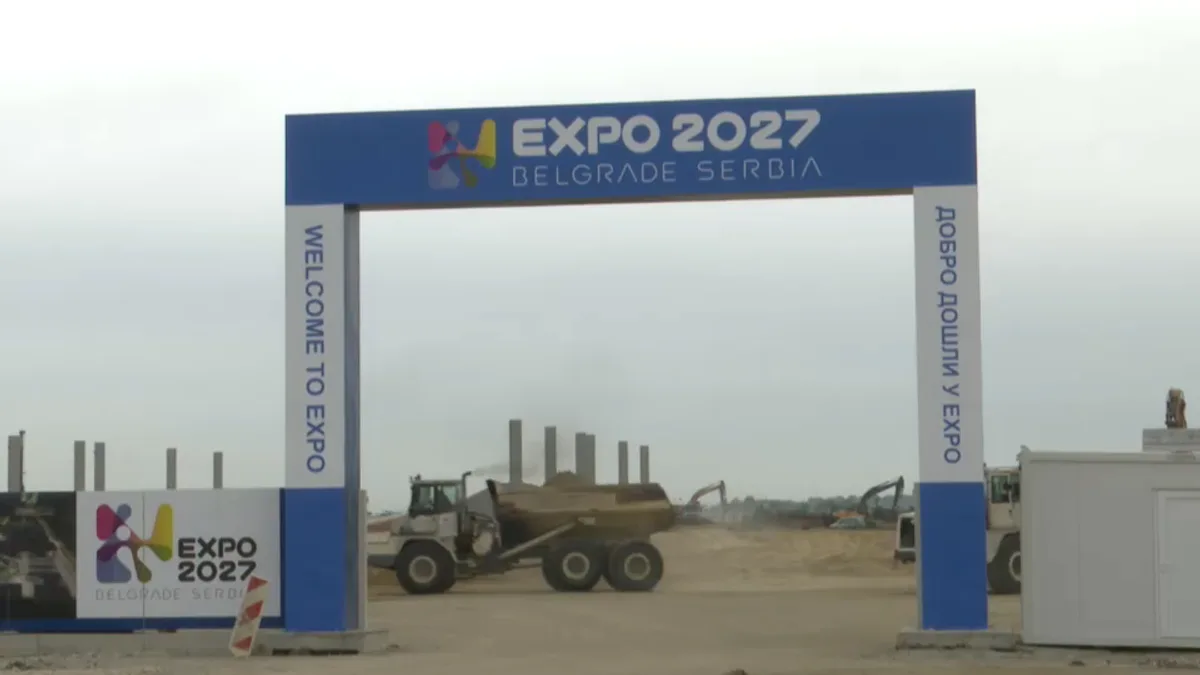
When Prime Minister Djuro Macut walked into the courtyard of the building on the corner of Resavska and Nemanjina streets on Wednesday, August 27, he was walking through space that has formally belonged to the Belgrade City Museum since 2006, but that has mostly served as a venue for other things ever since. The halls of the former Military Academy, once built for fencing practice, hosted the October Salon for years, while the museum’s own permanent exhibition kept waiting somewhere in the future. That future now has a date. Macut announced that reconstruction and expansion work should be finished by 2028, and that part of the museum will open already during the specialized Expo 2027 exhibition.
Sources disagree on exactly how big the future museum will be. Macut, as quoted by Tanjug, spoke of 17,400 square meters holding 150,000 items on display. Vreme, citing a contracted works value of around 36 million euros, gives a slightly smaller figure, 17,057 square meters. The gap is not trivial, but both numbers point to the same shift: after 120 years of operating without a building of its own, working out of an apartment on Zmaj Jovina Street that still has no permanent display today, the Belgrade City Museum is getting a space larger than anything the institution has ever had.
When Paper Becomes a Building
The building at 40b Resavska Street was constructed in 1899 for the Military Academy, designed by architect Dimitrije T. Leko in the neo-Renaissance style favored for state institutions at the end of the nineteenth century. The wing facing Nemanjina Street was added only after World War I, and the whole building is now protected as a cultural monument. The City of Belgrade received the building in 2006 through an agreement with the Ministry of Defense, but property disputes over the inner courtyard, which the museum shares with the General Staff building, held up any further progress for years.
A design concept was chosen only in 2016, in a competition won by the VIA studio, architects Jelena Ivanovic Vojvodic and Goran Vojvodic. Developing the project took nine years, and a contractor was found only on the third tender in two years: the job went to the V.D. Concord West consortium. Nine years from concept to the first worker on site is not the kind of speed museums usually boast about, and that gap between paper and construction site is exactly why the prime minister’s visit, with actual deadlines attached, reads as news rather than ceremony.
Six Museums Before Expo
The Belgrade City Museum is not an isolated case. By the start of Expo 2027, six major museums in Belgrade are supposed to be up and running: alongside this one, there is the Natural History Museum, designed by Branislav Mitrovic and getting its own aquarium, the History Museum in the old railway station building at Savski Trg, the Archaeological Museum in the renovated Post Office Palace, the Nikola Tesla Museum in the former Milan Vapa paper factory, designed by Zaha Hadid Architects with the Belgrade studio Cube Partners, and the Aviation Museum. All six start from the same problem, collections bigger than the buildings meant to house them, and all six now need to meet a deadline that, judged against what the Belgrade City Museum has been through so far, is fairly tight. Conservators and museum professionals have openly warned that such ambitious deadlines may be hard to meet without compromise: a building should not be finished only as exhibition scenery while the storage depots meant to keep the actual objects are still waiting their turn.
Macut himself made no secret of being pleased with what he saw. “I think this is a great opportunity for Belgrade to get the space it deserves,” he said during the tour of the works, adding that the city had waited decades for a space like this and that the museum would, for the first time, become a place that brings families together rather than just a collection with no address of its own.
The same logic, treating neglected cultural heritage as a state priority, sits behind the recently approved 463.9 million dinars for the restoration of Manasija Monastery. The difference is that the monastery has centuries to spare. Going by the deadlines just announced, the museum on Resavska Street no longer does.