Celine Dion Fulfills a Promise in Paris After Six Years
At the opening of a 26-show residency at Arena Plenitud, the singer paused in tears after the first song as 30,000 fans chanted her name.
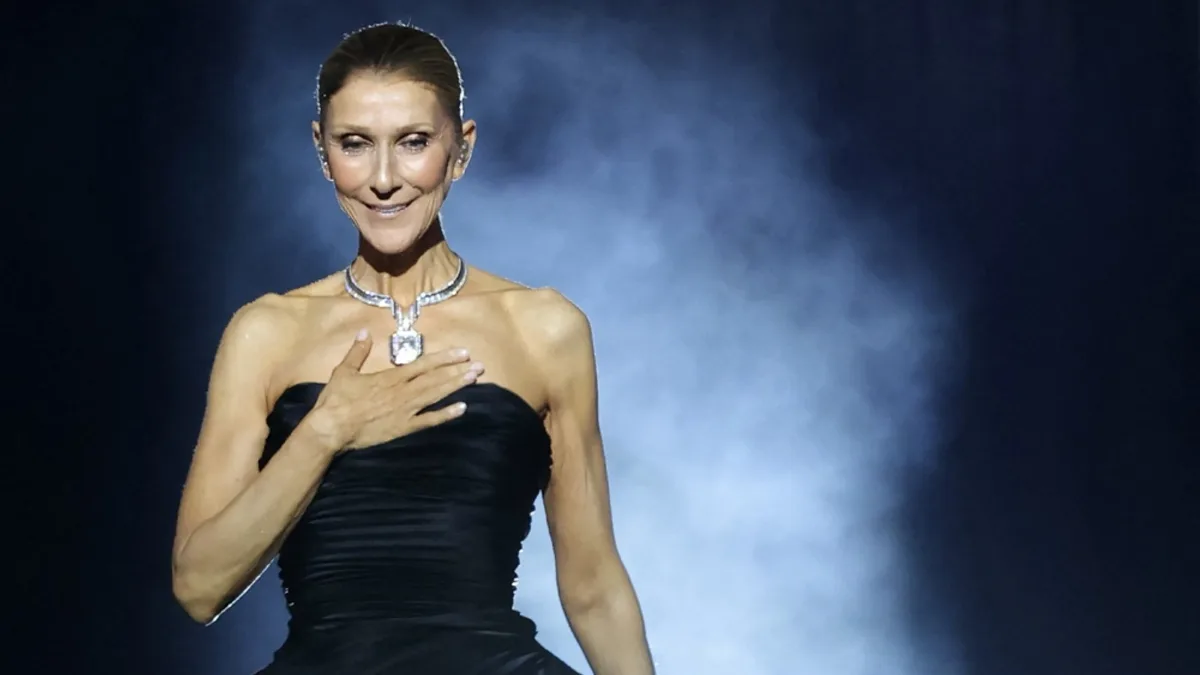
The first song of that Saturday night at Arena Plenitud ran a little over three minutes, and then Celine Dion had to stop. Thirty thousand people watched the singer, microphone still in hand, fall silent for a few seconds that felt far too long for a concert’s rhythm, while the hall began chanting her name. When she finally spoke, the sentence didn’t sound like part of a scripted set piece. It sounded like something nobody in that arena, including Dion herself, had planned for.
“Finally, it’s unbelievable that we’re all together. The road here was harder than I expected, but I held on to a faint ray of light in the distance, deep in the mountains,” she told the crowd, switching between English and French. “Tonight I want to sing for you, sing for myself, sing for life,” she added.
That, on September 12, marked the official start of a 26-show residency at Arena Plenitud (formerly Paris La Défense Arena), a venue that technically doesn’t sit in Paris at all but in Nanterre, on the city’s western edge, a distinction that largely disappeared from that morning’s coverage under the simple label “Paris.” The first sixteen shows, running through mid October, sold out long ago, with ten more scheduled for next May. According to figures cited on Wikipedia, more than 480,000 tickets were sold for those sixteen autumn nights alone, after over nine million people entered the lottery for the right to buy them, a number that says more about the scale of anticipation than any review that follows.
Celine Dion is 58 and carries a four-decade career behind her, with albums in both English and French and hits that long ago became radio staples everywhere. In December 2022, she revealed she has stiff person syndrome, a rare autoimmune and neurological disorder that causes muscle spasms and rigidity and for which, according to the National Institute of Neurological Disorders and Stroke as cited by CBS News, there is currently no cure. The diagnosis forced her to cancel her Courage world tour, and her only public appearance in the years since was brief: singing Edith Piaf’s “Hymn to Love” from the Eiffel Tower at the opening of the 2024 Paris Olympics. Saturday night’s concert was her first full, headline length performance since March 2020.
What sets this story apart from the usual comeback narrative is how much of the surrounding spectacle the city itself took on, work that would normally fall to a marketing campaign. In the days before the concert, Paris reportedly filled up with costume contests, karaoke nights and Seine river cruises dedicated to the singer, and the suburban train station serving the arena was temporarily renamed “Celine.” French outlets estimate her residency will bring the city hundreds of millions of euros in economic benefit, and Le Parisien reported that former U.S. First Lady Michelle Obama quietly attended the show. When an entire apparatus, from a web of partner hotels down to a renamed train station, is built around one return to the stage, it becomes clear the city’s institutional welcome isn’t only a gesture toward the artist. It’s also arithmetic: for these two weeks at least, the city’s cultural agenda and one singer’s interests have converged.
The more revealing detail lies in the setlist itself. Dion opened the night with the intimate, French language “On ne change pas” from the 1990s and closed with the newer “Des milliers de baisers,” and in between, according to the list published on Wikipedia, came roughly twenty songs including “My Heart Will Go On,” “Because You Loved Me,” “The Prayer,” “The Power of Love” and “All By Myself,” songs her voice has carried at full power since the nineties. That choice wasn’t an accidental dramatic arc. Rather than build the show as proof of recovery and sidestep the riskier parts of her catalog, she chose precisely the songs that test vocal endurance the most, in front of an audience that knew exactly what was at stake.
How closely the world followed her every word that night shows in how several outlets recorded nearly the same remark in slightly different versions. CBS News quoted her as saying, “These are, of course, tears of joy. I’m overjoyed to see you.” Ynet recorded a similar but not identical line: “These are tears of joy, of course. I’m overjoyed to see you.” The same outlet also captured another part of her address: “I promised myself I wouldn’t cry. I don’t keep my promises, but I’m overjoyed to see you all,” as well as: “I promised I’d come back, that I’d stand on a stage again. So here I am, singing for you and singing for myself.” Hello magazine rendered the same thought slightly differently: “The road here was rocky, longer than planned, but I made it.” The differences are small, the kind that come from translation and transcription, but together they point to an address that clearly wasn’t written or rehearsed, but pieced together on the spot, sentence by sentence, while she was crying.
The audience recognized it before any critic had written a line. “It’s surreal to be here! I was convinced we’d never see her again, let alone that she’d launch a concert series like this one,” said Elizabeth Landry, a 38 year old fan from Quebec who lives near the singer’s hometown of Charlemagne. That sentence captures the most precise read on the evening: this wasn’t a concert built to prove the illness had been beaten, but a performance that left the illness visible, in the pauses, in the tears, in a voice that occasionally needed to catch its breath. It’s exactly that refusal to polish everything to perfection, in an industry that typically sells comebacks as unqualified triumphs, that will make this night in Nanterre remembered longer than any ticket sales record.