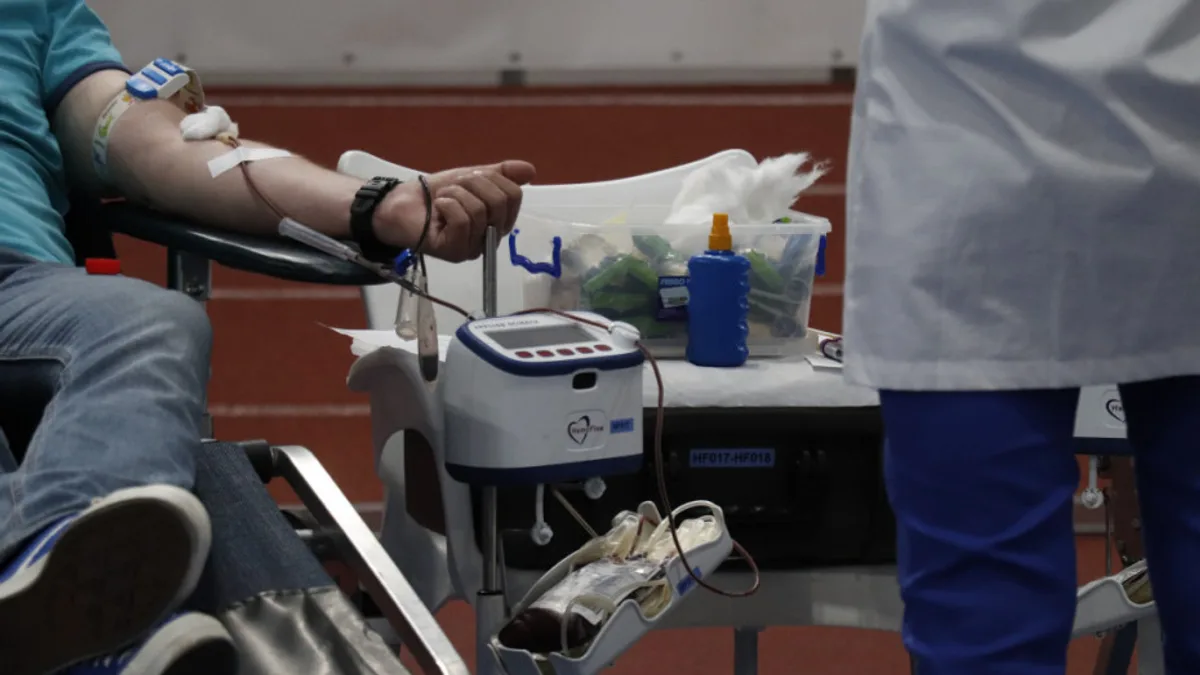
Belgrade Blood Institute Down to One Day's Supply
Serbia's Institute for Transfusion of Blood warns its reserves have fallen to a single day's supply, with type A and O blood most needed. Here is where to donate in and around Belgrade this weekend.

How long can Serbia’s hospitals keep running without new blood donors? According to the latest figures, just one day. The Institute for Transfusion of Blood of Serbia has issued a public warning that its reserves have dropped to a minimum, right at the point in the year, after summer, when they would normally start climbing back up.
“The Institute for Transfusion of Blood of Serbia has blood reserves for one day, they are currently at a minimum level, and all blood types are needed, but especially A and O, both positive and negative,” Mirjana Knezevic of the Institute for Transfusion of Blood of Serbia told Tanjug.
She added that the situation is unusual for this time of year.
“Blood reserves may be at their lowest level since the start of summer, because weeks like this have not happened in a long time, for months now,” Knezevic said.
According to her, negative blood types are generally always in short supply, but now positive types are lacking too, especially A and O.
How much blood does Serbia actually need?
Sources disagree here on the exact figure. Tanjug and B92 report that the Institute needs to collect 300 units of blood every day, while Dnevnik quotes Knezevic citing 350 units a day. On the weekly total there is no discrepancy: both figures work out to 1,500 units.
The drives themselves are currently producing results close to that minimum, not above it. According to Dnevnik, just over 300 units of blood were collected the day before the appeal was issued, a day Knezevic calls a “good day,” but not enough to rebuild the reserves. So far, though, no scheduled operation in the country has been postponed because of the shortage.
Who can donate blood?
Healthy citizens between 18 and 65 can donate. The process is quick, and the Institute, at 39 Svetog Save Street in Belgrade, accepts donors on weekdays from 7 a.m. to 7 p.m., and on Saturdays and public holidays from 8 a.m. to 3 p.m.
Where and when can you donate this weekend?
Besides its permanent site in Belgrade, the Institute’s teams are also out in the field these days. The schedule for the coming days looks like this:
- Friday, September 18: New Belgrade, bus near the old Merkator store, 9 a.m. to 1 p.m.
- Saturday, September 19: New Belgrade, bus near the Immo Outlet Center, 9 a.m. to 1 p.m., and Cukarica, at the “Ujedinjene nacije” Elementary School, 10 a.m. to 2 p.m.
- Sunday, September 20: Vozdovac, at the PEP College on Vojvode Vlahovica Street, 10 a.m. to 2 p.m., and Golubac, at Tumane Monastery, bus from 7 a.m. to 2 p.m.
- Monday, September 21: the Cultural Center in Mionica, 9 a.m. to 2 p.m., the Red Cross building in Pozarevac, 8 a.m. to 2 p.m., and the Sports Hall in Smederevo, 8 a.m. to 2 p.m.
Can’t make it to a scheduled drive?
Blood is also accepted outside this schedule, on every working day. At the Transfusiology Service of the Zemun Clinical Hospital Center (KBC Zemun), at 9 Vukova Street, donors are received on weekdays from 7 a.m. to 5 p.m. At the Institute for Transfusiology and Hemobiology of the Military Medical Academy (VMA), at 17 Crnotravska Street, donors are accepted on weekdays from 7:30 a.m. to 2:30 p.m.
For any further information about donating blood, the Institute has also opened a phone line for donors, 011 344 0479. As Knezevic puts it, the healthcare system cannot function without enough blood, and right now, she says, that limit is closer than it has been in months.