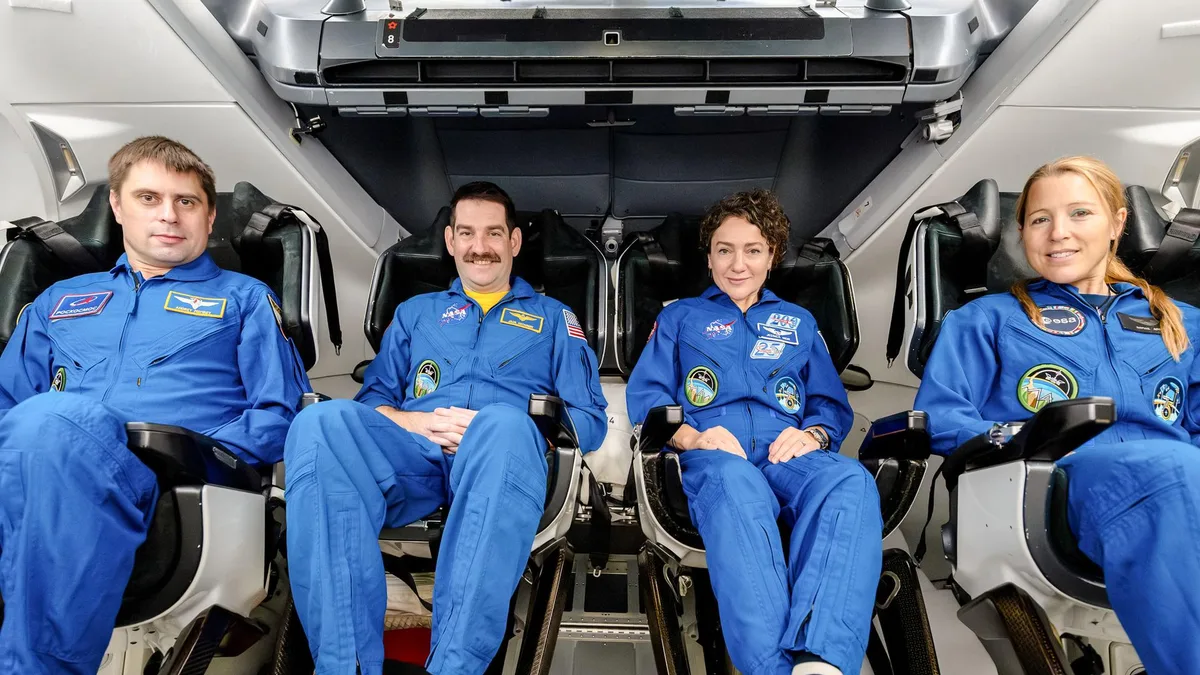
Menon and Adenot Set to Finish Station Antenna Today
Anil Menon and Sophie Adenot head back out into open space today to finish installing a high-speed antenna on the International Space Station, a job interrupted on August 18.

NASA astronaut Anil Menon and European Space Agency astronaut Sophie Adenot are heading back out into open space today to finish installing a high-speed data antenna on the International Space Station. The spacewalk begins at 8:35 a.m. Eastern time, 2:35 p.m. Central European Summer Time, with NASA starting live coverage an hour and a half earlier. It is scheduled to run six and a half hours and will be the 283rd spacewalk in the history of the International Space Station, which has been continuously crewed since November 2000.
This is the second attempt to finish the job. The first spacewalk, on August 18, was the 282nd in the station’s history and ran six hours and 23 minutes, wrapping up at 2:52 p.m. Eastern. Menon and Adenot removed the station’s failed ground communications antenna that day and secured it to the truss structure, but installing the spare had to be postponed after disconnecting cables and loosening bolts took longer than planned. The work was pushed to the next spacewalk, and the station has kept operating in the meantime on a fully functional ground antenna, which handles the high-speed data links to NASA’s tracking and relay satellites and to mission control centers around the world, including the Mission Control Center in Houston.
Who Is Doing What Today
Work resumes today on the Z1 truss segment, above the Unity module. Menon rides the Canadarm2 robotic arm, operated from inside the station by Jack Hathaway, while Adenot stays tethered to Z1 and detaches the spare antenna from its external stowage platform. Once it is mounted, the two astronauts run the electrical and data connections needed to bring the antenna online. Station commander Jessica Meir is tracking the spacewalk from inside the station and, together with Hathaway, is helping the two astronauts suit up and out of their spacesuits. If time allows, a backup task is also on the schedule: replacing a retroreflector on the forward port of the Harmony module, which improves the accuracy of navigation data for spacecraft docking with the station.
Preparations for the spacewalk took place on Monday, when Menon and Adenot checked their tools in the Quest airlock, tested their spacesuits for leaks and ran through procedures with Hathaway and Meir. All four then met with flight controllers on the ground after their shift to review readiness for the spacewalk and the robotic operations. The rest of the Expedition 75 crew spent that day on other station tasks. Russian flight engineers Pyotr Dubrov and Anna Kikina took turns wearing an acoustic sensor around the neck that lets doctors measure how microgravity changes the movement of air and fluid in the lungs. Dubrov then loaded the Progress 94 cargo ship with trash and outdated equipment ahead of its undocking in September, while Kikina activated equipment that automatically photographs islands and volcanoes across the Asia-Pacific region. Andrei Fedyaev, meanwhile, was programming a separate imaging system to capture African lakes and the continent’s Atlantic coast across multiple wavelengths.
This is Menon’s third career spacewalk and Adenot’s second. On August 18, during the spacewalk designated U.S. EVA-97, Adenot became the first French woman to walk in space. She arrived at the station in February aboard SpaceX’s Crew-12 flight, while Menon arrived on July 14 aboard a Russian Soyuz spacecraft.
The new antenna is meant to restore the station’s high-speed relay link with flight control at Johnson Space Center in Houston. Whether the job gets done within the planned six and a half hours will hinge on the same step that slowed the first attempt: connecting cables and tightening fittings in a spot that ground controllers can only watch through the astronauts’ helmet cameras.