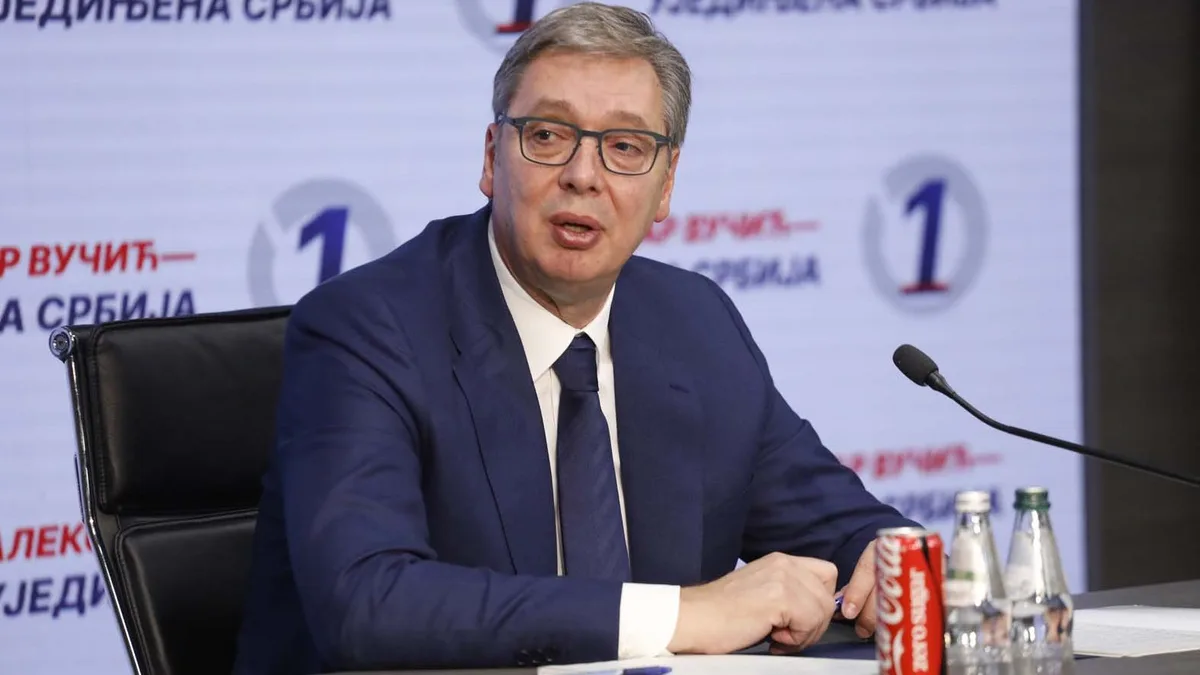
Vucic weighs a separate presidential vote, candidate teased
Sources close to the governing party say the president is seriously weighing holding a presidential election before a snap parliamentary one, while the student movement vows to field its own candidate.

- President Vucic is weighing calling the presidential election separately from a snap parliamentary one.
- The governing party is mulling two options for a candidate, with a decision possibly landing at the SNS rally for Vidovdan on June 28.
- The student movement says it will field its own candidate.
- Analysts warn that SNS together with SPS polls below 50 percent.
President Aleksandar Vucic is seriously weighing a scenario in which a presidential election would be held before a snap parliamentary one, sources close to the governing party indicated on June 18. The reasoning behind such a move is straightforward: the party leadership reckons the anti-government front, the opposition and the student movement, will not agree on a joint candidate in time, so splitting the electoral cycles would hand the government a head start.
This is not merely a technical question about the order of voting. By detaching the presidential race from the parliamentary one, the government would fight its first match on the ground where it is traditionally strongest, a personalized plebiscite, while catching its rivals before they have settled on a single name. By our information, that timing calculation is exactly what makes the scenario appealing to those advocating it.
Who could be the government’s candidate?
Political sources describe two schools of thought within the party leadership. The first is that the candidate should come from outside the Serbian Progressive Party, a figure from academic circles loyal to the government, with names such as Vladan Petrov and Cedomir Antic floated. The second is to keep the choice within the party itself. Both options have their logic: an outside candidate broadens the voter base beyond the party core, while an internal one guarantees control and loyalty.
Milos Vucevic, the formal SNS leader, is not given much of a chance for that role. The reason is the heavy burden tied to the collapse of the canopy in Novi Sad, a tragedy that marked his term and would loom over any presidential campaign as a constant weight. The decision on a candidate, according to the same sources, could be announced at a major SNS rally planned for Vidovdan, June 28, in Belgrade.
What does the other side say?
The student movement leaves no room for doubt. Ceda Aleksic, one of the movement’s representatives, confirmed that students plan to have their own candidate should a presidential election take place. That puts the government’s bet on a disorganized rival in question before it has even been placed.
Psychologist Zarko Korac assessed that a joint election is the more likely scenario, since SNS together with SPS polls below 50 percent. Seen that way, splitting the cycles carries its own risk for the government: the presidential race would become a test of strength ahead of the parliamentary one, and a weak result at the start would cast a long shadow over everything that follows.
The question of timing remains: if the government’s candidate is being teased for Vidovdan, and the student movement is already promising a name, who really benefits from votes for president and for parliament falling at different times?