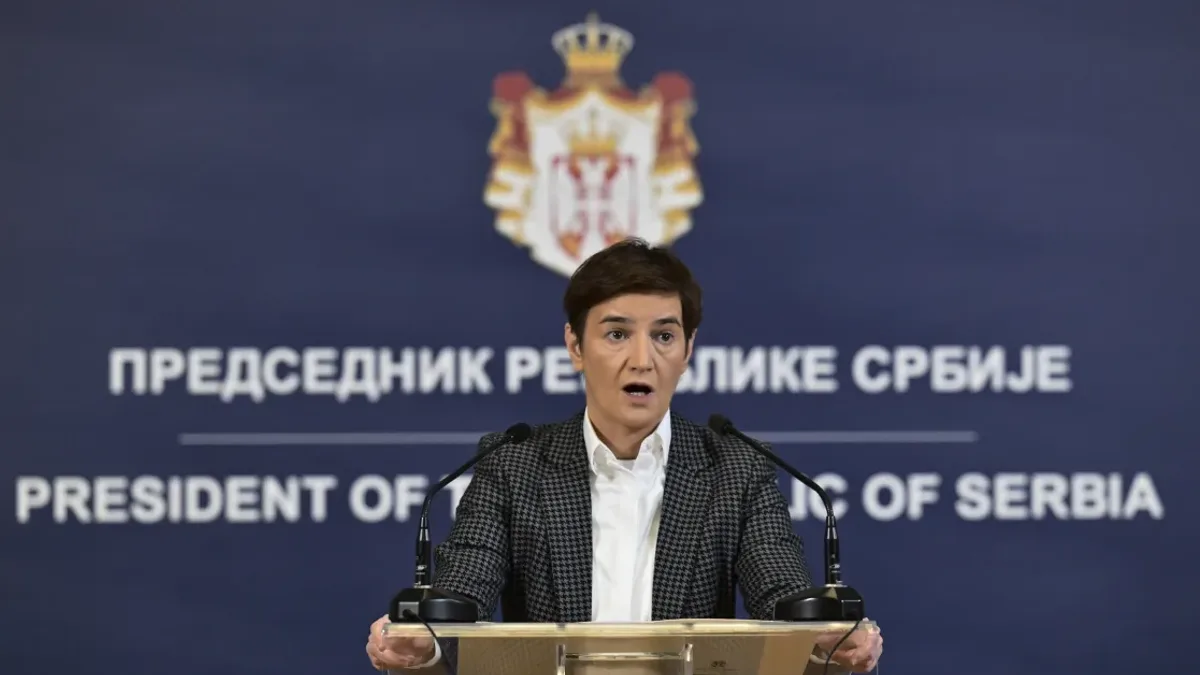
MPs ask how Paunovic ran a pharmacy that does not exist
Question time on July 28 opened three fronts: Paunovic's directorship at an institution closed in 2021, the Zijin mine expansion near Bor, and the belated dialogue with Washington.

- Question time was held on July 28, during the continued session on no confidence in the government.
- Minister Paunovic allegedly held a director's post from 2014 to 2025, although the institution was closed in 2021.
- MPs also raised the Zijin mine expansion and the strategic dialogue with the United States.
- The government side offered no concrete answer to any of the three questions.
Question time in the Serbian parliament on July 28 turned into three separate subjects raised one after another, during the continued session on no confidence in the government. In order: the post of director held by Minister Snezana Paunovic at an institution that formally does not exist, the expansion of mining operations run by Zijin near Bor and Zajecar, and the question of why strategic dialogue with the United States is starting only now. All three went unanswered in substance.
Verica Milanovic of SRCE asked how it was possible that Paunovic had allegedly held a director’s post at a pharmacy institution in Pec from 2014 to 2025, if that institution was closed in 2021. The question is not about the amount of money but about the institution itself: how a legal post can survive four years after the body it belonged to disappeared, and who signed the paperwork in those years.
How a job outlives the institution
Answering that is not a matter of political judgment but of an administrative trail. An institution that is shut down stops being an employer, and the decision appointing its director loses its subject. If the post was nevertheless still recorded after the closure, there must be an act somewhere that allowed it, and a body somewhere that failed to annul it. All of that is verifiable, which is precisely why the question was uncomfortable.
In the corridors the topic has for weeks been tied to the wider debate on confidence in the government, because it concerns not a single decision but how long a situation was allowed to last. For the opposition it is an argument about a system that does not record its own changes. For the government, judging by the pattern of answers so far, it is a technical matter for the competent services rather than for the chamber.
Dragan Jonic of the Ecological Uprising moved the debate to Bor and Zajecar. He asked Minister Sara Pavkov about the expansion of mining operations in that area and said residents have no clear information about construction plans, exact locations or the relocation of the population. Those are three separate things, and each has its own paperwork: a spatial plan, an environmental impact study and an expropriation procedure. When none of the three steps has been presented publicly, citizens learn about the future of their own place of residence from the media.
Why does strategic dialogue begin only now?
Djordje Stankovic of NPS asked Foreign Minister Marko Djuric why strategic dialogue with the United States began only recently. He compared the move to buying a greeting card after an election and asked whether arms sales to Ukraine and Israel had been aimed at securing a photograph with Donald Trump. The comparison is sharp, but the question underneath it is legitimate and easy to check: strategic dialogue is a format that exists with a large number of countries, so the starting date says more than any statement.
Aleksandar Jovanovic Cuta put questions about the movements of Prime Minister Djuro Macut. The prime minister replied that this was an attempt to influence judicial bodies. In procedural terms that answer is a refusal to address the question on the merits, and as such it is a political message in itself.
What links all four questions is not their subject but their type. None of them asks for an opinion, all of them ask for a document: an appointment decision, a spatial plan, a start date, a movement record. A question time in which not one of those documents was mentioned says more about how the executive treats parliamentary oversight than the entire no confidence debate does.
Do you expect written answers to these questions, or will they too stay in the record with no follow-up?