Plenum Seeks 30-Year Ban on Rebuilding Burned Forests
Academic Plenum wants Serbia's Forestry Law amended, on the model of Spain's Article 50, so burned forest cannot change use for 30 years, backed by a public wildfire registry.

Academic Plenum has called for an amendment to Serbia’s Forestry Law that would keep burned forest and forest land off limits to any change of use for at least 30 years from the date of the fire. The request was published on August 7, 2026, in a statement and on social media, on the same day firefighters were battling nine active wildfires at once.
The plenum brings together teachers, associates and researchers from the University of Novi Sad and other higher education and research institutions in Vojvodina. They say the proposal was modeled on Article 50 of Spain’s Forestry Law, a provision that in Spanish law acts as a time barrier after a fire.
They laid out the economic logic behind the request without softening it.
“The law must remove any possible economic benefit from fire. Fire must not become a shortcut to building land, a mine, an industrial zone or profit. Burned forest must remain forest.”
The message is addressed to lawmakers, not to any single investment. The statement did not name a specific project on any burned site.
Where the Legal Gap Lies
The plenum is not arguing that no obligation exists after a fire. It argues that the existing obligation does not cover what comes after it.
“The existing law requires rehabilitation, but it does not set a thirty year barrier between a fire and a change in land use. That legal gap must be closed.”
The distinction is legally measurable. Rehabilitation binds the owner and manager to what follows immediately after the fire is put out, while the question of what may be built there in five or ten years remains open. A thirty year deadline would close that question in advance, without a case by case review.
What Is Actually Being Requested
The request is not a single sentence but a package of provisions:
- a ban on changing the use of burned forests and forest land for at least 30 years
- a ban on any activity that interferes with the natural regeneration of vegetation
- mandatory rehabilitation, reforestation and restoration plans for burned areas
- a publicly accessible registry of burned areas and public wildfire maps
- an obligation to provide compensatory forest area, with exceptions allowed only by law, for reasons of overriding public interest
“We are also demanding public wildfire maps, expert damage assessments and mandatory rehabilitation and reforestation plans.”
In this framework, the registry and the maps are tools of control. If every burned parcel is publicly visible on a map, any later request to change its use leaves a trail that can be checked against the date of the fire.
Why Has the Request Come Now?
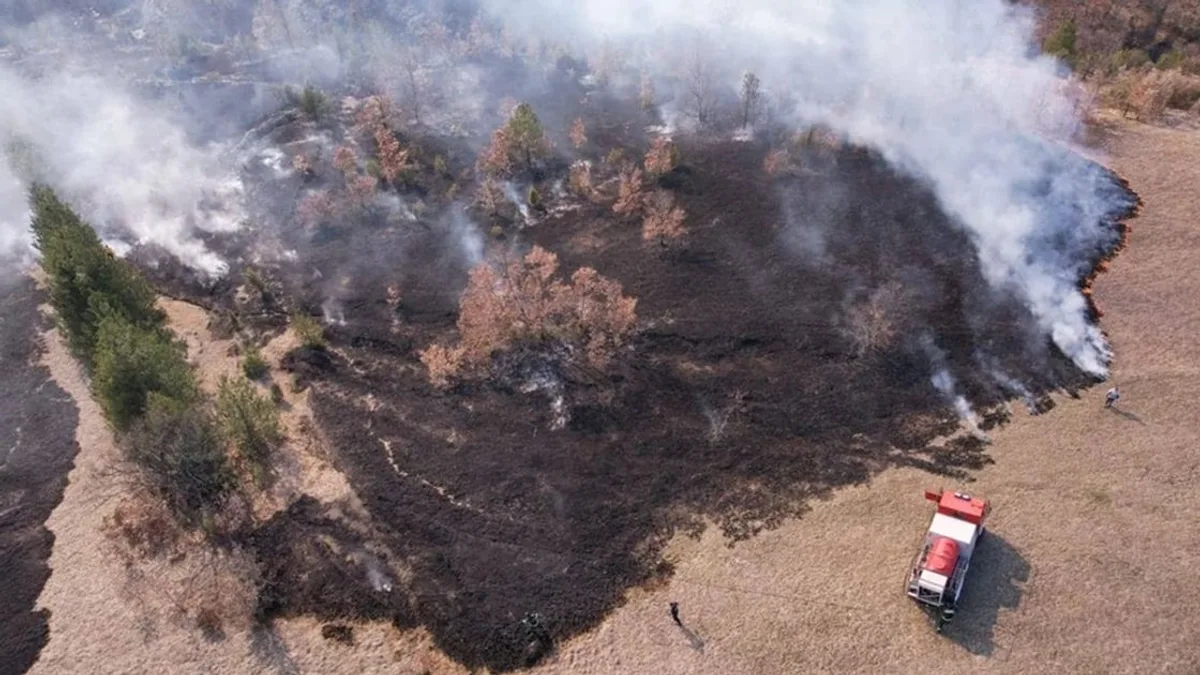
Fires in recent weeks have hit Deliblato Sands, areas near Kraljevo, Cacak, Topola, Zajecar and Subotica, and other locations across Serbia. The plenum used Deliblato Sands as its measure of the damage.
“Deliblato Sands shows the scale of the damage: on almost 35,000 hectares there is a unique mosaic of steppe, sand and forest, with about 900 species of higher plants, 20 orchid species, about 150 breeding bird species and about 40 mammal species.”
We wrote about Deliblato Sands on August 5, when three Interior Ministry helicopters were putting out a fire covering more than 300 hectares, and again the next day, when a new fire broke out a kilometer from the July hot spot. The same location has burned more than once in the same season, and each new fire finds ground that never recovered from the last one.
Who Can Turn the Request Into Law
This is where the plenum’s control ends. An association of teachers and researchers has no right of legislative initiative. Under Serbia’s Constitution, a bill can be submitted by the Government, any member of parliament, the assembly of an autonomous province, at least 30,000 voters, or the Ombudsman and the National Bank of Serbia within their own areas of competence.
The request, then, has been drafted as a finished piece of legislative text, but until one of the authorized proposers takes it up, it remains public pressure. The path through 30,000 voter signatures is technically open, as is the shorter path of a group of lawmakers pushing the text through as an amendment or their own bill.
A three decade time barrier is not a neutral decision. It affects both private forest owners and local governments that plan land use, so the debate around it will not stay confined to nature protection but will also touch on property and planning powers. In the Serbian context, the Spanish model is as much a political question as a legal one.
The first deadline that can already be marked on the calendar is the start of the regular autumn session of the National Assembly, on the first working day of September. That is when it will become clear whether any authorized proposer has picked up the text.