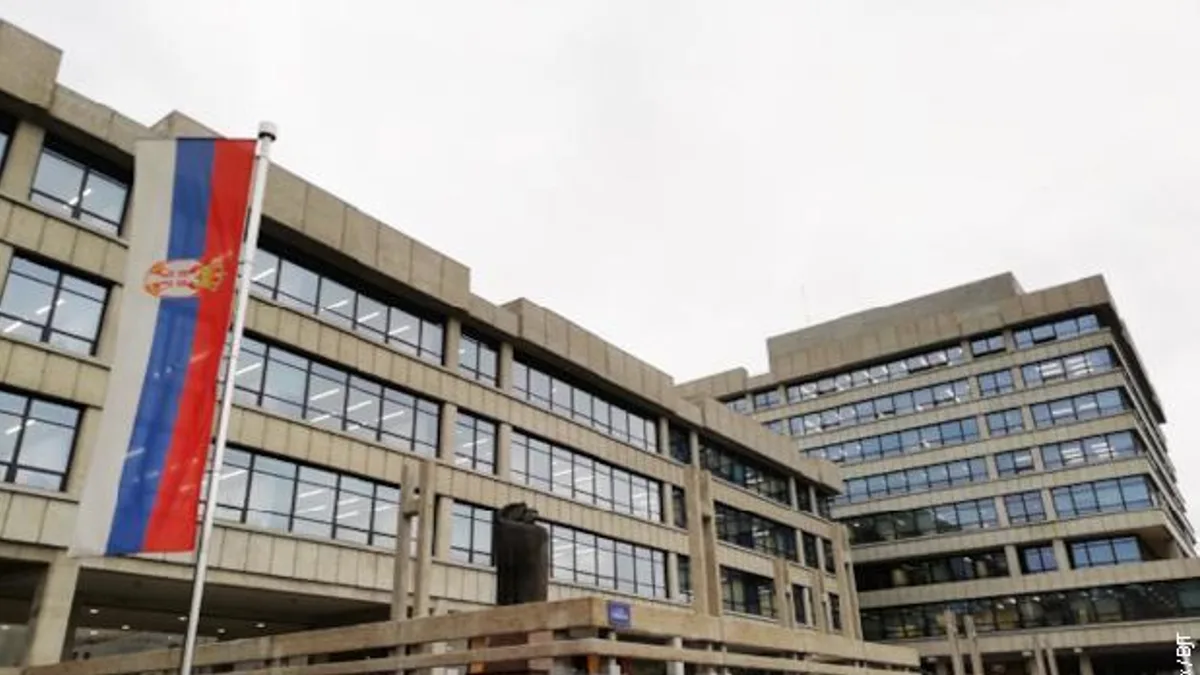
Vesic Denies Responsibility for Novi Sad Canopy Collapse
A transcript of Goran Vesic's November 22, 2024 statement to prosecutors is now public. He says the ministry did not decide to open wing B's vestibule; the prosecutor calls part of his defense absurd.

Former Minister of Construction, Transportation and Infrastructure Goran Vesic told the Higher Public Prosecutor’s Office in Novi Sad that neither he nor his ministry decided to put the vestibule of wing B at the Novi Sad Railway Station into use, the site where a canopy collapsed on November 1, 2024, killing 16 people.
Vesic was questioned on November 22, 2024, three weeks after the collapse. The public first saw the transcript of that hearing on August 11, 2026, when the weekly Vreme and the Novi Sad news portal 021 published it, based on a copy of the confirmed indictment obtained through a freedom of information request. Until then, only the content of the indictment itself was known from the case, without the defendants’ side.
What Vesic Claims About the Decision to Open the Vestibule
In his statement, he denied that the wing B vestibule was put into use on his order. He said he had no part in that decision through any act or action of his own, that it fell outside the jurisdiction of both the ministry and the minister, and that no regulation gives the minister authority over such matters.
The pace of the station’s reconstruction, he said, was agreed between the investor, Serbia’s Railway Infrastructure, and the contractor, a Chinese consortium, and the works proceeded according to that agreement. The internal handover of the wing B vestibule was completed on July 4, and the official opening took place on July 5, 2024, with media and city and provincial officials in attendance.
Vesic described that ceremony as a political act with no legal weight:
“The act that took place on 05.07.2024 did not produce any consequence, nor was the wing B vestibule put into use because of that act.”
The same defense includes his claim that he would not have attended the opening at all had his assistant, Anita Dimoski, not told him beforehand that the internal handover was complete. Dimoski, he said, was familiar with the correspondence on the handover on behalf of the ministry as the project’s financier, and her job was to see the procedure through to the invoice. He himself, he said, attended only two meetings on the reconstruction, both times to push companies to move faster on matters within their own remit.
As for the memo announcing that passengers would be allowed to use the wing B vestibule, Vesic said he learned of it only after the canopy collapsed.
Why Does the Defense Mention March 2022?
Because that is when the first section of the Novi Sad Railway Station was put into use, and, according to the statement, that occasion also lacked the occupancy permit and the documentation cited in the order to open the investigation. That places the opening of the wing B vestibule within a practice that already existed at the same construction site before July 2024.
On the claim that he did not know about problems at the station, Vesic was categorical. The transcript states that he had neither the obligation nor any knowledge that deficiencies of any kind existed at the Novi Sad Railway Station, and that he therefore does not consider himself responsible.
How the Prosecution Responded
Prosecutor Slobodan Josimovic called parts of that defense absolutely absurd and senseless. That assessment made it into the text of the indictment itself, meaning Vesic’s November 2024 statements were known to the prosecution before the indictment was drafted and filed.
The indictment has been legally valid since this past summer. The Novi Sad Court of Appeals on June 15, 2026 upheld an appeal by the Higher Public Prosecutor in Novi Sad and overturned a ruling of the Higher Court from December 24, 2025, confirming the indictment. That decision returned six people to the ranks of the accused:
- Goran Vesic
- Jelena Tanaskovic
- Anita Dimoski
- Milan Spremic
- Marina Gavrilovic
- Dejan Todorovic
The indictment as a whole covers 13 defendants, divided into three groups by type of responsibility, as we reported earlier.
The statement now made public was given during the investigation, not at a main trial, and represents the defendant’s defense. Vesic is charged with the criminal offense named in the indictment and, until a final verdict, guilt has not been established. What is new is that the public now has, for the first time, both sides of the case file: what the prosecution says happened, and what the man who was minister at the time of the opening said he had no duty to know.