Ohrid Archbishopric, Mickoski Answer Vucic on Skopje
The Holy Synod of the Macedonian Orthodox Church, Ohrid Archbishopric, and Prime Minister Hristijan Mickoski reacted to Aleksandar Vucic's remark that the Serbian church is the same in Skopje.

The Holy Synod of Bishops of the Macedonian Orthodox Church, Ohrid Archbishopric, issued a statement addressing part of a speech by Serbian President Aleksandar Vucic, who, while listing cities where the Serbian church is the same, also named Skopje. The statement came out on August 13, and two days later North Macedonia’s Prime Minister Hristijan Mickoski commented on the same remark when reporters asked him about it.
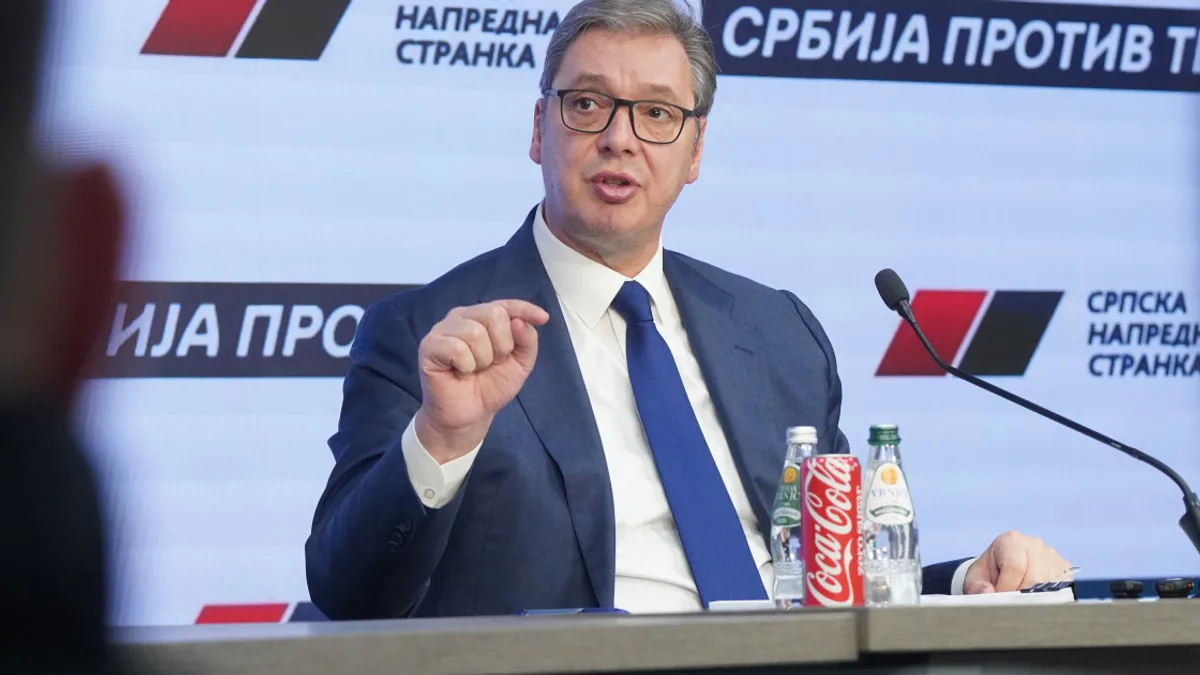
Vucic spoke on August 4 in Mrkonjic Grad, at an event marking the anniversary of Operation Storm. His theme was the unity of the Serbian Orthodox Church and what he described as attempts to federalize and confederalize it.
The Serbian church is the same here in Mrkonjic, the same in Pirot, the same in Sydney, the same in Skopje, the same in Frankfurt, in Melbourne and everywhere else in the world.
In Skopje, the list was read as a claim about church jurisdiction rather than as a figure of speech about the diaspora.
What did the Synod in Skopje say?
The Synod’s statement describes the church as the successor to Justiniana Prima and the restored Ohrid Archbishopric, then turns to the scope of its mission.
The MOC-OA carries out its spiritual and pastoral mission toward all Orthodox Christians on its canonical territory, without any condition tied to their national, political, cultural or ethnic background.
The sentence is aimed at two audiences at once. At Belgrade, because it names the canonical territory as the church’s own. And at the domestic public, because the church will not accept being described as the institution of a single nation. In its closing lines, the Synod adds that the church’s work must not be conditioned by political or ideological projects.
Mickoski declined the argument but defined the church’s status
North Macedonia’s prime minister told reporters on August 15 that he had no intention of commenting on statements like Vucic’s, then spelled out how his government views the country’s own church.
The Macedonian Orthodox Church, Ohrid Archbishopric of Justiniana Prima, represents what is the brightest part of Macedonian Orthodox identity.
His statement was released the same day at 6:17 p.m. The formula is a familiar one: the government stays out of the church dispute itself while confirming that it regards the church as a pillar of national identity, which lets the political part of the message land without a direct clash.
Why the dispute is flaring up four years after the Tomos
The split between the two churches ran for decades. The Macedonian Orthodox Church was granted broad autonomy within the Serbian Orthodox Church in 1959, then unilaterally declared autocephaly in 1967, a move Belgrade did not recognize at the time.
The resolution came in 2022. Serbian Patriarch Porfirije announced in Skopje on May 24 of that year that the Council of the Serbian Orthodox Church had accepted and recognized the autocephaly of the Macedonian Orthodox Church, Ohrid Archbishopric, and the Tomos was handed over in Belgrade on June 5. The Ecumenical Patriarchate had already recognized the name Ohrid Archbishopric, with the note that the Serbian Orthodox Church should settle the remaining questions with it.
That is why hearing Skopje named in the same breath as Pirot, Sydney and Melbourne struck the Macedonian public as a step back toward the situation before recognition, even though Vucic was not speaking about jurisdiction.
Reactions inside the Serbian church were not unanimous
The same speech drew different responses from two church bodies in Montenegro. The Metropolitanate of Montenegro and the Littoral said on August 5 that it is not for politicians to interpret or steer church life, adding that uninvited interference in church affairs serves neither the state nor the church. The same day, the Diocese of Budimlja and Niksic thanked Vucic for what it called his continuous attention, care and understanding of the circumstances in which the Serbian Orthodox Church operates in Montenegro.
The Serbian Orthodox Church has not yet responded to the statement from Skopje. Its next regular chance to do so will come at the session of the Holy Assembly of Bishops, and until then the only official document governing the relationship between the two churches remains the Tomos from June 2022.