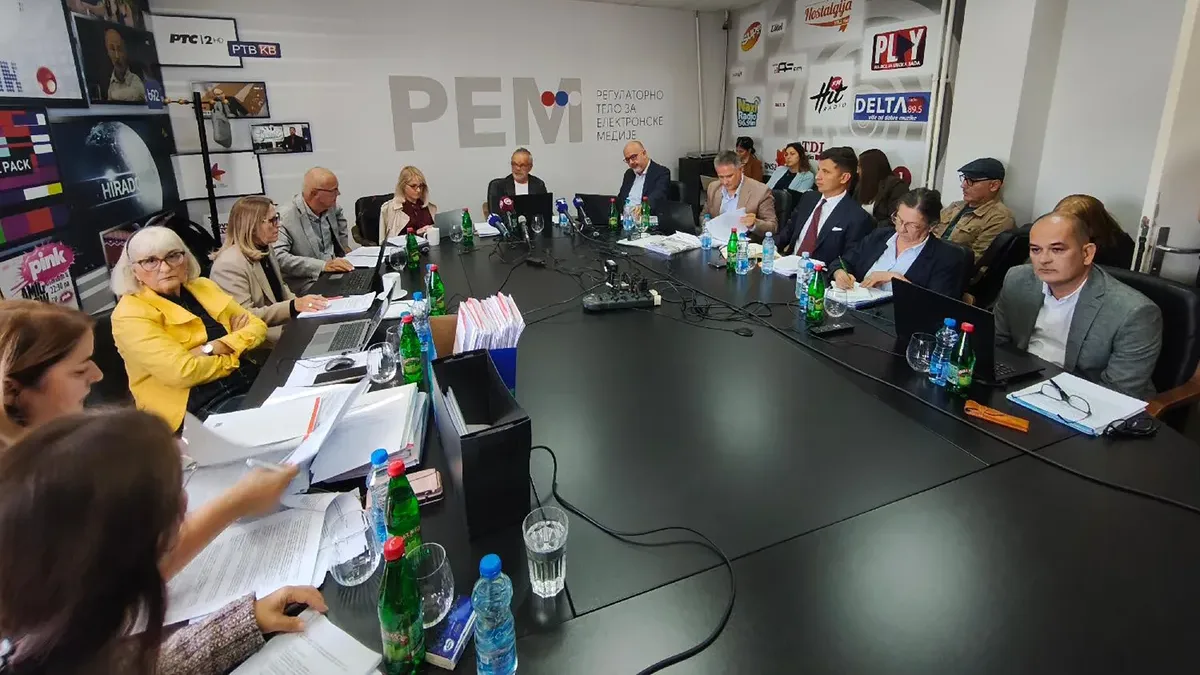
Sabic Refuses Democratic Party's Call to Resign From REM
REM Council member Rodoljub Sabic told the FoNet news agency he resigns on his own judgment, not on a party's request, and called the Democratic Party's appeal at least doubly controversial.

Rodoljub Sabic, a member of the Council of the Regulatory Authority for Electronic Media (REM), has turned down the Democratic Party’s call to leave the body. He sent his reply through the FoNet news agency, after the party asked him and the other independent Council members on August 15 to consider resigning.
“I have resigned from more important positions before, when no one asked for it or expected it. I did that in line with my own judgment and conscience, not at the request of any party or party leader. It is not out of the question that the same could happen with REM,” Sabic said.
Sabic is a lawyer and Serbia’s former commissioner for information of public importance. In his reply, he recalled that the selection of the independent members was the result, as he put it, of a serious effort by a large number of civil society organizations, carried out in line with the law.
What is the Democratic Party asking for?
In its statement, the party linked the regulator’s work to the media landscape during the campaign period. As proof that the new Council has changed nothing, it cited data from the organization Crta showing that Serbian President Aleksandar Vucic appeared live on television 49 times in the first 11 days of August.
“While regime-friendly media are more unrestrained than ever, Vucic is scoring points with the European Commission by pointing to the new REM and your presence on it. Citizens got even more propaganda, hatred and targeting out of the supposed media reform, while Vucic got an argument that he secured pluralism and made a concession to a rebellious society,” the Democratic Party said.
The statement also claims the regulator has not adopted a single decision since the new members took office. The party also raised the issue of regional, pro-government television stations, alleging that some broadcast their programs through Telekom without being entered in the Media Registry and without a permit from the regulator, while still receiving millions from city budgets. It is also demanding answers to public questions about the attempted shutdown of broadcasters N1 and Nova S.
Why does Sabic call the appeal at least doubly controversial?
The first reason, he said, is that the appeal names him personally while lumping the Council’s three other members together as “the others.”
“First, because it names only me personally, while treating the other three women on the REM Council, worthy, autonomous individuals with undisputed dignity, as ‘the others.’ That feeds the absurd insinuation pushed by those in power, that behind all this stands some personal scheme of mine rather than a serious action carried out in line with the law by a large number of civil society organizations,” Sabic said.
His second reason concerns the party’s own past treatment of him. He said he had been publicly subjected to ugly attempts at discrediting him and to crude, vulgar insults from the party’s top officials, which makes it hard to understand, in his words, why the same party is now appealing to his dignity.
He also rejected the claim that the independent members lend legitimacy to those in power simply by being present. He recalled that the European Commission’s proposal to open cluster 3, drafted while the independent members were still refusing to take part, stated that the Council had not been constituted, but also that the authorities had shown maximum constructiveness. In his assessment, refusing to join after parliament’s interpretation of the law would have made the independent members look like people who do not respect the law, and would have confirmed the government’s insinuation that Serbia lacks a regulator precisely because of them.
How the return to the Council came about
Four independent candidates, Rodoljub Sabic, Dubravka Valic Nedeljkovic, Ira Prodanov Krajisnik and Mileva Malesic, were elected by the National Assembly on November 12, 2025. A month later, on December 19, 2025, they resigned.
The turning point came on July 10, 2026, when parliament adopted an authentic interpretation of Article 18, paragraph 4 of the Law on Electronic Media. The interpretation carries the force of law and retroactive effect, so the four decided to take up their seats on the Council after all.
Who has reacted to the return
Reactions came from both sides of the political scene back in July, right after the decision was announced.
- Nebojsa Zelenovic of the Democratic Party wrote on X: “There you go, students, now you know who you’re dealing with. Fake experts, cheap phonies and petty souls without a shred of shame. And all of that is headed into the past along with the gang in power.”
- The Serbia Center party, led by Zdravko Ponos, said in a statement: “Although the decision of the four members to take up their posts may have been driven by the best of intentions, to keep the blame for the institutional blockade from being pinned on the opposition and the citizens, it is fundamentally harmful. By joining a body whose constitution process has been legally crippled and compromised from the very start, they lend legitimacy to a political farce.”
- Serbian Progressive Party lawmaker Vladimir Djukanovic mocked the independent members’ return, posting a clip from a Nova S broadcast alongside his comment.
The dispute, then, is not running between the government and the opposition, but within the part of the public that spent a year demanding the independent members’ election. Sabic has not ruled out resigning, but he has set his own condition: his own judgment, not a party’s demand. The first test of that judgment will be the Council’s first decision, or the lack of one.