Serbia's Election Body Lets Voters Pick Their Booth
The Republic Election Commission approved keeping both the old cardboard screens and the new cabin-style booths at polling stations, voting 11 to five with one abstention.

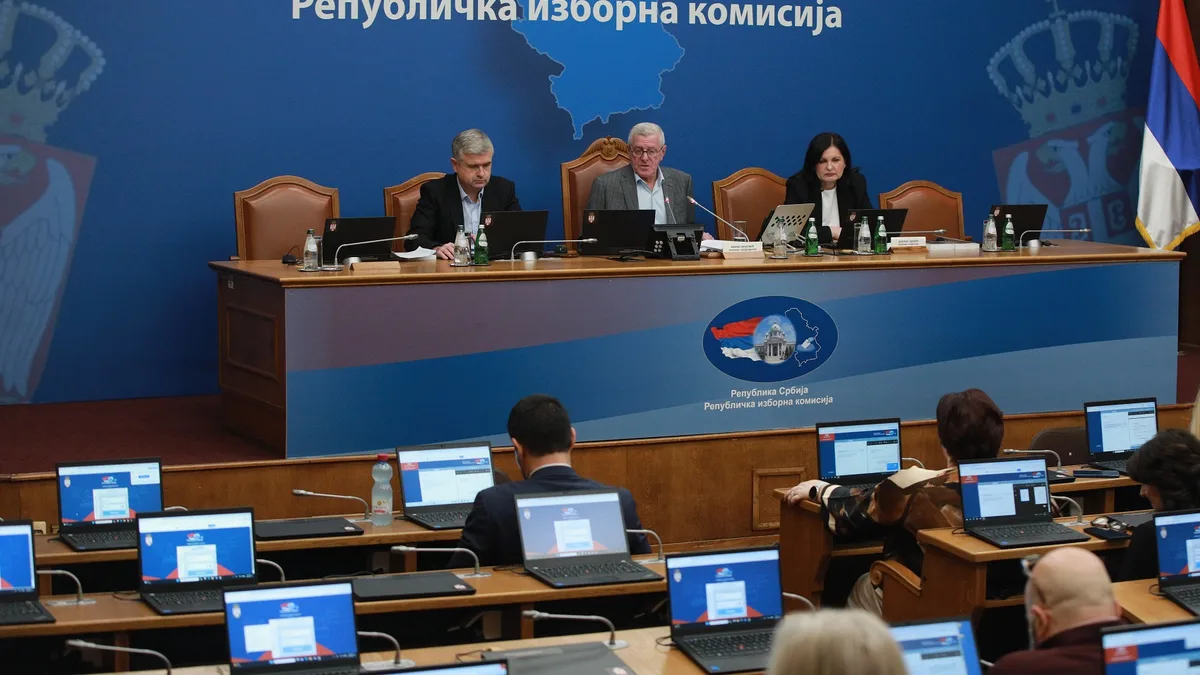
The Republic Election Commission (REC) approved a proposal on August 24 that will keep both the existing cardboard voting screens and new cabin-style booths available at polling stations at the same time, letting each voter pick which one to use. Eleven of the 17 REC members present voted for the proposal, five voted against, and one abstained. The decision takes effect on the day it is published.
The vote came after more than a week of delay. The session where the booth question first came up opened on August 19, but the commission put off closing the agenda item on amending the Instruction on Uniform Standards for Election Material because, as REC president Vladimir Dimitrijevic explained, no agreed-upon proposal had been reached by that point.
A procedural dispute also broke out over whether that session had formally ended or simply been paused. REC member Sofija Mandic argued that the August 19 session was over and that a new one, the commission’s 13th, should have been convened instead, which in her view meant the procedure had been violated. Dimitrijevic rejected that, saying the agenda item had not been closed but only postponed.
“The session was not closed, nor was the act withdrawn so that a session would need to be called under the special deadlines set out in our rules of procedure. It was said, and we all agreed, that this agenda item would be postponed,” Dimitrijevic said, adding that it was still the same 12th session, merely resumed on a different day.
What the new booth looks like
The measure the REC adopted specifies that the new booth will be an aluminum structure two meters tall, enclosed on three sides, with a curtain at the back and an LED strip inside. Unlike the existing cardboard screens, which are open and rely on the voter simply facing the wall, the new structure shields the voter from view entirely.
Dimitrijevic said the reason for keeping both types available at once was the doubts that have surfaced in the meantime about each design.
“The screens for ensuring the secrecy of the vote were proposed so that, in effect, the idea is that at polling stations, since various doubts have emerged about the credibility, correctness, functionality and guaranteed secrecy of the vote, both for the existing screens and for the new ones, we practically have both types of screens available at polling stations,” Dimitrijevic said.
The REC president added that the arrangement is meant as a transitional model until the new booths are fully adopted, and that it was drawn up with the commission’s expert services. He also noted that one of the recommendations from the OSCE Office for Democratic Institutions and Human Rights (ODIHR) concerns exactly this, changing the screens at polling stations, and that the request was repeated after the last local elections. “Voters are free to choose the screen behind which they feel more comfortable voting,” Dimitrijevic said.
A split vote at the REC
REC member Vladimir Dragas voted against the proposal, arguing that introducing the cabins is expensive and unnecessary, and that vote secrecy can be achieved simply by properly applying the existing setup. Deputy REC member Marko Zivanovic asked why 30,000 cabins were being procured at all if polling stations would keep using the existing cardboard screens anyway, saying that since agreement is hard to reach, the commission should have settled on just one type.
REC member Veljko Perovic, on the other hand, argued for adopting the cabins, pointing to ODIHR’s recommendations. Deputy REC member Jasmina Belic voted against, citing ODIHR reports warning that the curtain makes it easier to photograph ballots.
Reactions from students and the opposition
Students in blockade and part of the opposition parties say the curtain on the new booth makes it easier to photograph ballots unnoticed, to pressure voters, and to run so-called Bulgarian trains, a scheme in which a voter is handed an already filled-out ballot that must be returned after voting as proof it was cast. According to them, the change to the voting screens landed on the REC’s agenda at a moment when more than 26,000 citizens were already in training to serve as polling station monitors.
This is Srpske vesti’s first report on the dispute over the design of the voting screens. The REC’s next session will show whether the debate over election material continues ahead of the announced elections, or whether the booth question has now been formally closed.