Kurti Asks von der Leyen in Pristina for Candidate Status
The European Commission president met Haxhiu and Kurti, while young people with banners greeted her outside the airport to protest the verdict against Thaci in The Hague.

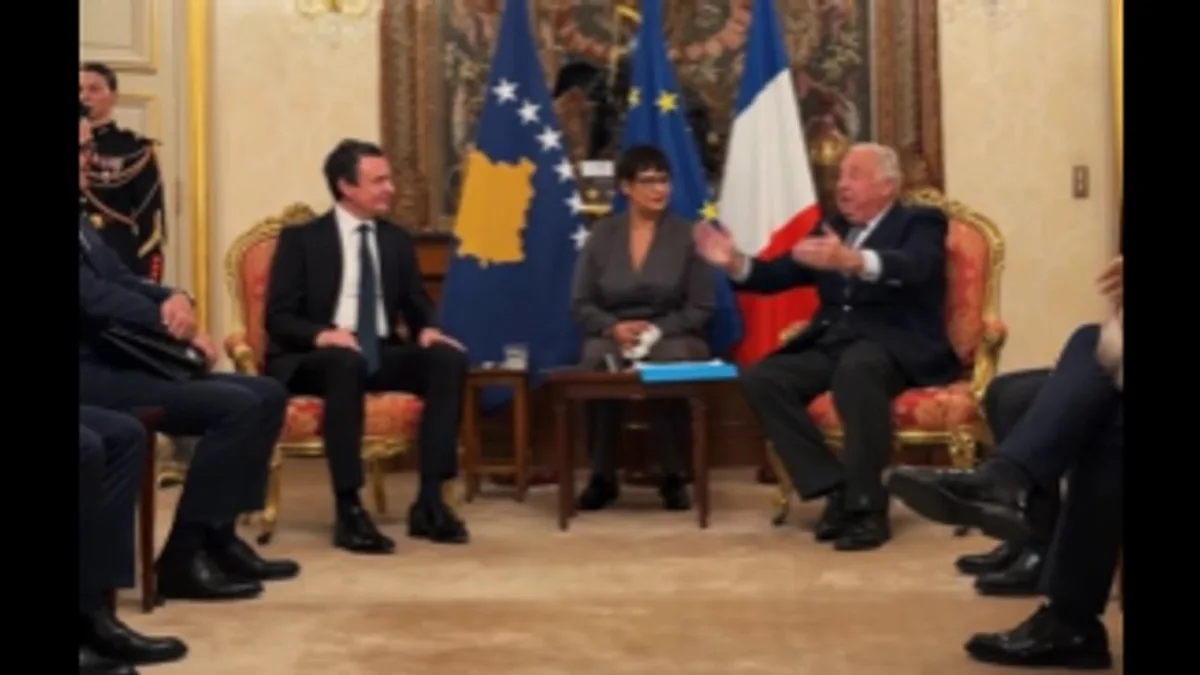
European Commission President Ursula von der Leyen spent October 1 in Pristina, where she met separately with Kosovo’s acting president Albulena Haxhiu and Prime Minister Albin Kurti. After the talks Kurti said Pristina is counting on her support for EU candidate status, while outside the airport young people with banners protested the verdict against leaders of the Kosovo Liberation Army (KLA).
The visit is the second stop on her annual Western Balkans tour, which runs from September 30 to October 2: Tirana on September 30, Pristina and Podgorica on October 1, Skopje on October 2. It is von der Leyen’s sixth visit to Pristina, and Kurti reminded her of that at the joint press conference after the meeting.
What did Kurti say at the press conference?
Kurti used his thanks for her visits to open the question of membership:
You first came after the pandemic and since then, despite all the challenges, you have come every year. Thank you for supporting Kosovo.
According to him, Kosovo has made progress since their first meeting, and independent experts have confirmed it. He listed results: “We have the highest economic growth in the region in this decade, we are fighting corruption well,” the prime minister said, adding that Kosovo’s public debt is the lowest in Europe and that the World Bank and the International Monetary Fund have removed it from the list of fragile and conflict-affected countries.
On security, Kurti said Kosovo is “a reliable partner and 100 percent aligned with the common security policy.” He also claimed that security and the rule of law have advanced most in northern Kosovo, and that nine out of ten citizens feel safe walking alone at night. Of the region, he said it contains electoral autocracies, while Kosovo has an electoral democracy.
He singled out elections: “They should be held once every four years, not twice a year.” Five days ago, he noted, Kosovo adopted five of the 12 laws sent to the Assembly, where he expects the rest to be voted through quickly. “I assure you that no European reform will be late,” Kurti said, adding that a deadlock in the Assembly could leave behind the European funds meant for those reforms.
Von der Leyen, according to reports from the conference, said she believes in Kosovo’s European future, but that institutional stability is the foundation for everything else, including progress toward the Union. “Kosovo is going through an important political moment,” she said, and then: “We support recovery, economic development, reforms and the creation of a modern, democratic Kosovo whose future is within the EU.”
Kurti had announced his request for candidate status before the visit, saying he would put it to the Commission president. The official part of the talks covered the European path, gradual integration and the six-billion-euro Growth Plan for the Western Balkans. The program also included a visit to the new building of the Faculty of Mathematics and Natural Sciences, which is financed by the EU.
What happened outside the airport?
Before von der Leyen arrived, groups of young people gathered in front of the airport terminal in Pristina. They carried banners reading “Today Thaci, tomorrow Zelensky,” “Not in my name” and “EU - you betrayed us.” After she left the airport, they blocked one exit and caused a traffic jam.
The protest is aimed at the September 16 verdict of the Specialist Chambers in The Hague. Hashim Thaci and Jakup Krasniqi were each sentenced to 25 years in prison, Kadri Veseli to 18 and Rexhep Selimi to 13. Multi-day protests have been held in Kosovo ever since.
The platform “Freedom Has a Name” announced a rally for 4 p.m. on Skanderbeg Square in Pristina under the slogan “Not in my name.” The organizers are calling for political unity, an institutional strategy and changes to the Law on the Specialist Chambers. Kosovo Police announced that from 3 p.m. they would close two streets, and in a statement on security measures said:
Kosovo Police recognizes the right of citizens to freedom of expression through peaceful gatherings and protests.
The sources available to us do not show how the protest on Skanderbeg Square went, so only what was announced can be reported.
Why was von der Leyen in Pristina and not Belgrade?
We reported earlier that the tour started in Tirana and bypasses Serbia and Bosnia and Herzegovina. The European Commission cites upcoming elections in those two countries as the reason and says von der Leyen will visit them afterward, once the votes are over. Last year’s tour covered all six Western Balkans partners.
At a Commission briefing, journalists asked whether Belgrade’s absence also has to do with the funeral of Ratko Mladic and the criticism von der Leyen directed at its glorification. The Commission answered that the reason is the elections, and recalled the president’s position that there is “no place in the European Union” for glorifying war criminals.
The timetable of the meetings differs between sources. KoSSev and Danas report that the visit began at 8:30 a.m., Radio KIM that the meeting with Haxhiu was scheduled for 12:30 p.m. and the one with Kurti for 1 p.m., while Euronews Albania, citing Kosovo media, reports that the meeting with Haxhiu started about 40 minutes later than announced. The tour ends tomorrow in Skopje.