Kurti and Sorensen in Paris: only Kurti cites recognition
Albin Kurti says he discussed normalization with Serbia centered on mutual recognition in Paris with Peter Sorensen, while Sorensen's post mentions only the next steps in the dialogue.
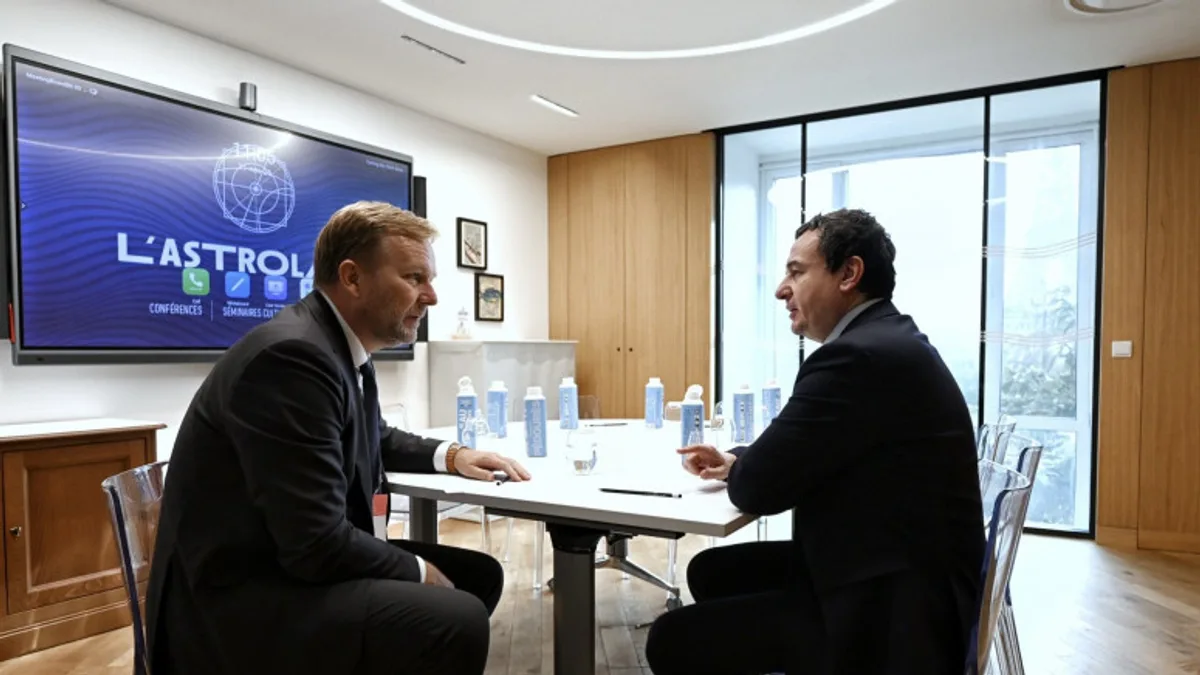
Albin Kurti, the prime minister of Kosovo, and Peter Sorensen, the European Union’s Special Representative for the Belgrade-Pristina Dialogue, held talks in Paris on November 11, 2026, but each published a different account of them. They met on the sidelines of the Paris Peace Forum, and both wrote about the meeting separately on X. Kurti’s post stresses mutual recognition between Kosovo and Serbia, while Sorensen does not mention it.
What did Kurti write about the talks?
Kurti listed three topics: Kosovo’s institutional stability after the election of a president, Kosovo’s path to European Union membership, and the prospects for normalizing relations with Serbia. His cabinet relayed the same account in a separate statement. The post is in English, and it reads:
“We discussed the full institutional stability Kosovo now enjoys after the election of the president, Kosovo’s path to European Union membership, and the prospects for full normalization of relations with Serbia, centered on mutual recognition,” Kurti wrote.
Translations of the last part of that sentence differ. Radio Kosovska Mitrovica renders it as “based on mutual recognition,” while Al Jazeera Balkans has “with a focus on mutual recognition.” Every version contains the same word: recognition.
The day before, speaking with students at a school in Paris, Kurti said he expects Serbia’s new leadership to recognize Kosovo’s independence. We previously covered Kurti’s stay in Paris, when he met Larcher.
What did Sorensen write about the same talks?
Sorensen wrote in English from the account of the special representative for the dialogue:
“Good exchange with PM Kurti today in Paris. With institutions now in place in Pristina, we discussed the way ahead in the Belgrade-Pristina Dialogue and the different aspects of the normalisation process, which matter for people on the ground and for the region.”
The post has no mention of recognition. Sorensen speaks about continuing the dialogue and about the parts of normalization that matter to citizens and to the region, and he treats the institutions in Pristina as the starting point. Al Jazeera Balkans translates his first sentence as “A fruitful conversation today in Paris with Prime Minister Kurti.”
When was their last confirmed meeting?
Before the Paris talks, Kurti and Sorensen last met bilaterally on July 24, 2026, in Pristina. One of the central topics was an attempt to bring back the Serb judges and prosecutors who collectively left Kosovo’s institutions in November 2022. Sorensen raised the question of their reintegration, and Kurti insisted that any return must comply with Kosovo’s constitution and laws. Kosovo’s judicial councils did not allow the return, even though the former judges and prosecutors tried to withdraw their resignations, and the European Union continues to warn that the multiethnic character of the judiciary must be ensured.
Why has the top level been stalled since 2023?
The technical part of the dialogue continues, but talks at the political summit have stood still for years. Kurti and Aleksandar Vucic last spoke directly within the dialogue on September 14, 2023. Both were invited to Brussels in June 2024, but no joint meeting took place. EU High Representative Kaja Kallas said in May this year that both sides had agreed on a new meeting, but that it was postponed by the elections in Kosovo. Sorensen said in early August that a top-level meeting would not be organized for photo opportunities, but only when conditions exist for concrete results.
The political picture in Belgrade has changed since then. Vucic resigned as president of Serbia on September 27, and the next day handed the duty to the Speaker of the National Assembly, Ana Brnabic, who is acting as president until a new one is elected. His list was then defeated in snap parliamentary elections on October 25: the student list won 140 seats and Vucic’s list 103. The formation of a new government is still ahead.
Where do recognition and the association of municipalities diverge?
The Belgrade-Pristina Dialogue began in March 2011 and was intensified at a high political level in October 2012. The Brussels Agreement of April 2013 provided, among other things, for the creation of an association of municipalities with a Serb majority in Kosovo. Belgrade insists on creating it as a mechanism for protecting the rights of the Serb community, while Kurti rejects a model with executive powers and warns of the possibility of parallel institutions and an autonomy modeled on Republika Srpska in Bosnia and Herzegovina. At the same time, Belgrade rejects recognition of Kosovo’s independence, which Pristina declared on February 17, 2008.