European Serbia: Djilas Promises Teachers 250,000 Dinars
The SSP, Serbia Centre and Solidarity list promises a teacher salary of 250,000 dinars, social pensions and a review of major contracts eight days before the vote.

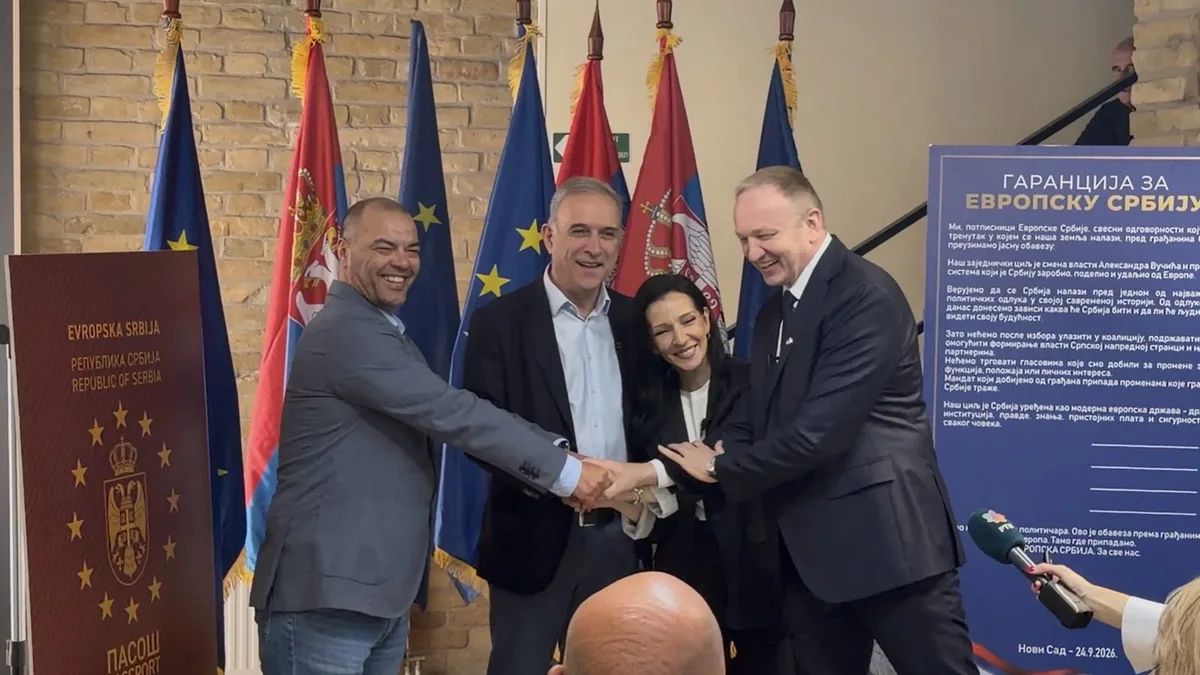
The “European Serbia” list held its election convention in Belgrade on Saturday, October 17, eight days before the elections scheduled for October 25. Dragan Djilas, president of the Freedom and Justice Party (SSP) and the first name on the list, said teachers in primary and secondary schools should earn 250,000 dinars, that pensioners should get back the money taken away by pension cuts, and that the Belgrade Waterfront project should be reviewed.
Djilas urged citizens to back the list on October 25 and said it was time to finish what began on October 5, 2000. He framed the appeal in these words:
“October 5 is one of the greatest, most glorious days in the history of the Serbian state and the Serbian people. On that day the foundations of a European Serbia were laid. So on October 25 this year, let us finish what we started on October 5, so many years ago, and say once and for all: Serbia in Europe, European Serbia, full stop.”
Djilas said Serbia has no alternative to the European path and warned that drifting away from the European Union would mean isolation, economic stagnation and more young people leaving the country.
What does Djilas promise teachers and pensioners?
Besides the 250,000-dinar teacher salary, Djilas pledged social pensions for citizens over 65 who have no income, along with extra support for the poorest pensioners. The money exists, he said, but is lost to corruption and poor management of public companies.
“When you pull out those billions that are spent that way, there is money left for health care, for education, and for everything else that is needed,” Djilas said.
Belgrade Waterfront, foreign investors and Russia
Djilas said that if power changes hands, major infrastructure projects and contracts should be reviewed, Belgrade Waterfront among them, along with the way public money is spent. He called for equal conditions for all investors and for domestic law to apply on Serbian territory, with no exemptions for foreign companies.
For the capital, he promised a metro built around citizens’ real needs, plus investment in schools, kindergartens and health centers. He also criticized opposition-minded groups that have no clear position on European integration, arguing that the “European Serbia” list is the only one that says unambiguously “no to Vucic, yes to Europe.”
On Russia, he said he holds no hostility toward the Russian people, but that Serbia should not come to resemble Russia under Vladimir Putin, where, in his words, the opposition is jailed, there are no free elections and the country is led into war.
What did Tepic, Ponos and Jesic say?
Marinika Tepic, SSP vice president and one of the list’s leaders, said the October 25 elections are “to be or not to be”: Serbia will either stay isolated, a black hole on the carpet of Europe as she put it, or jump on the last train. She said that once the judiciary becomes independent, it will be possible to seize illegally acquired property of people in power, and she held up a sticker stating that such property belongs to the Republic of Serbia. That sticker, she said, should appear on illegally acquired buildings.
Tepic also addressed the European Parliament’s election observation mission, which is expected to be led by Andreas Schieder:
“The arrival of the European Parliament mission, which is expected to be led by Andreas Schieder, is important because its report on the situation in Serbia could serve as an institutional basis for further action by European institutions,” said Marinika Tepic.
She added that it matters for the international community to follow the election process and react if irregularities occur. Alongside a photo from the convention, Danas also published her statement: “We were the first to draw attention to corruption, and when it started killing, everyone woke up.”
Zdravko Ponos, president of Serbia Centre and a list leader, called on the authorities to “keep their sticky fingers away from the will of Serbia’s citizens” and to make sure the vote passes peacefully. He urged people to turn out:
“I call on them to make sure October 25 is not like September 24 was. We do not need another October 5, let everything be settled by the will of the citizens on October 25,” Ponos said.
According to a report by the FoNet agency, Ponos said the authorities had spent 14 years spreading lies and stoking fear of the European path, which dented support for EU membership: it fell from 72 percent in 2003 to around 35 to 36 percent. He also said pension cuts harmed 850,000 pensioners, for a total of 840 million euros, and that hundreds of thousands of young people and many health workers have left Serbia. The authorities, he said, should enter the campaign with a candle in hand and ask for forgiveness, among other things for the deaths of 16 people in Novi Sad.
“And instead of remorse and shame, yesterday they entered Novi Sad swaggering like conquerors on tractors, with thugs, with police, with fire, with threats,” Ponos said.
Goran Jesic, leader of the Civic Movement “Solidarity,” spoke about the same days from the perspective of a Novi Sad resident. He said he felt defeated by the gathering of government supporters and football fan groups in the city the day before:
“As a resident of Novi Sad, I capitulated yesterday. We fought for two years, thousands of people, thousands of days were spent in prisons and detention, and some are still in prison today,” Jesic said.
He asked why more citizens and opposition representatives had not gone to the Novi Sad railway station the day before to light candles, as in previous months. To voters he said:
“There is no wasted vote and no fixing things after this election. We cannot vote for the lesser evil this time either, as we have so many times before. Be careful how you vote on October 25. You are not voting for the lesser evil, you are voting for your children and for a European Serbia,” Jesic said.
Jesic also warned that continuing the policy of moving away from the EU could lead to Serbia’s isolation, further emigration of young people and a society with an ever older population, and that there is no guarantee the country will survive 15, 20 or 30 years if it keeps making the wrong political decisions.
Who is on the list, and when is the vote?
The “European Serbia” list brings together the SSP, Serbia Centre (SRCE) and the Civic Movement “Solidarity.” Djilas is first on the list, with Tepic and Ponos as leaders. Citizens vote on October 25, 2026. Reports from the convention contain no response from government representatives to the announcements.