Pristina court sentences Milorad Djokovic to 10 years
The Basic Court in Pristina convicted Milorad Djokovic of Vitomirica, near Pec, of a 1999 war crime at first instance. The defense plans to appeal.
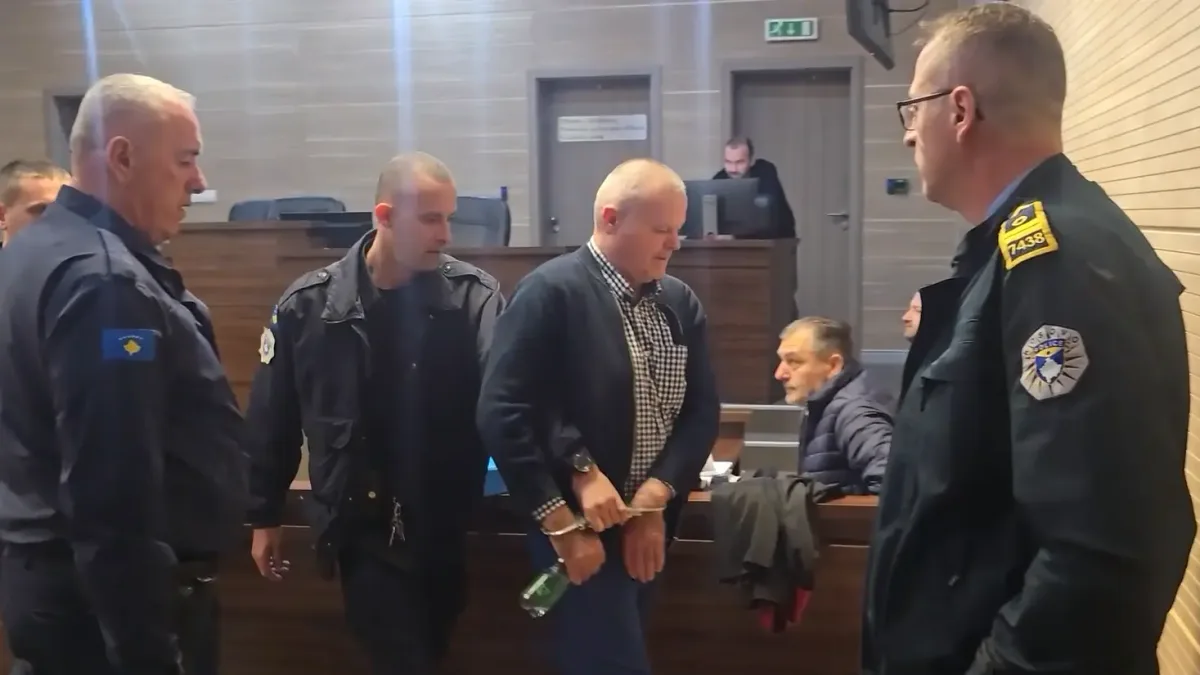
Milorad Djokovic of Vitomirica, near Pec, has been sentenced to ten years in prison in Pristina. On October 21, 2026, the Basic Court found him guilty in a first-instance ruling of a war crime against civilians, committed in May 1999 in the village of Ozdrim near Pec. The verdict is not final: Djokovic remains in detention until it becomes final, and the time he has already spent there counts toward the sentence.
The panel was presided over by Judge Donika Salja (KoSSev gives her name as Donika Salja Avdulji). Representatives of the injured parties’ families attended the reading of the verdict, along with, according to KoSSev, representatives of the Humanitarian Law Center Kosovo and other organizations that monitor war crimes trials. Djokovic must pay court costs and another 100 euros to the injured parties.
What was Djokovic convicted of, and what was he cleared of?
According to the verdict, Djokovic, a reserve police officer, took part in Ozdrim in May 1999, together with other Serbian police officers, in the search, beating and arrest of dozens of Albanian civilians. Those arrested were held for three days in a shed, where they were beaten and starved. The judge read out: “After three days of torture, the group was released, and others were sent to a prison in central Serbia.”
The prosecution had charged him with far more: taking part in the killing of eight civilians and in the expulsion of several dozen Albanians. According to KoSSev, the judge concluded there was no evidence for the expulsion or the killings. Djokovic was therefore convicted on one count of the indictment and acquitted on the two most serious. He was arrested on June 27, 2022, and pleaded not guilty at the start of the trial. The verdict had been postponed on July 27, at the defense’s request, because of inconsistencies in one witness’s statement.
What does the defense say, and when is the appeal due?
Defense lawyers Vasilije Arsic and Dejan Vasic have announced an appeal to the Court of Appeals, which they must file within 30 days. After the verdict, Arsic said:
“Unfortunately, the court has handed down a verdict sentencing Djokovic to 10 years in prison, only because of an alleged finding that he took part in the mistreatment of Albanian civilians in ‘99. We as the defense will certainly appeal this verdict, but what is good for the defense is that we managed to prove that Djokovic did not take part in a single killing, even though the prosecutor claimed that he took part in the killing of eight people.”
Arsic added that the reasoning in the verdict is so far very brief and unclear, but that the defense has “plenty of material” to overturn it. “We as the defense did everything to prove Djokovic’s innocence, and we believe we will confirm that even more strongly in the appeal process,” he said.
Vasic said they are “partly dissatisfied with the verdict, given that the court convicted Milorad Djokovic on only one count of the indictment, while he was found not guilty on the two most important and most serious ones.” After the verdict he added:
“That part of the indictment (the killing) was rejected at first instance. I must point out that this panel, which tried the case of Milorad Djokovic, was in procedural terms the most mature panel to have handled cases before the Special Department of the Basic Court in Pristina, and the mystery of why Milorad was convicted on the part concerning the unlawful detention of civilians will probably be cleared up by the Court of Appeals in the appeal process.”
Why was he in court in the first place?
Djokovic worked as a registrar in Gorazdevac and was the only Serb living in Vitomirica. He was in a property dispute with local Albanians and the municipality of Pec. One of the witnesses during the evidentiary proceedings said that Djokovic had taken over his great-grandfather’s estate, and that this is where the problem began. Defense lawyer Arsic has previously explained the other side of the story:
“First they wanted to take his property, which in the end they managed to do by force. The municipality of Pec took it from him without any compensation, even though that was contested before the Administrative Court in Pristina. We won a ruling in Djokovic’s favor, but later they tore down the house he had started to build in Vitomirica. And that impression leads us to suspect that everything started from then.”
How did Belgrade react?
The Office for Kosovo and Metohija issued a statement calling the verdict naked legal violence by the regime in Pristina. The statement reads:
“Djokovic’s only sin is that, as a Serb from Metohija, he claimed his stolen property back from usurpers of Albanian nationality, after which he was charged with an alleged war crime without any evidence or credible witnesses. This is yet another example of how Kurti’s judiciary rules by a purely political and ethnic key, by which Serbs are guilty whenever an Albanian, out of personal motives or material gain, points a finger at them.”
The Office adds that Djokovic lived in Vitomirica until the March pogrom, from which, it says, he was expelled and his house burned. After returning to his home area, he started court proceedings over the usurpation of his own property, and only then was he charged.
This is the seventh first-instance war crimes verdict handed down this year by the Basic Court in Pristina. In the previous six cases, according to KoSSev, seven people were convicted. According to RTS, several dozen Serbs are currently in prisons in Kosovo and Metohija, either as convicts for war crimes or as people on trial or facing proceedings yet to be opened. The defense has 30 days to file an appeal.