Student List Seeks Alta Bank Probe and EPS Review
At its first thematic press conference since the election, the list asked the caretaker government for answers on Alta Bank, EPS, gas, excise duties and NIS.
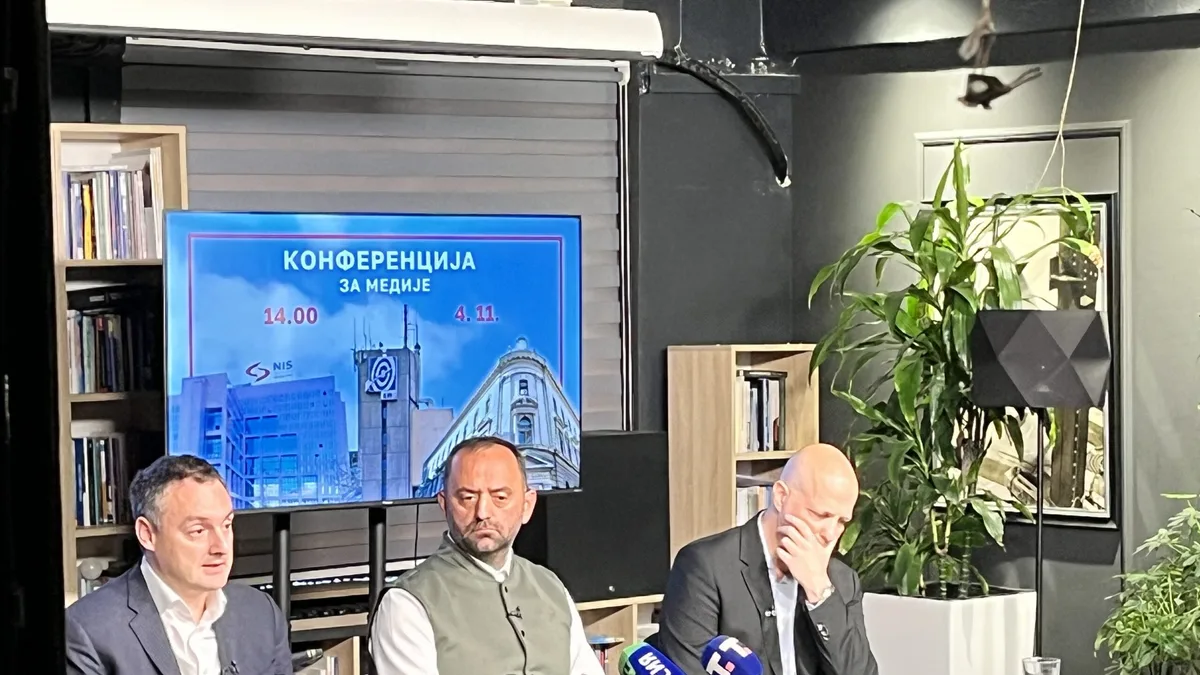
The Student List held its first thematic press conference since its October 25 election win on Wednesday, November 4, at 2 p.m. It asked the caretaker government to open an investigation into Alta Bank, review the operations of Elektroprivreda Srbije (EPS) and present a clear plan for gas, fuel excise duties and NIS. The speakers were economist Emir Zildzovic, Stevan Cveticanin, a professor at the Faculty of Technical Sciences in Novi Sad, and Dejan Radivojevic, a professor at the Faculty of Mining and Geology in Belgrade, all candidates on the list.
The conference was opened by Maja Petrovic, a student at the Faculty of Mining and Geology:
“The citizens of Serbia have made it clear what kind of country they want to live in, and they have trusted us to run its future. That is why we believe our duty to the citizens does not begin on the day we enter the offices, but began as soon as the votes were counted.”
The list claims the outgoing government is putting off problems so it can pass the responsibility to the next one. We have reported before on Alta Bank and the National Bank of Serbia’s decision, but these are the first demands the winning list has made on the subject.
What does the list want in the Alta Bank case?
The National Bank of Serbia revoked Alta Bank’s operating license on October 30, 2026, citing undercapitalization and illiquidity. The Student List points out that in June 2026 the bank reported a capital adequacy ratio of 17.92 percent, and says it must be established how the situation deteriorated so quickly, whether the reports accurately reflected the risks and whether the National Bank acted in time. It names the regulator’s failure to react in time, together with the leadership of the National Bank under Governor Jorgovanka Tabakovic, as possible causes, along with inaction by the prosecution.
The specific demands are a review of all major loans to related parties and of guarantees issued, an independent analysis of the loan portfolio and publication of a timeline of the National Bank’s supervisory measures. The list also wants an explanation of the decision to move EPS bill collection to Alta Bank from July 2025, and of the terms under which EPS and other public companies did business with the Alta group. For the gravest forms of abuse, it mentions prison terms of 10 to 12 years.
Zildzovic said the investigation had to be comprehensive and must establish who took part in creating and concealing the problem:
“It seems that direct supervision failed. How is it possible that a bank holding more than ten times as much cash in its vaults as other banks was not subject to adequate oversight?”
According to him, almost 400 million euros was illegally withdrawn from the vaults. A prosecution document published by KRIK cites a suspicion of about 390 million euros, of which 370 million never even entered the vault. Zildzovic also called for an examination of the circumstances in which the National Bank allowed Alta to take over JUBMES banka, which he described as an unusual case in international practice, since an exchange office had taken over a bank. He said he hoped the Deposit Insurance Agency would appoint an independent bankruptcy trustee. He urged citizens to stay calm and analysts not to spread unverified information.
What was said about the state of EPS?
Cveticanin called for a full, urgent and transparent review of EPS operations:
“These are not political questions but questions of life, of direct importance to every person in this country.”
He said Unit A2 at Kostolac is not operating and that the overhaul of Unit B2 at the TENT power plant was postponed by two years, so the plant is running at reduced capacity. The period of low water levels, he said, further limits hydropower plants and shows the system’s vulnerability and the lack of an energy strategy. He also asked why the previous government channeled money into the National Stadium instead of generating capacity, and whether the money from the budget revision would be enough to last through the heating season. He called on Minister of Mining and Energy Dubravka Djedovic Handanovic and the EPS management to publish the real state of the company and production projections through the end of the year, adding:
“The public has the right to know the condition of one of the most important companies in the country.”
What was proposed on gas, excise duties and NIS?
Radivojevic started with excise duties. The temporary 25 percent reduction, introduced by the caretaker government, expires on November 8:
“If that measure is lifted and the full amount is passed on to retail prices, we can expect gasoline to rise by more than 21 dinars and diesel by more than 22 dinars per liter. The government can adopt a new decision even during a caretaker mandate, within its powers.”
Some media rounded the diesel figure to “more than 20 dinars.” Once the new government is formed, the list would consider amending the Excise Duties Law.
The long-term gas arrangement with Russia expired at the end of May 2025. The latest extension, from September 30, 2026, runs until December 31. Radivojevic said such short-term contracting does not give the state, the economy and the energy system enough predictability, and asked for a multi-year contract with clear volumes, schedules, delivery flexibility and prices. The Ministry of Mining and Energy, Srbijagas and the government are responsible for the negotiations. He named these alternatives:
- Azerbaijani gas through the interconnector with Bulgaria
- the LNG terminal at Alexandroupolis in Greece
- a route from Hungary
- the Neptun Deep field in Romania
- additional links through North Macedonia and Greece
On NIS, the American OFAC extended the operating license on October 30 until December 11, which is not a lifting of sanctions. The list wants to see the contract on the sale of the Russian stake to MOL, including the price, payment deadlines and obligations toward the Pancevo Refinery, as well as the government’s June 16, 2026 agreement with MOL, which provides for raising the state’s share by five percentage points. Radivojevic said:
“For now, we do not have all the information about the negotiations on the sale of the majority Russian ownership in NIS.”
He noted that Serbia has four representatives on the NIS Board of Directors, whom he sees as a channel of information, and that the country must have a fallback scenario in case OFAC does not extend the license.
What do we know about the government’s response?
As of the time of writing, Minister Djedovic Handanovic, EPS and the National Bank had not published a response to the demands from the conference. Vreme noted that the speakers did not present any new information. The first deadline the list itself cites is November 8, when the excise reduction expires, and the next is December 31, when the gas arrangement ends.