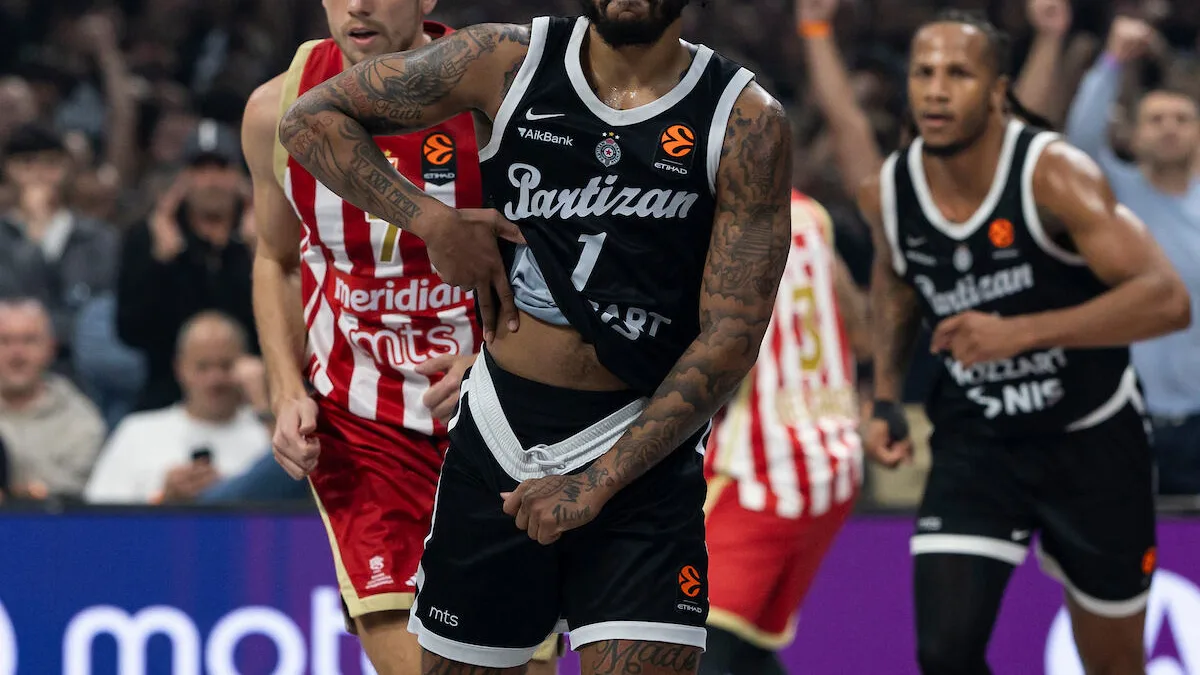
Partizan sign Derek Willis on a two-year contract
American forward Derek Willis has signed a two-year contract with Partizan, becoming the club's sixth summer signing. He shot 37 percent from three-point range for Paris last season.

- Partizan officially unveiled American forward Derek Willis on July 28.
- The contract runs for two seasons.
- Willis is the club's sixth signing of this transfer window.
- Last season with Paris: 5.8 points per game and 37 percent from three.
The ball goes into the pick and roll, the defence collapses towards the paint, and at that moment somebody has to be standing in the corner ready to punish it. Partizan spent too much of last season without that somebody. The ball handler would turn, look for a shooter on the wing and find a player who would rather attack the rim than let it fly. Now, at least on paper, there is an address to pass to.
The black and whites have officially presented Derek Willis. The American forward has signed a two-year contract and becomes the club’s sixth addition of this transfer window. The order is familiar: Kevarrius Hayes first, then Lamar Stevens, followed by Alessandro Pajola, Nikola Tanaskovic and Luka Vildoza. Willis closes out the summer rebuild and changes the arithmetic of the front line.
He stands 205 centimetres and was born in 1995. He came through Kentucky but went undrafted in the NBA, so he built his career the long way around, via Denver’s development squad and a string of European clubs including Efes and Venice. That is the CV of a player who learned to fill a role rather than demand the ball.
Why did Penarroya want this exact kind of forward?
Joan Penarroya spent the entire summer hunting for spacing at the four. His offence lives on ball movement and on forcing the opposing centre out of the paint, and that does not happen while his opposite number stands on the shooting line without posing a threat. Willis poses one. Last season in a Paris shirt he shot 37 percent from beyond the arc, a number defences have to respect.
There is a nuance here that the raw figures do not show straight away. Willis is not a shooter who needs twenty attempts. He is a shooter who stands where he should, does not break the action and knocks it down when the ball comes back out after a drive. In a league where every minute is filed down to the detail, that kind of player shortens a coach’s bench instead of stretching it.
The other side of it is defence. At 205 centimetres with a wing’s mobility, Willis can switch across two or three positions, and that is now a requirement rather than a bonus. The EuroLeague punishes every mismatch, and Partizan were too often forced last season to change their lineup instead of simply changing the assignment.
The Paris numbers and what comes next
The statistics are modest, but they need reading in context. Across 28 EuroLeague games Willis averaged 5.8 points, 3.9 rebounds and 1.2 assists. That is not the line of a primary option and it was never meant to be. It is the line of a specialist who spends fifteen or so minutes on the floor and asks for nothing during them beyond one open look.
The risk exists and it is only fair to name it. If the percentage drops, Willis has no second tool to justify the minutes, because he is not a player who creates on his own. That is precisely why Partizan committed to two years rather than one: the bet is that his role in a system generating more open shots will suit him better than Paris did.
The next step is pre-season and the first friendlies, where it will become clear whether Penarroya uses him as a conventional four or as a small-ball centre in closing stretches. That detail will decide how much Willis really changes the rotation.
Do you think a shooting profile was Partizan’s genuine priority, or did the squad still need someone who can create for himself?