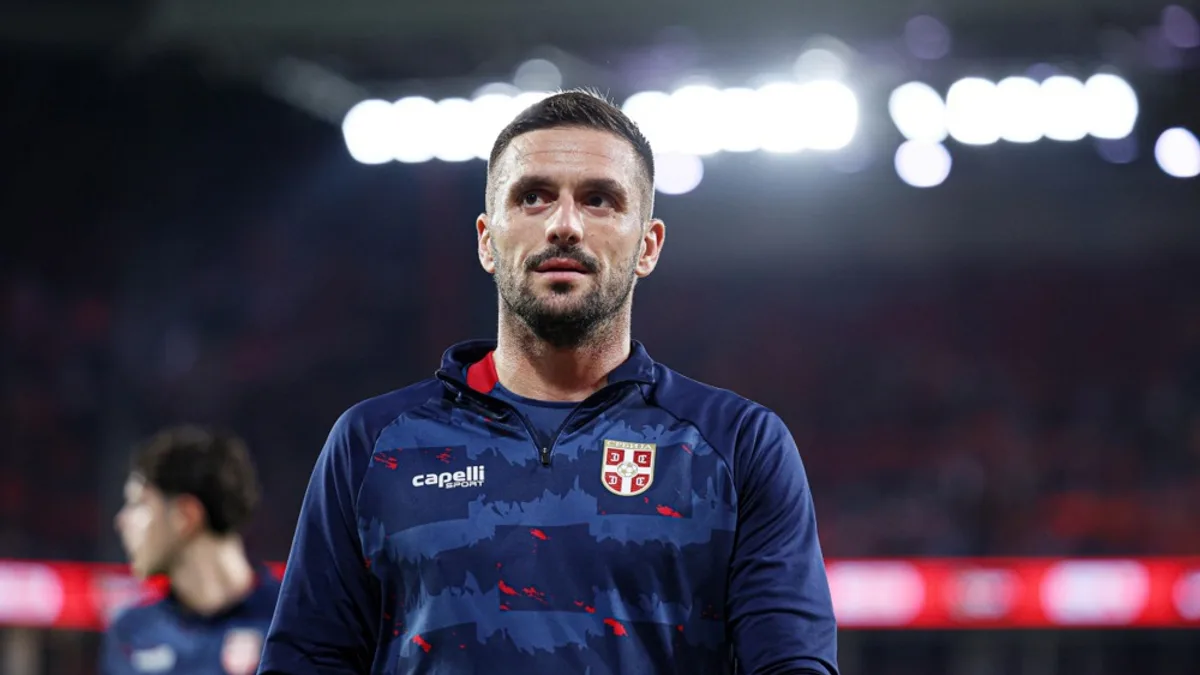
Serbia Faces Greece at Marakana, No Vlahovic for Paunovic
Serbia hosts Greece tonight at Marakana in the opening round of the Nations League, without injured striker Dusan Vlahovic. Paunovic and Tadic previewed the match at a press conference.

The last time Veljko Paunovic stood on the pitch at the Rajko Mitic Stadium, he was seventeen years old and wearing a Partizan shirt, in the club’s hundredth eternal derby. Now he returns to that ground as Serbia’s head coach, ahead of the opening round of Nations League Group A2 against Greece, and admits it feels like an entire era has passed since then.
At a press conference on September 23, the day before the match, the coach chose his words carefully. He knew he was speaking to a public that has not had many reasons to trust the national team lately.
“It feels like I haven’t been at the Rajko Mitic Stadium since that hundredth eternal derby, when I played for Partizan as a seventeen year old,” Paunovic said, recalling the match he played before leaving for Spain.
He did not ask the stands for sympathy. Instead, he made clear that support has to be earned on the pitch: “I’m not begging anyone. Love can’t be given as a gift, it has to be earned on the field,” Serbia’s coach said.
Serbia hosts Greece on Thursday, September 24, at the Rajko Mitic Stadium, in the opening round of Group A2 of the Nations League’s top division. According to B92, Telegraf, 021 and Sport klub, kickoff is at 8:45 PM, while RTS 2’s programming schedule lists the broadcast starting at 9 PM, which is likely when coverage itself begins rather than the match. RTS 2 holds the live broadcast rights, with Predrag Strajnic on commentary, and the match is refereed by Glen Niberg. Germany and the Netherlands complete the group alongside Greece, and Serbia’s return fixture against the Dutch comes already on Sunday, September 27, kicking off at 6 PM, again in Belgrade.
The coach has few doubts about his starting lineup. Telegraf reports a 4-2-3-1 setup: Vanja Milinkovic-Savic in goal, Nedeljkovic and Terzic at full back, Pavlovic paired with either Gudelj or Erakovic at center back, Stankovic and Sergej Milinkovic-Savic in midfield, and Zivkovic, Tadic and Kostic supporting lone striker Luka Jovic. The bench, however, is a serious concern: Mitrovic, Vlahovic, Milenkovic and Rajkovic are all unavailable, while Greece is missing Rote and Djanulis, and Bakasetas was not even called up.
The biggest talking point ahead of the media was the absence of Dusan Vlahovic. Paunovic confirmed that the striker reached out to him personally after Besiktas’s match in Turkey. “He contacted me after the Besiktas match and said he felt something in his calf,” the coach said, describing the first signal that came out of Istanbul. Turkish media report that the hamstring issue is not serious, but no risk was taken. “We got the report, and that’s as far as it goes on our end. Unfortunately, we don’t have a say in these situations,” Paunovic added, making clear the call was made by the medical staff, not the coaching team.
Paunovic did not hide his respect for his counterpart, Serbian born coach Ivan Jovanovic, who now leads Greece. “I know Ivan from football circles and through his major achievements. He is an outstanding coach who leaves his mark wherever he goes,” Serbia’s coach said. Jovanovic finished the previous edition of the competition as League B group winner and is now leading Greece in the top tier for the first time, while Serbia, over the same period, finished third in a group with Spain, Denmark and Switzerland.
Captain Dusan Tadic, back in the national team after a lengthy absence, described his return as if he had never left. “It all went by fast. It was like being on vacation, and then I came back,” Tadic said of his time away from the squad. “It’s like I never left, everything’s the same. They’re all our people,” the captain added, describing the mood in the locker room ahead of the clash with Greece.
What worries organizers most is ticket sales. According to Sport klub, around 15,000 tickets had been sold ahead of the match, even though the Football Association of Serbia had hoped to fill all 40,000 seats. This is, notably, the national team’s first match in Belgrade since September 2025, when hooligans attacked fans in the stands, followed a month later by a loss to Albania in Leskovac. The wounds from that night, it seems, have not fully healed, and that shows more clearly in the ticket numbers than in anything Paunovic has said.
Under the competition format, the top two teams in Group A2 advance to the quarterfinals in March 2027, while the bottom finisher is relegated to League B. Serbia continues that story already on Sunday, hosting the Netherlands at the same stadium from 6 PM.