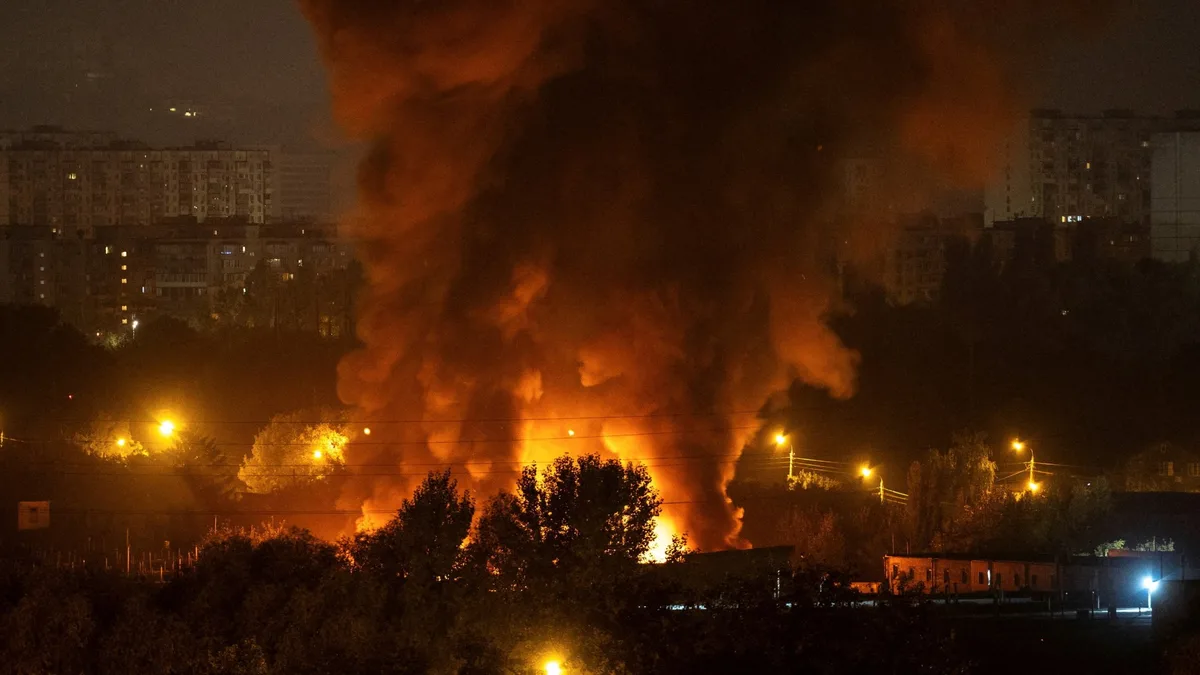
Moscow tells foreigners to leave Kyiv, signals strikes on decision-making centres
Russian embassies in third countries have urged their own nationals and foreign diplomats to leave Kyiv, with Moscow announcing new strikes on what it calls decision-making centres and drone factories; Ukraine reads the move as psychological operation.

The Russian Foreign Ministry on Wednesday evening, repeated on Thursday morning, urged foreign nationals and diplomats in Kyiv to leave the Ukrainian capital ahead of new military operations. These are to target, the statement says, “decision-making centres, command posts and drone production facilities”.
The appeal was delivered through Russian embassies in third countries. It is the first public signal from Moscow that it plans a fresh wave of strikes on Kyiv after the massive attack of 24 May, when 90 missiles and 600 drones hit the capital, leaving at least two dead and 77 wounded.
For Serbia, which has an embassy in Kyiv and several hundred citizens living or working in Ukraine, the appeal is not a procedural formality. It is a concrete security signal that the Foreign Ministry shared immediately with partners through Serbia’s permanent mission to the OSCE in Vienna.
The Serbian embassy in Kyiv, which has been operating in reduced capacity with three diplomats since February 2022, issued a recommendation on Wednesday evening for Serbian nationals to relocate to the regions of Lviv and Uzhhorod, where the risk of missile strikes is significantly lower.
President Volodymyr Zelensky, at a joint press conference with Prime Minister Denys Shmyhal on Wednesday, was direct:
The Russian appeal is a classic combination of threat and information warfare, which Kyiv treats as an attempt at demoralisation, not an operational announcement.
In the same address, military intelligence chief Kyrylo Budanov judged that Moscow turns to this pattern when “there is nothing to show on the front”. Ukrainian forces have in the past month retaken three villages in the Donetsk region and struck a reserve drone-pilot base in Russia’s Krasnodar Krai.
Three technical differences from the 24 May attack
Three technical shifts set this announcement apart from earlier escalations:
- Type of weapon: in the 24 May strike Moscow for the first time used the hypersonic ballistic system Oreshnik, confirmed by the Ukrainian General Staff, a technological leap from the previously used Iskanders and Kalibrs
- Depth of targeting: Shahed-type drones are now flying through corridors 200 to 300 kilometres inside Ukraine, on routes they had not covered before
- Timing pattern: strikes are timed to coincide with European diplomatic calendars, just before High Representative Kaja Kallas rolls out a new package of measures
Brussels, through High Representative Kallas, announced on Monday a five-billion-euro package to reinforce Ukrainian air defences, with a concrete emphasis on the delivery of additional Patriot systems and IRIS-T combat systems. It is financed by Germany, the Netherlands and the Nordic members. According to information from Berlin, the Bundeswehr on Wednesday approved the transfer of an additional Patriot system, which the German defence industry and the Chancellery confirmed in parallel.
Washington reserved, Belgrade reads the signals
Washington is staying reserved in its public messaging at this stage. Secretary of State Marco Rubio said on Tuesday that the United States “currently has no information that would justify the evacuation of American citizens from Kyiv” but is monitoring the situation together with NATO partners. That position differs from the Russian embassy in Kyiv, which already withdrew its staff in February 2022 and is now urging foreigners to follow. The US embassy in Kyiv continues to operate at full capacity, with diplomats rotated every six weeks.
Belgrade, which has not sanctioned Russia while recognising Ukraine’s territorial integrity, is not commenting publicly on Moscow’s signal. Diplomatic communication with Kyiv runs through the embassy. The Foreign Ministry on Wednesday evening recommended that all Serbian nationals postpone any travel to Ukraine, except for humanitarian or journalistic purposes, with the recommendation in force until further notice.
What do you expect over the next seven days, a dramatic escalation or a continuation of the war of attrition that has been running since autumn 2025?