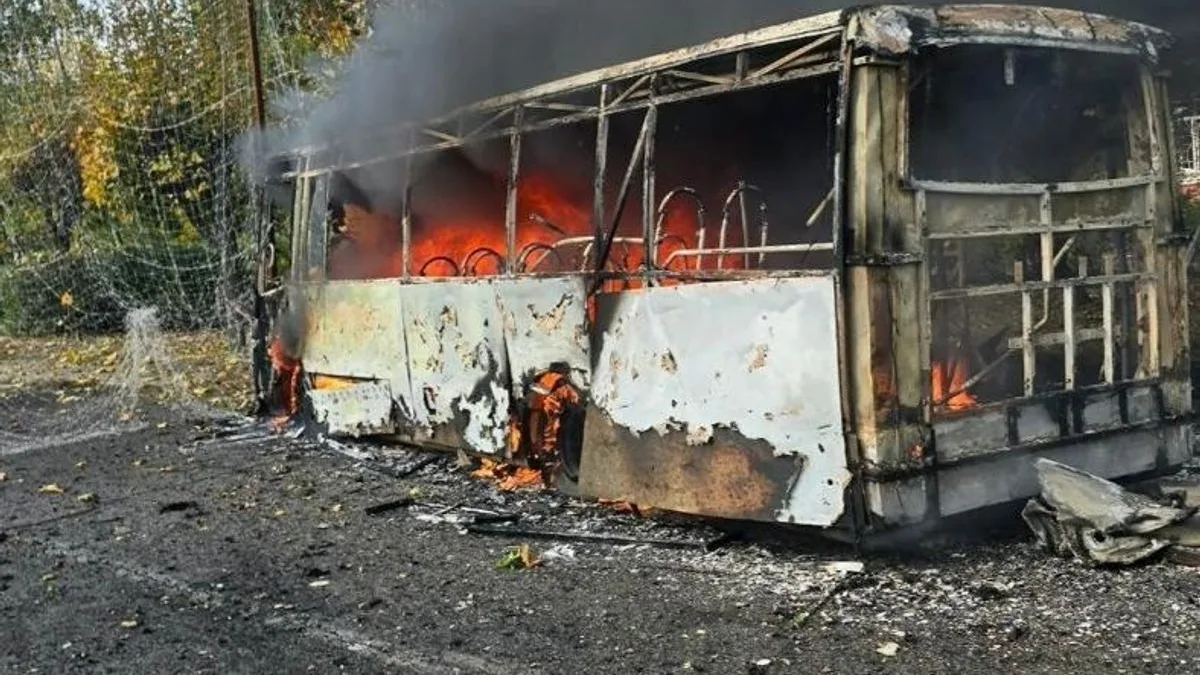
Drone Strike Kills Nine on Bus Near Lisichansk
A drone attack on a passenger bus in the Russian-controlled part of Luhansk region killed nine people on Wednesday, and Russian investigators are treating the case as an act of terrorism.

A bus carrying 15 passengers was hit on Wednesday, August 26, on a stretch of road between Zolote and Pervomaisk, in the part of Luhansk region controlled by Russia. The vehicle was traveling from Lisichansk to Stakhanov, a city Ukraine still officially calls Kadiivka. Nine people were killed and six injured, according to Leonid Pasechnik, head of the self-proclaimed Luhansk People’s Republic.
The strike on a civilian vehicle behind the front line adds to a run of attacks recorded along the entire line of contact in recent weeks, from missile strikes on Kyiv to hits on refineries inside Russian territory. Rarely, though, do the casualties turn out to be civilians outside major cities, on a road people use for their daily commute.
What is known about the victims
According to Pasechnik, eight passengers died at the scene. A 20 year old woman was taken to intensive care, where doctors tried to save her life but failed, bringing the final death toll to nine. Among the injured are an 18 year old woman and the mother of one of the passengers who died. Three passengers and the bus driver were treated at the scene and were not admitted for further care.
The Russian side says the bus was hit by an unmanned aerial vehicle, though the type and model of the drone had not been established as of Wednesday evening. Pasechnik described the strike as a deliberately chosen target, not a stray hit near the front line.
“The strike by Ukrainian armed forces was targeted,” Pasechnik said in a statement released shortly after the attack, adding: “This is an act of terrorism by the bloody Kyiv regime.”
Terrorism investigation
Russia’s Investigative Committee opened a case under its terrorism statute over the attack on the bus, committee spokeswoman Svetlana Petrenko confirmed. According to her, a team has been assembled to gather evidence, determine the type and model of the drone, and reconstruct the full sequence of events, from the bus’s departure from Lisichansk to the moment of the strike on the road to Stakhanov.
Military expert Andrei Marochko told the Russian news agency TASS that a strike on a civilian vehicle could not have been accidental.
“The drone operator sees in real time where the strike lands,” Marochko said, pointing out that modern drone munitions are guided by the operator right up to the moment of impact, which in his view makes it unlikely the vehicle was mistaken for a military target.
No independent confirmation
Reuters reported the Russian side’s account but noted it could not independently verify either the death toll or the circumstances of the attack as described by Pasechnik. The Ukrainian side had not commented on the claims from Luhansk region as of this writing, and has neither confirmed nor denied that its forces carried out a strike on that road.
Zolote and Pervomaisk, the towns between which the bus was struck, sit on a stretch of the front that has been under Russian control since 2022, while Lisichansk is a city Russian forces captured in the summer of that year after weeks of fighting against Ukrainian troops withdrawn from neighboring Severodonetsk. The road is still used for civilian traffic despite its proximity to the front line, which is why attacks on passenger vehicles in that area regularly make headlines in Russian and local media once the region came under Russian administration.
Cases in which the Russian side labels a strike on a civilian vehicle in the border areas of Donbas as an act of terrorism are not uncommon, but an independent on the ground investigation is typically absent in such cases, since foreign observers and journalists have no access to the parts of Luhansk and Donetsk regions under Russian control. As a result, claims about the type of weapon and the identity of the attacker, from either side of the front, generally remain unverifiable beyond the statements of the warring parties themselves.