Nepal Flood Death Toll Hits 1,243, 4,875 Still Missing
A week after a wall of water tore through the border with Tibet, Nepal's flood death toll has passed a thousand: 1,243 confirmed dead and 4,875 missing, including 583 foreigners from 39 countries.

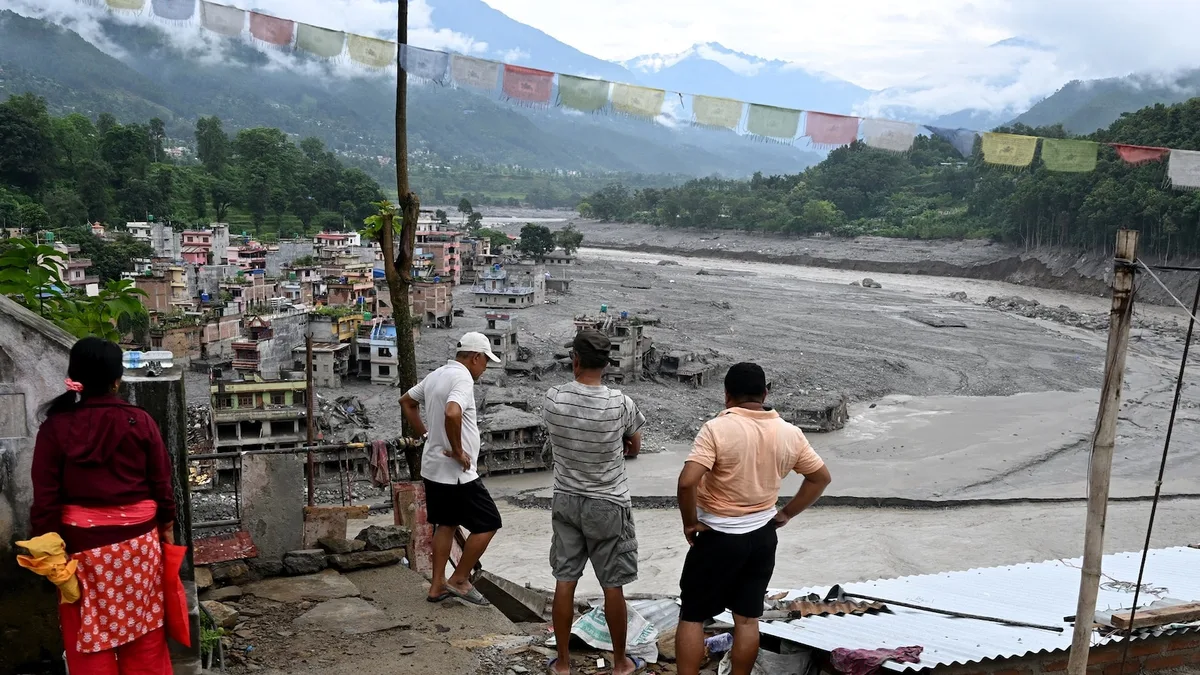
The death toll from the floods that struck northern Nepal a week ago has passed a thousand. Nepal Police said on Wednesday, September 3, that 1,243 people have died and 4,875 remain missing nationwide, a week after a wall of water rolling down from the border with Tibet wiped out the Gyirong border crossing and villages along the Trishuli River.
The English Wikipedia page tracking the disaster hour by hour lists a slightly different figure for the same period, 1,252 dead in Nepal against an identical 4,875 missing. The gap comes from the two sources updating at different points in the same day, since Nepali authorities have yet to publish one single, reconciled count. On the Chinese side of the border, in the Tibet Autonomous Region, authorities reported 21 dead and 541 missing on September 2. Combined with Nepal’s toll that day, then standing at 1,204 dead, the cross-border total came to roughly 1,225 victims, not the 1,273 sometimes cited when figures from different days get added together by mistake. A widely repeated figure of 2,301 injured also dates back to August 29 and does not reflect the situation in early September.
Why did the glacier suddenly give way?
The disaster began on the morning of August 26, when part of the Langtang Lirung glacier, about 64 kilometers north of Kathmandu and right on the border with Tibet, broke away from the summit. The collapse produced a magnitude 5.2 seismic signal picked up by seismographs around the world. The resulting mass of ice, rock, mud and debris surged downstream, destroyed the Gyirong border crossing and tore through settlements along 72 kilometers of the Trishuli River.
Alton Byers, a senior researcher at the Institute of Arctic and Alpine Research at the University of Colorado Boulder, explains why rock that had held its ground for centuries suddenly gave way.
“Permafrost was the cryospheric glue that held rock, ice and glaciers together for millennia, and now we’re getting more and more evidence that warming is weakening it.”
Thawing permafrost, he says, is making mountain slopes across the Himalayas increasingly unstable, and similar collapses could strike other points along the range.
From a thousand to 1,243: the first death toll by district
On September 1, Nepal’s Disaster Risk Reduction and Management Authority reported 1,003 dead, roughly 4,000 missing and nearly 12,000 rescued. In just two days, the death toll rose by 240 people, and the number of missing climbed to 4,875.
Nepal Police also released, for the first time, a breakdown of recovered bodies by district: 348 in Chitwan, 218 in Nawalparasi East, 208 in Nawalparasi West and 155 in Nuwakot, with more bodies found in Rasuwa, Gorkha, Dhading and Tanahun. In Chitwan, roughly 160 kilometers from the worst hit area, bodies had been carried by the water for so long and were so badly damaged that only nine could be identified right after they were recovered. The flood swept some bodies as far as 240 kilometers downstream, all the way into neighboring India.
Among the missing, 583 foreigners
Nepali authorities say 583 of the 4,875 missing are foreign nationals. A broader tally kept by Wikipedia, based on reports from individual embassies, puts the number at 590 missing citizens from 39 countries, including 288 Indians, 127 Nepali tour guides and staff traveling with foreign groups, 75 Americans and 53 Ukrainians. Most of the missing foreigners were on a pilgrimage route to Mount Kailash in Tibet that runs directly through the Gyirong crossing.
The search continues in the tunnels
In a statement on the state of the search, Nepal Police said: “Security forces, including the Nepal Army, have rescued 11,993 people by helicopter and by land.” Around 21,314 army, police and special unit personnel have been mobilized for the search effort, the statement added. Crews are still searching tunnels and the underground sections of hydropower plants along the flooded river, where earlier estimates suggested several hundred workers remained trapped.
Preliminary damage has been estimated at 200 billion Nepali rupees, about $1.3 billion. Nepal’s Ministry of Finance warns that reconstruction alone could cost as much as 762 billion rupees, about $5 billion. The final death toll will depend on how quickly search teams can clear the remaining buried tunnels, a timeline Nepali authorities have not yet set.