Sweden: Left Bloc Leads 176-173, Kristersson Won't Concede
Sweden's center-left opposition leads 176 to 173 seats in the Riksdag, but Prime Minister Ulf Kristersson refuses to concede, vowing to seek a government coalition. Final results are due Thursday.

Sweden held a general election for a new Riksdag, its 349 seat parliament, on Sunday, September 13, and preliminary results point to an extremely tight race. The center-left opposition bloc, led by Social Democrat leader Magdalena Andersson, has 176 seats, while the ruling right-wing bloc of Prime Minister Ulf Kristersson holds 173. A majority requires 175 seats, so a difference of just three seats will decide whether the far-right Sweden Democrats enter government for the first time in the party’s history, a scenario that would be unprecedented for Europe as a whole. The outcome is being closely watched by the Serbian diaspora in Sweden, one of the largest in northern Europe, since a change of government would directly affect the immigration policy that Kristersson’s government has sharply tightened over the past four years.
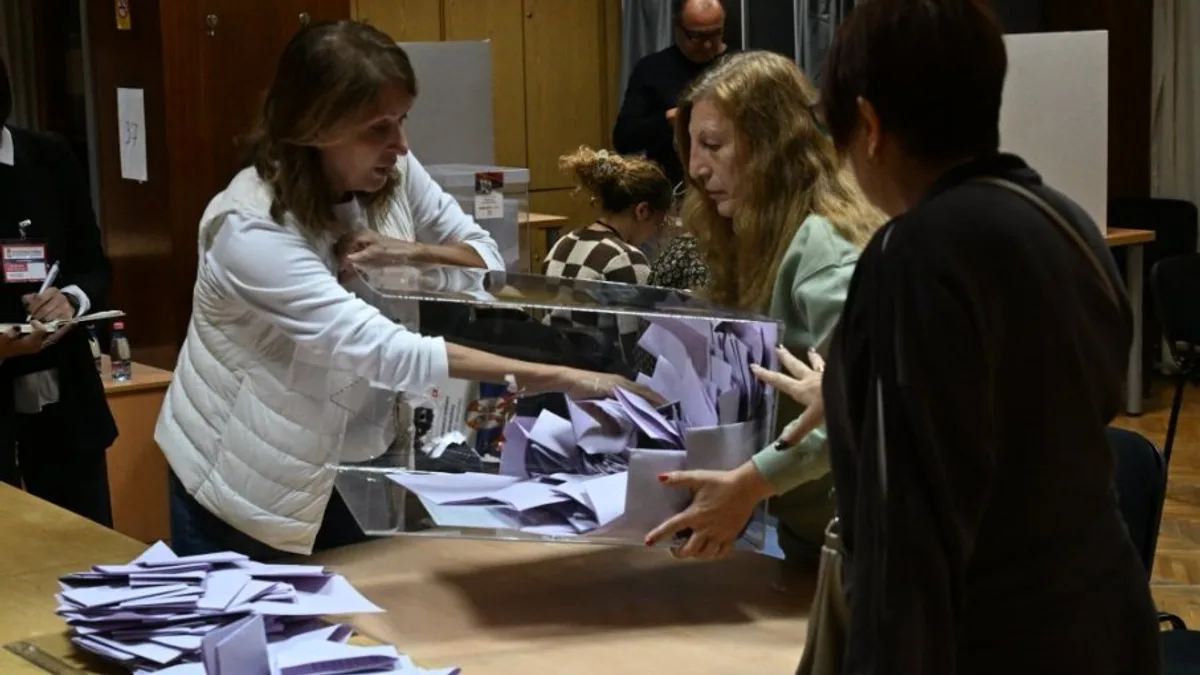
According to Sweden’s Election Authority, 6,195 of a total 6,312 voting districts have been counted, or about 94 percent of ballots, and the gap between the two blocs stands at roughly 20,000 votes. Per the latest preliminary count, the Social Democrats won 28.1 percent of the vote, Kristersson’s Moderate Party 19.9 percent, and the Sweden Democrats 17.6 percent, only third place behind the Moderates. Earlier in the count that evening, the figures looked somewhat different: 27.8 percent for the Social Democrats, 19.8 for the Moderates and 17.7 for the Sweden Democrats, while the margin between the two blocs briefly narrowed to a single seat, 175 to 174, before widening to three.
Why is the prime minister still refusing to concede?
Kristersson did not concede defeat in his address to supporters on election night, and Andersson, for her part, did not declare victory. The prime minister said that regardless of how the night’s results ultimately hold up, he would explore the possibility of forming a government capable of securing support for his economic policy. According to Ireland’s public broadcaster RTE, Kristersson said:
Even if tonight’s results hold, I will explore whether it’s possible to find a viable government constellation… capable of securing support for the fiscal policy Swedish voters have voted for.
Part of the caution stems from the makeup of the opposition itself. Even if Andersson’s lead holds until the end, she faces the difficult task of assembling a coalition of four parties deeply divided over immigration policy, taxes on the wealthiest, and the construction of new nuclear reactors. The Left Party, heir to Sweden’s former communists, and the market-oriented Centre Party struggle to find common ground on economic issues, and with only one to three seats of room for disagreement, there is almost no margin left. The mood at Social Democrat headquarters in central Stockholm was cautious that night as well. Adonay Endrias Kidane, a physician and party supporter, told RTE it was an extremely close race, but that in his assessment the Social Democrats had still run a good campaign.
The Sweden Democrats’ historic decline
For the Social Democrats, this is one of the weakest results in more than a century, given that they won 30.3 percent in the 2022 election. Still, the steepest drop belongs to the Sweden Democrats, who took 20.5 percent in 2022, then overtook the Moderate Party to become the country’s second strongest party. For the first time since Jimmie Åkesson took over the party more than two decades ago, it is now losing both seats and vote share, even though pre-election polls had predicted the opposite, a historic breakthrough for the far right. The party, founded in the late 1980s with input from neo-Nazis among its early members, now says it purged extremists from its ranks long ago. Its program for a potential place in government includes a ban on face coverings in public places and the shutdown of programs aimed at integrating newcomers.
What a far-right role in government would mean for Europe
A win for the right-wing bloc would be welcome news for far-right parties across the continent, already emboldened by Alternative for Germany’s win in state elections a week earlier. France’s National Front, whose biggest prize is next year’s presidential race, is also watching the Swedish scenario closely, since a Sweden Democrats entry into government would be the first time a similar party in Europe has won cabinet seats after years of backing a government only from the opposition benches. Since taking office four years ago, Kristersson’s government has scrapped permanent residency for refugees, tightened welfare eligibility rules, and sped up deportations of people without the right to stay, measures its supporters praise as an effective fight against gang crime and illegal migration, while critics describe them as pressure that erodes civil liberties.
Sweden, a country of about 10.6 million people, has roughly eight million eligible voters, and more than half cast their ballots before election day itself, in line with the country’s traditionally high turnout. Our newsroom reported ahead of the vote that the Sweden Democrats were close to entering government for the first time in the party’s history, a scenario the preliminary results are now calling into question.
A final decision on the winner has yet to be made. Postal votes that arrive late and ballots cast by Swedes abroad will not be counted until Wednesday, and the Election Authority says an official result is not expected before Thursday at the earliest. The caution is reinforced by the exit poll from state broadcaster SVT, based on 13,709 voters, which gave the opposition as much as 51.3 percent against 46.8 percent for the right-wing bloc, a far wider gap than the actual count shows. Something similar happened in 2022, when the exit poll predicted a win for Andersson, only for the final count to reverse the result. Andersson conceded defeat three days after the vote.