

Zaporizhzhia: 11 dead after bombs hit apartment block
The regional administration reports 11 dead, three of them children, while prosecutors say at least 15. A missile attack on Kyiv around 2 p.m. knocked out power, water and the metro.
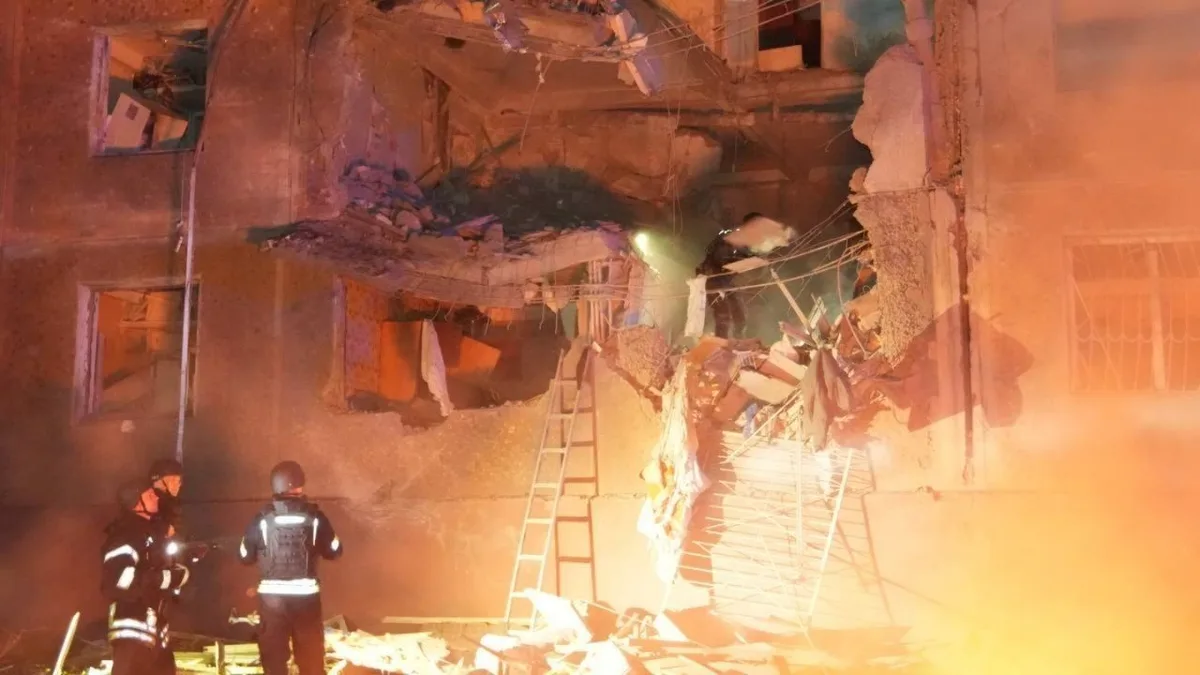
Guided aerial bombs hit a five-story apartment building in Zaporizhzhia on Saturday, October 10, and the death toll climbed through the day: from four victims at first to 11 according to the regional administration, and at least 15 according to Ukrainian prosecutors. Around 2 p.m. a daytime missile attack followed on Kyiv, after which power, water and the metro failed in the capital. The day before, officials from the United States, Ukraine and European allies met in Miami to discuss ways to end the war, and no agreement has been announced.
How many people died in Zaporizhzhia?
Ukraine’s air force warned at about 5 a.m. that Russian tactical aircraft had launched guided aerial bombs toward Zaporizhzhia. A five-story building was hit: one entrance was partly destroyed, and parts of the structure collapsed down to the second floor.
The figures differ by source and by the hour they were released, so it helps to line them up in the order they arrived:
- Mykhailo Semikin, acting head of the Zaporizhzhia regional military administration, said at about 7:05 a.m. that 4 people were dead and 4 injured.
- Ivan Fedorov, co-chair of the Zaporizhzhia region’s Defense Council, then spoke of 8 dead and 16 injured, including three children, two of them seriously hurt. At that point the fate of another 12 people was unknown.
- The regional military administration later reported 11 civilians dead, among them three children. It did not say how many people were still listed as missing.
- According to Ukrainian prosecutors, as reported by Al Jazeera, at least 15 people died.
Rescuers pulled two residents, a woman and a man, from the rubble, and the search for those buried continues. In his first update, Semikin said someone else could still be trapped:
“Another person may still be under the rubble.”
October 11 has been declared a day of mourning in Zaporizhzhia. The same city was hit the day before: on October 9, guided bombs struck residential areas, killing at least one man and injuring seven people, including a child. Zaporizhzhia is a regional center near the front line that remains under Ukrainian control, while Russia has held parts of the region since February 2022.
Ukrainian President Volodymyr Zelensky linked the attack to sanctions on Russian diesel in a post on social media:
“Today Russia expressed its gratitude for the lifting of sanctions on diesel exports by dropping five guided bombs on residential buildings in Zaporizhzhia.”
Zelensky added that rescuers are still searching for people under the rubble. Kyiv Independent carried a post the same day by U.S. President Donald Trump on Truth Social, written after a conversation with Vladimir Putin: “Russia will immediately deliver over 300,000 tons of diesel fuel to the American and world market, another 500,000 tons during November, and right after that 1,000,000 tons.” None of the sources consulted says exactly when that post was made.
What happened in Kyiv around 2 p.m.?
Around 2 p.m., several explosions were heard in Kyiv while a missile-threat alert was in force. Mayor Vitali Klitschko said on Telegram that a restaurant building in the Obolon district was hit, and that missile debris fell into the courtyard of an apartment building at another address in the same district. According to him, drone debris also fell on a 25-story apartment building and an eight-story office building in the Solomianskyi district. Emergency services are at the scene, and there was no information on casualties in Kyiv at the time of publication.
Power problems began about an hour earlier. Kyiv Independent journalists reported an outage in the Pechersk and Borshchahivka districts at about 12:50 p.m., and according to the utility DTEK, the Bucha district of Kyiv Oblast also lost power. Klitschko described the situation this way:
“Because of damage to an energy facility in Kyiv Oblast, the electricity supply in the capital has worsened. There are also disruptions to the water supply in the city.”
A sudden voltage drop stopped the Kyiv metro, escalators included. The city administration said service resumed at about 2:30 p.m., with longer intervals between trains. Russia has stepped up strikes on Ukraine’s power grid since October 1, and after the attack on October 8 Kyiv was almost entirely dark, with millions of people without water.
What came before the attacks?
Officials from the United States, Ukraine and Europe held talks in Miami on Friday, October 9. U.S. envoy Steve Witkoff said on X that participants included “the E3, the European Commission, Ukraine and NATO,” and that the talks covered:
“potential paths to de-escalate and end the war with Russia before winter and advance efforts toward a sustainable and lasting peace.”
The topics were energy resilience, grain exports, security guarantees, Ukraine’s reconstruction and its accession to the European Union. U.S. Secretary of State Marco Rubio had warned a day earlier, on Thursday, that the conflict is in a dangerous stalemate:
“The other way that stalemates end is escalation.”
Rubio told reporters that the conflict could spill over to neighboring NATO members. Al Jazeera’s Kyiv correspondent Audrey McAlpine described what the daytime attacks look like: “There are more and more attacks during the day across Ukraine, and in Kyiv lately more and more jet-powered drones are hitting targets in the middle of the day.”
The portal has already reported on an earlier guided-bomb strike on buses in Kramatorsk, which killed 33 people. Zaporizhzhia and Kyiv are a separate event, and both attacks came a day after the talks in Miami.


