North Korea fires missiles, one flies 910 km
South Korea's military detected the launch around 9:20 a.m. near Pyongyang. Japan counted at least two missiles, and all landed outside its economic zone.
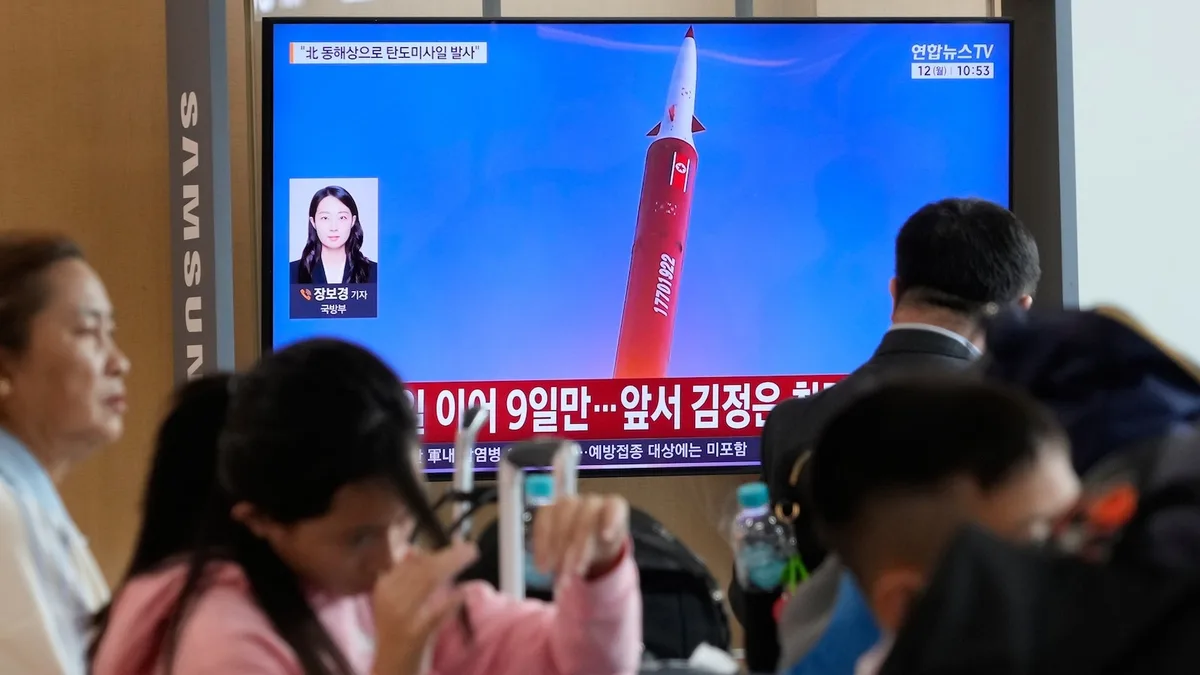
North Korea fired several ballistic missiles from the Pyongyang area toward the Sea of Japan on Monday, October 12, and one of them flew more than 910 kilometers. The event is far from Serbia, but it touches one of the most sensitive security questions in Asia: Japan, South Korea and the United States are jointly analyzing the flight, and tests on the peninsula have not let up this year.
What exactly happened on Monday?
South Korea’s Joint Chiefs of Staff said its military detected the launch around 9:20 a.m. local time, which is 0:20 GMT.
“Our military detected multiple ballistic missiles launched from the Pyongyang area around 9:20 a.m.”
The same statement said the military had stepped up surveillance and readiness:
“Our military has strengthened surveillance and readiness in preparation for possible additional launches.”
According to the South Korean side, some of the missiles flew more than 900 kilometers. The National Security Office in Seoul called an emergency meeting after the launch.
Japan’s Defense Ministry gave more precise figures. The first missile was launched around 9:19 a.m., climbed to roughly 20 kilometers and flew about 220 kilometers. The second was launched around 9:36 a.m., climbed to about 70 kilometers and flew more than 910 kilometers. The missiles landed outside Japan’s exclusive economic zone, and there are no reports of damage so far.
The two sides count differently: Seoul speaks of “multiple” missiles, while Tokyo confirms at least two.
Why is the second missile getting extra scrutiny?
Japan’s Deputy Defense Minister Takashi Kojari told a news conference in Tokyo that the missiles may have flown an irregular trajectory. The Japanese ministry said so officially as well:
“As for the second missile, Japan, the United States and South Korea are currently conducting a detailed joint analysis, including the possibility that it flew on an irregular trajectory.”
Kojari also gave figures for the year as a whole: since the start of 2026, North Korea has carried out at least 11 test launches involving about 18 ballistic missiles and other projectiles. In his words, that is more than double the number of launches and about three times as many projectiles as last year.
Japan has lodged a protest with Pyongyang. “We lodged a strong protest and firm condemnation with North Korea over this launch through our embassy channel in Beijing,” Kojari said, adding that North Korea’s actions “threaten the peace and security of our country, the region and the international community.”
How does this fit with earlier tests?
This is the first launch reported since October 3, when North Korea fired an intermediate-range ballistic missile. Kim Yo Jong, the sister of North Korean leader Kim Jong Un, claimed at the time that the missile used an unspecified artificial intelligence technology and could change its trajectory at low altitude.
Seoul announced a few days later that it had successfully tested a domestic hypersonic glider, a weapon that is lifted into the upper atmosphere by a rocket and then glides toward its target. The presidential Blue House said it gives a “new deterrence capability” able to hit key targets on the Korean Peninsula.
Relations between the two Koreas are strained by another dispute as well. Last week a joint investigation by Seoul and the United Nations concluded that North Korea planted mines that injured three South Korean soldiers in the demilitarized zone, which Pyongyang denies. Kim Yo Jong called South Korean demands for an apology “despicable” and rejected Seoul’s offer of medical equipment.
Seoul and Pyongyang are technically still at war, since the Korean War ended in 1953 with an armistice rather than a peace treaty.