France Cost-of-Living Protests: 270+ Detained, Lyon Fire
Yellow vests, students and workers took to the streets over rising prices, and by afternoon more than 270 people had been detained nationwide.
Serbia ties its European future to decisions made in the Union’s main capitals, so unrest in one of them is not somebody else’s domestic affair. On Saturday, October 17, 2026, six months before the presidential election, France held a national day of protest against the rising cost of living. By the afternoon more than 270 people had been detained across the country, a tourist office was burning in Lyon, and demonstrators had broken into city hall in Marseille.
In brief
- The protest began on social media and drew yellow vests, high school students, university students, employees and climate activists.
- By midday, according to the interior minister’s office, there had been 140 actions with 32,800 people outside Paris and 166 detentions nationwide.
- Paris, Lyon and Marseille saw the worst of it, and a fire also hit a university building in Rouen.
- An inter-union strike has been called for November 5.
Who took to the streets, and why
The call to protest spread on social media and through the website 17octobregiletjaune.net, which addresses residents of neighborhoods, farmers, workers and pensioners. They were urged to come out on streets and roundabouts and to gather around gas stations, toll booths and major roads. The call to revive the yellow vest movement, which marked Emmanuel Macron’s first term in 2018 and 2019, met a separate protest by high school and university students demanding better conditions for learning.
Education Minister Edouard Geffray and the student organizations have made no visible progress in the past 48 hours, after three rounds of talks since the movement began. Their demands about dilapidated school buildings, the Parcoursup system and class schedules remain the same. Saturday is also the first day of the school break.
Frank, a civil servant from Gueret, summed up the discontent that reaches beyond the big cities. He came out with about 400 people and told the news agency AFP:
“By the end of the month I have nothing left, prices go up and wages don’t. We can’t go on, we’re suffocating.”
What happened in Paris?
The day began around 7 a.m., when about a hundred masked people attacked the building that houses the television channel CNews and the radio station Europe 1, in the west of the city. They blocked the parking garage entrance, threw objects and smashed several windows. According to the police prefecture, 21 people were detained. By 10 a.m. there were 40 detentions in Paris, and some shops on the Champs-Elysees had started to barricade themselves.
Figures on detentions by midday differ between sources. The police prefecture, as cited by BFMTV, reported more than a hundred people detained, checked for carrying protective gear such as hard-shell gloves or hoods and for prohibited weapons. Sud Radio elsewhere records 100 detentions and 589 checks, and a third source reports at least 61 detained and nearly 600 checks.
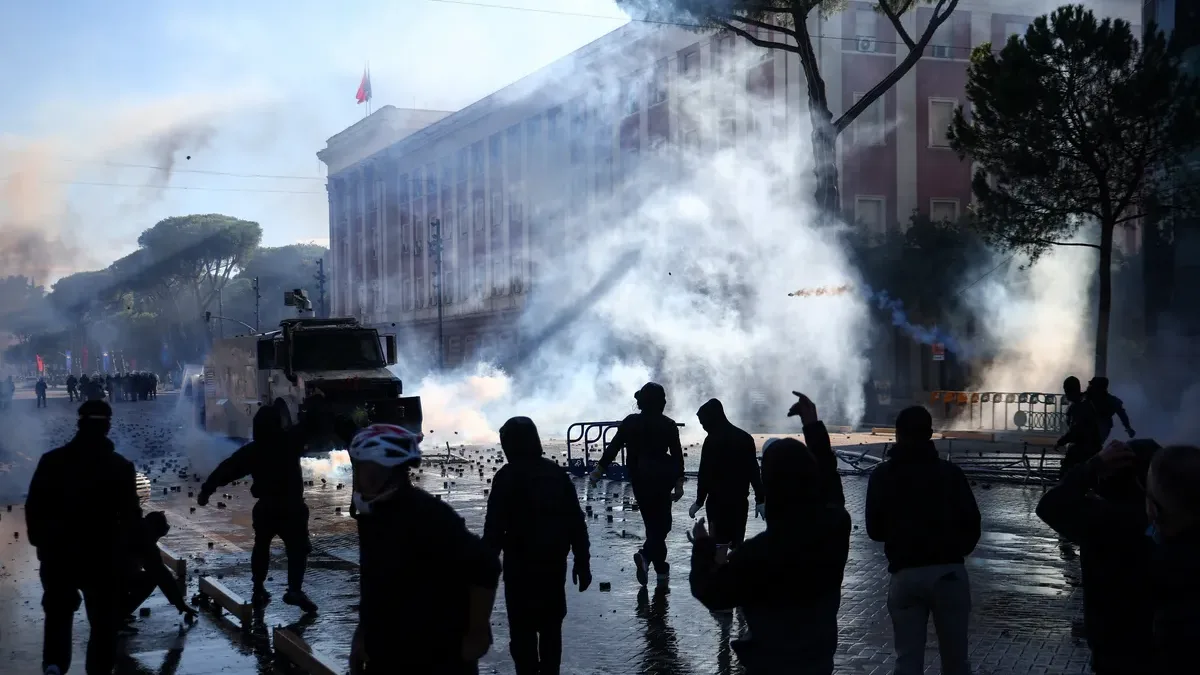
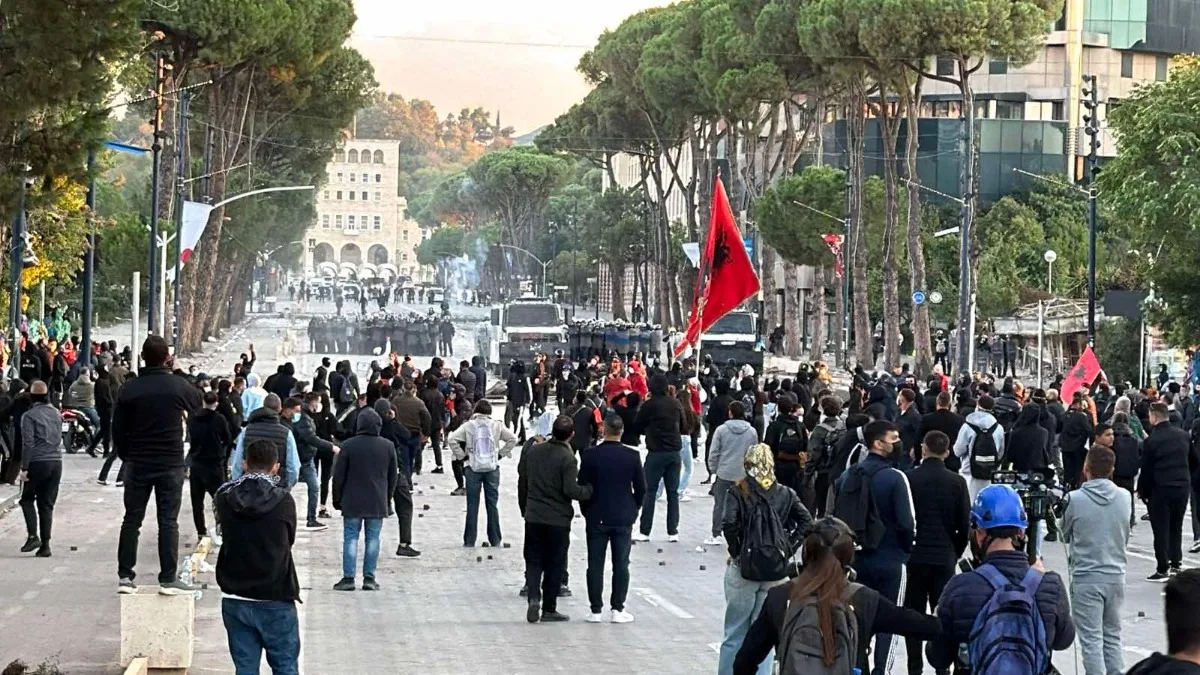
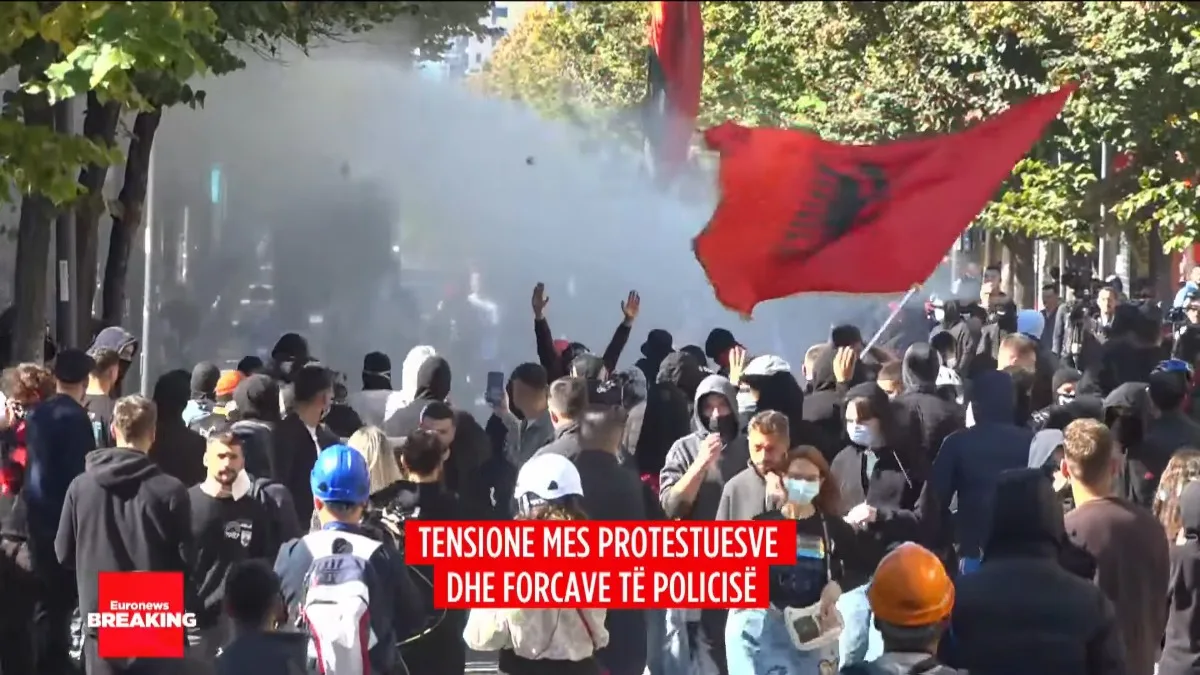
At Place de la Republique, where the official march was due to set off at 2 p.m., police clashed with several hundred masked people, mostly dressed in black. Police fired tear gas repeatedly, and some demonstrators launched fireworks from mortars. A car was set on fire, and in the Reaumur-Sebastopol area CRS riot police chased a group that had set a wooden barricade alight. One column was stopped 150 meters from the Elysee Palace. The official, peaceful march did set off, heading for Place de Clichy.
Fire in Lyon and a break-in at Marseille city hall
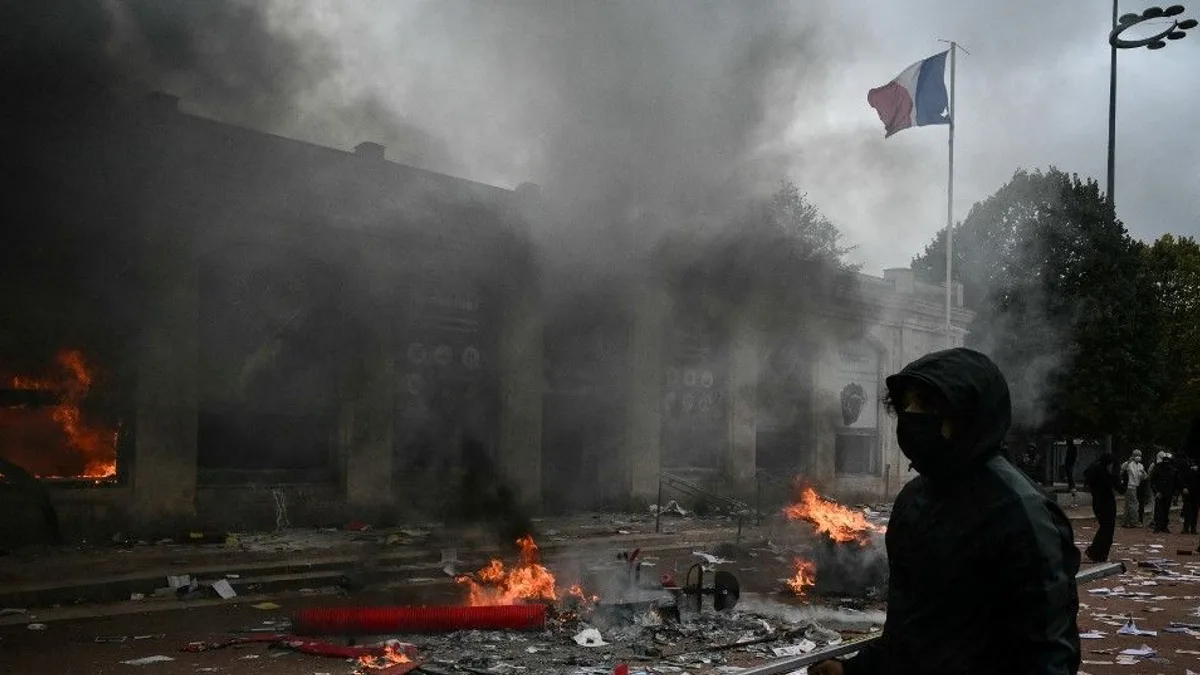
In the afternoon in Lyon, a tourist office near Place Bellecour was on fire as demonstrators attacked its window. According to Sud Radio, firefighters had not yet arrived. One police officer was evacuated near Place Bellecour, and firefighters carried another person away on a stretcher. Their condition was not known.
In Marseille, according to an AFP reporter, demonstrators broke down the doors and briefly entered the lobby of city hall. On the Cannebiere, shops and a municipal police station were damaged, the interior minister’s office said, and trash containers were also on fire. Early in the morning in Rouen, a fire, probably arson, hit the Faculty of Philology building, according to a source close to the investigation. Unrest was also reported in Rennes and Nantes.
Blockades were few: roundabouts were taken in Rennes, Langon and Marmande, and in Toulouse police prevented a blockade of trains and of one roundabout. In Gaillac, in the Tarn department, demonstrators closed the entrance to a shopping zone.
What the government and the opposition say
The office of Interior Minister Laurent Nunez, which was not named, warned at noon that “the likelihood that the far left will cause disorder in the afternoon marches is very high”. The same source spoke of “violent and targeted operations” and said the movement is marked by strong mobilization of the far left “which only wants to create disorder”.
On Friday Nunez announced that stun grenades could be used in case of “extremely serious urban violence”. Their use had been suspended during the student movement, particularly after a 15-year-old demonstrator in Lens lost a hand. Sebastien Malzieu, deputy chief of staff of the CRS central directorate, told franceinfo that “the goal is not for anyone to get hurt”, but for police to be ready to step in when needed.
On Friday Macron called for “calm” from Brussels. Before the protests the government tried to ease the discontent: it approved 500 to 700 million euros for a plan to support agriculture in 2027 and extended aid for fuel purchases. Farm organizations, among them the Confederation Paysanne and the Coordination Rurale, do not consider that enough and have called for protests.
At Place de la Republique, Green Party leader and presidential candidate Marine Tondelier also spoke:
“I am fed up with the public order doctrine in this country. It needs to be rethought, and quickly. And above all, it endangers everyone, demonstrators and police officers alike.”
She urged the government to rethink the doctrine as tensions spread to the edges of several marches across France. Many left-wing lawmakers are also expected at the marches, as is Communist leader Fabien Roussel.
What comes next
The inter-union call is for November 5, when public and private sector employees are asked to strike and take to the streets, mainly over wages and public services. The student movement continues through negotiations with the education minister. The total number of Saturday’s detentions is not final, because the figures were published during the day.