Pale marks 35 years of Republika Srpska National Assembly
Wreaths at the Sabornost monument and a gala academy in Pale: Gasic spoke for Serbia on Dayton, while Dodik and Minic addressed the court verdict and the Assembly's role before the war.
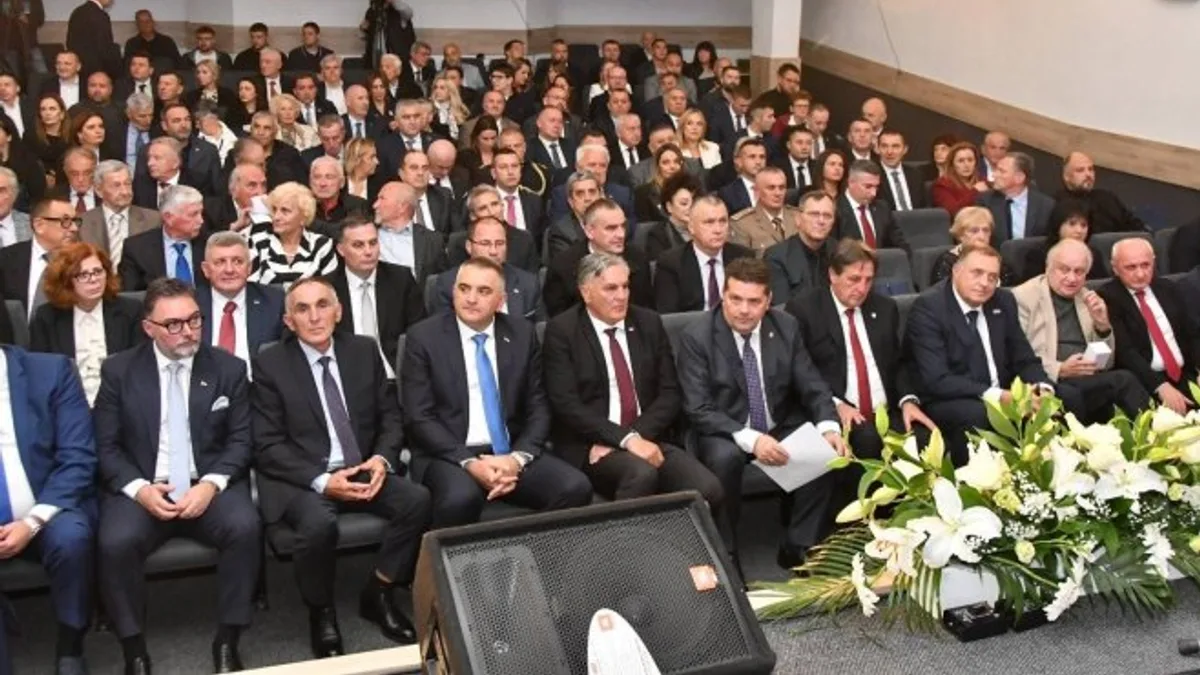
The National Assembly of Republika Srpska marked 35 years of existence on October 24, 2026, in Pale, on the exact anniversary of its founding in Sarajevo in 1991 as the Assembly of the Serb People in Bosnia and Herzegovina. For Serbia, the presence of Defense Minister Bratislav Gasic at the gala academy carried political weight: as a signatory of the Dayton Agreement, Belgrade used the occasion to state once more how it reads that document. Gasic said:
The Republic of Serbia stands firmly on the positions of preserving the letter and spirit of the Dayton Agreement.
Also speaking at the event were Republika Srpska President Sinisa Karan, National Assembly Speaker Nenad Stevandic, Alliance of Independent Social Democrats (SNSD) leader Milorad Dodik and Prime Minister Savo Minic. Besides remembering the founding, the anniversary became a showcase of the political messages Banja Luka is sending today.
How did the program in Pale unfold?
The commemoration began with the laying of wreaths at the “Sabornost” monument on the Square of Creators of Republika Srpska. Karan, Stevandic, Dodik and Minic laid a wreath, followed by other delegations. The gala academy started at 4 p.m. at the Pale Cultural Center.
Karan wrote on X that it was an honor to attend, and offered his assessment of what happened in 1991:
It was a great honor for me to attend today’s marking of 35 years of the existence and work of the National Assembly of Republika Srpska
In his words, the Serb people chose a path of freedom, political self-determination and institutional organization in 1991. Bojan Vipotnik, the Republika Srpska minister of spatial planning, construction and ecology, said after the academy: “Thirty-five years of the National Assembly of Republika Srpska are a guarantee of our sovereignty, but also of peace in this region.”
What has the National Assembly produced in 35 years?
The Assembly of the Serb People in Bosnia and Herzegovina was founded in Sarajevo on October 24, 1991, by Serb deputies elected in the first multiparty elections in 1990. On February 28, 1992, it adopted the Constitution of Republika Srpska, and it later authorized Serbia to negotiate and sign the Dayton Agreement on behalf of Republika Srpska, which explains why Gasic’s speech in Pale mattered in Belgrade too.
Stevandic laid out the scale of the Assembly’s work across eleven convocations:
- 505 sessions held
- 2,357 laws adopted
- 3,471 decisions made
- 1,795 conclusions
- 13 resolutions and 31 declarations
- two positions and seven protests
Stevandic assessed those figures this way: “With that, the National Assembly stands shoulder to shoulder with many older parliaments in the world.” He added that what the first convocation set in place 35 years ago has been preserved and strengthened, and concluded: “We put the interests of the Serb people first.”
What did Dodik and Minic say?
Dodik, who was a deputy in the first convocation, spoke about why the Assembly was founded and argued that it was not the cause of the war. At a press conference in Pale he said: “The National Assembly was created as the political reflection of the people of Republika Srpska, to defend itself, not to attack.” He recalled that the Assembly was formed several months before the armed conflict began, and Republika Srpska two to three months before it, which in his interpretation shows that neither was the real reason for the war.
At the academy he went a step further in judging the 1991 decision, with an admission about who made it:
I must admit that the decision was made by the SDS of that time, which decided to continue the political struggle in that way. Now, from this distance, I will say that it was a capital historic decision, an important one, and that it was made at the right time. Had there been no such decision, there would be no Republika Srpska either.
Dodik also mentioned Serbian President Aleksandar Vucic and his appearance at the UN General Assembly over the Srebrenica resolution: “This people must not forget his conduct. He could have stayed sitting in Belgrade, but at the UN General Assembly he fought to dispute what is not true, but what others wanted to impose.”
Prime Minister Minic spoke about the people who led Republika Srpska’s institutions over three and a half decades, and placed the verdict against Dodik by the Court of Bosnia and Herzegovina in that line:
All of them were persecuted the whole time. The fact that we recently had a ruling by the Court of Bosnia and Herzegovina, which convicted Milorad Dodik as president of Republika Srpska in violation of all the laws that apply in Bosnia and Herzegovina, because he signed a decree promulgating a law passed by the National Assembly, says enough about that.
Minic also wished that future sessions of the National Assembly be dignified and that all deputies be the voice of the Serb people of the whole of Republika Srpska.
What message did Belgrade send from Pale?
Beyond the sentence on Dayton, Gasic gave Republika Srpska a pledge of long-term cooperation:
Be assured that in the years to come we will continue to build the closest and strongest ties with you, because the wellbeing of our compatriots in Republika Srpska is just as important to us as the wellbeing of Serbs in the Republic of Serbia.
Stevan Medic, president of the “Creators of Republika Srpska” association, spoke about who created the state and who defended it: “The Army did not create Republika Srpska. Neither did the police. Rather, the Army and the police defended the Republika Srpska that had been created.”