Bosnia Court Voids Republika Srpska Ban on Army Symbols
The court found Article 359b of the Republika Srpska Criminal Code incompatible with the Bosnian Constitution and annulled Zeljka Cvijanovic's vital interest statement. Dodik: let them try.
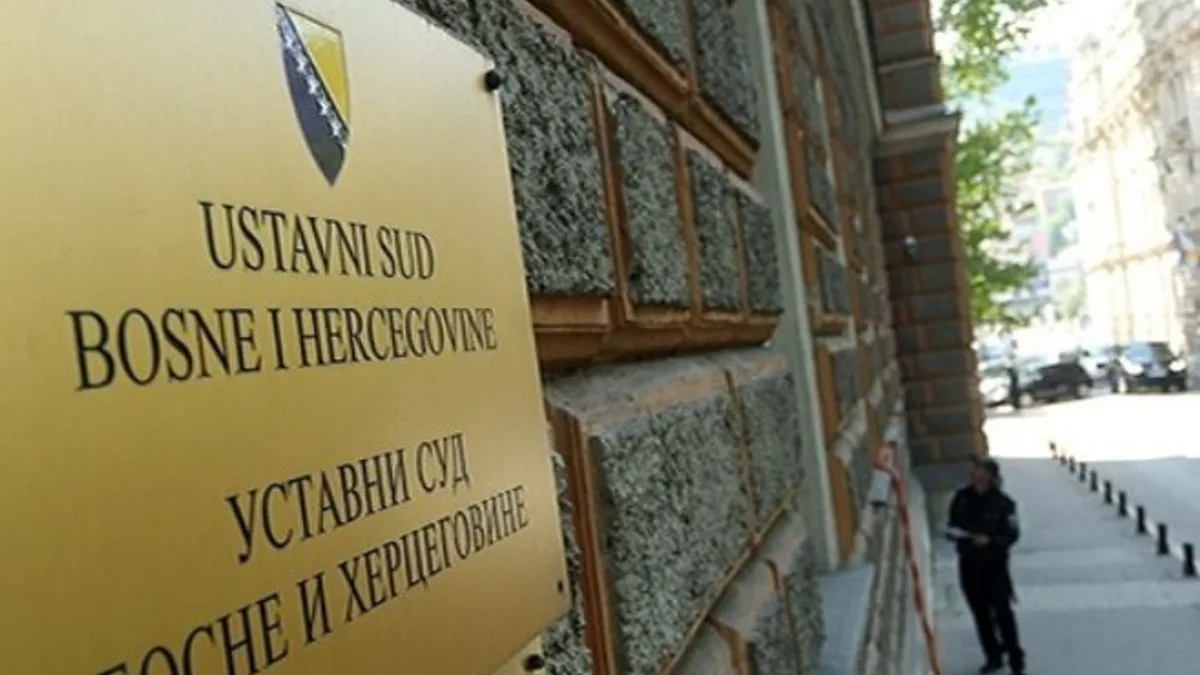
The Constitutional Court of Bosnia and Herzegovina has ruled that the provision of the Republika Srpska Criminal Code punishing the display of Army of the Republic of Bosnia and Herzegovina (RBiH) symbols is incompatible with the Bosnian Constitution. The decision concerns the entity along the Drina, right next door to Serbia, and reactions from Republika Srpska came the same afternoon, November 20.
What did the Constitutional Court rule on Army of RBiH symbols?
At a plenary session held on November 19 and 20, the court concluded that Article 359b of the Republika Srpska Criminal Code is not in line with Articles I/2 and III/3.b) of the Bosnian Constitution. The article punished the public display, showing, wearing, production, reproduction or distribution of flags, symbols, insignia, greetings and slogans that promote or glorify the Army of the RBiH.
The requests for review were filed by eleven members of the House of Representatives of the Bosnian Parliamentary Assembly, along with Presidency member Denis Becirovic and Denis Zvizdic. The SDA had earlier filed an appeal over the same ban. The Constitutional Court of Republika Srpska had previously found that the law did not violate the vital national interest of the Bosniak people.
In its reasoning, the court states that the regulations of the Republic of Bosnia and Herzegovina on the appearance and use of Army of the RBiH symbols remain in force under the constitutional principle of continuity. The National Assembly of Republika Srpska, the court said, has no authority to decide that legal acts of the institutions of the Republic of Bosnia and Herzegovina cease to apply. The Army of the RBiH, with its military heritage, forms part of the Armed Forces of Bosnia and Herzegovina, and the corresponding infantry regiments are obliged to display their insignia. The full texts of the decisions will be published later.
How did Zeljka Cvijanovic’s veto fall?
At the same session the court annulled in its entirety the statement by the Serb member of the Bosnian Presidency, Zeljka Cvijanovic, on a violation of the vital interest of Republika Srpska, together with the National Assembly decision confirming it. It found that both are incompatible with Article V/2.d) of the Bosnian Constitution.
The timeline of the dispute is short. On June 29, 2026, the Presidency adopted a decision without consensus appointing the members of the Commission to Preserve National Monuments. Cvijanovic triggered the vital interest protection mechanism on July 1, and the National Assembly of Republika Srpska confirmed her statement on July 7. After the court’s ruling, the Presidency’s June 29 decision stays in force.
In its report, RTRS recalls that the Constitutional Court has dealt with this subject several times and that, after appeals, it has each time declared itself without jurisdiction over Annex 8 of the Dayton Agreement, which governs the work and appointment of the commission.
The court also examined a request by Zeljko Komsic to review certain provisions of the constitutions of the Federation of Bosnia and Herzegovina and Republika Srpska on the mechanism for protecting vital national interest. It concluded that the contested amendments do not conflict with the Bosnian Constitution or international conventions.
What are Dodik, Cvijanovic and Minic saying?
SNSD leader Milorad Dodik responded at a press conference. “If 100 constitutional courts come, they will not raise a single flag of the Army of the RBiH in Republika Srpska, let them try,” Dodik said, according to RTRS. He added: “This is the constitutional right of the Serb people and Republika Srpska. The will of the Serb people cannot be challenged.” Of the ruling itself he said: “I guarantee you. This is a typical Muslim conspiracy to destroy Republika Srpska.”
Cvijanovic told RTRS that the Constitutional Court of Bosnia and Herzegovina had struck a blow at the constitutional order, and about the Commission to Preserve National Monuments she said: “There will be no such commission, if this continues.”
Savo Minic spoke out on X, and RTRS carried his message:
The National Assembly of Republika Srpska is not an institution whose decisions can be politically ignored. The vital national interest protection mechanism is one of the foundations of the Dayton constitutional order.
In the same post, Minic says Republika Srpska will defend its rights and powers “decisively, institutionally and in line with the Constitution.”