Kospi Falls Over 8%, Seoul Halts Trading After Nasdaq Rout
The tech selloff that began on Wall Street moved to Asia and Europe on Friday: Kospi fell more than 8%, Taiex 9%, and investors fear tighter oversight of data centers.
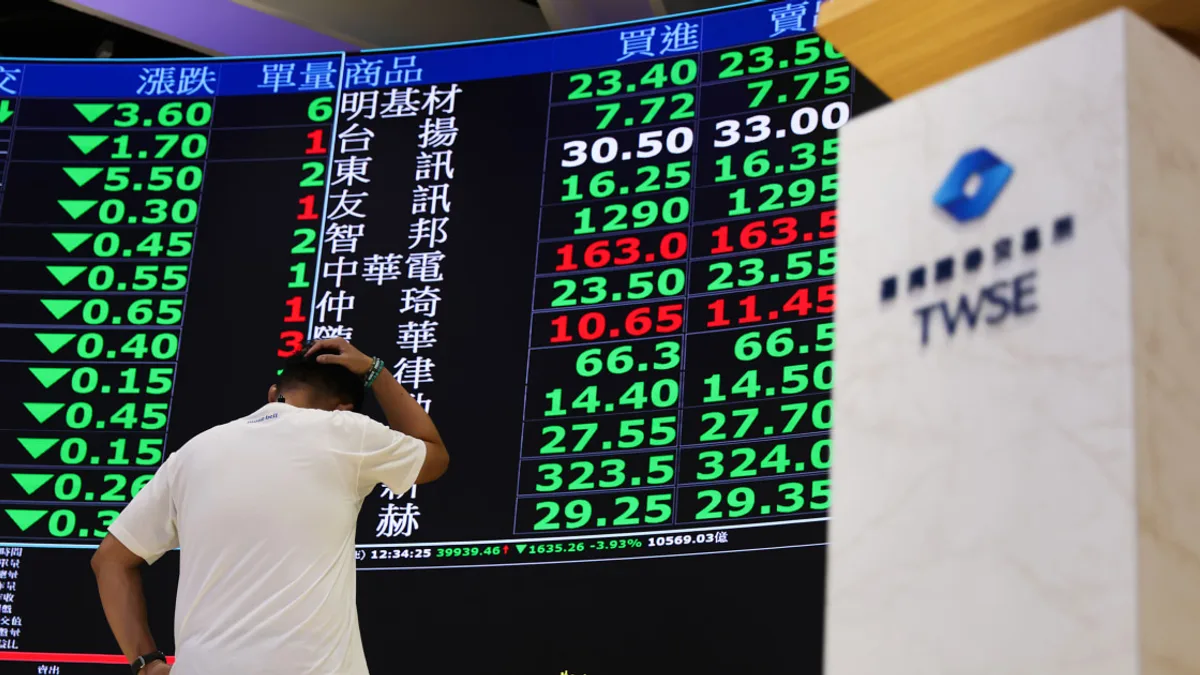
The Nasdaq Composite fell 5.5% on Thursday and closed more than 10% below its recent peak, putting it in correction territory. The selloff in tech stocks moved to Asia and Europe on Friday, November 6, and in Seoul trading was briefly halted across the entire market after the Kospi index dropped more than 8%. Investors link the decline to the outcome of the US midterm elections and fear of stricter oversight of data center construction.
What happened on Wall Street on Thursday?
The Nasdaq 100 lost 6.3%, while the S&P 500 fell 4.4%, wiping out roughly $2.8 trillion in market value. For the S&P 500 it was the worst day in 18 months, since President Donald Trump’s global tariffs rattled markets. The Philadelphia Semiconductor Index dropped 12.2%.
How far did Asian markets fall?
In South Korea the Kospi fell more than 8%, which triggered a temporary trading halt. Shares of Samsung and SK Hynix, makers of memory chips for data centers, lost more than 10% at the open and then recovered part of the drop. According to data from the Friday session, SK Hynix was down 10.44%, Samsung 6.35%, LG Innotek 7.02% and LG Display 4.45%.
Japan’s Nikkei 225 fell as much as six percent at one point, entering bear market territory, and is on track for its worst week since 2020. Moves in individual stocks during the session:
- SoftBank Group: down 10.83%
- Kioxia Holdings: down 8.72%
- Renesas Electronics: down 5.74%
- Advantest: down 4.99%
- Tokyo Electron: down more than 5%
In Taiwan the Taiex index fell nine percent. Shares of TSMC, the world’s largest contract chipmaker, were down 4.69% during the session.
In mainland China the STAR Market index and the ChiNext AI index each fell more than four percent. The STAR 50, which tracks leading semiconductor and artificial intelligence companies, is trading at half its June peak, with about $500 billion in market value erased. Shares of the Chinese model developer Z.ai are down more than 80% from their peak, after a 2,000% surge in June, and lost another 10% on Friday.
Why is the drop being linked to the midterms?
Investors expect a Democratic majority in Congress to tighten oversight of the industry, including AI infrastructure projects, which would mean longer and costlier construction. Among the newly elected officials are candidates opposed to data centers, including Gina Hinojosa, the governor-elect of Texas, the largest data center market in the United States.
That is how market participants read it, not a proven cause of the drop. Charu Chanana, chief investment strategist at Saxo Markets in Singapore, told NBC News how the decline was distributed:
“Markets were punished in proportion to how dependent they are on the US AI infrastructure investment cycle.”
She added that the Chinese part of the story looks different: “There is a legitimate argument that parts of China’s AI equity bubble have already burst.” In her assessment, China treats chip and AI development as a strategic national priority, so investment can continue without immediate profitability. South Korea is more exposed because Samsung and SK Hynix are part of the commercial infrastructure build-out.
Timothy Moe, chief Asia-Pacific equity strategist at Goldman Sachs, said on CNBC’s Squawk Box Asia that position unwinding, stop-loss selling and higher volatility amplified the selloff. He also described how the market behaves in moments like this:
“The market tends to shoot first and ask questions later. I think that is exactly what is happening now.”
How did Europe fare?
London’s FTSE 100 fell nearly two percent on Friday, and France’s CAC 40 and Germany’s DAX posted similar losses. The tech sector was among the least affected in morning trading, down about 0.25%, while shares of the chip equipment makers ASML and ASMI rose 4% and 3%, respectively.
How much of this year’s gains is left?
The Kospi more than doubled in market value in June and by Friday had given back most of its gains for the year. Still, compared with a year ago the Kospi is up 25%, the Nikkei 225 is up 13% and Taiwan’s tech index is up 47%.
Tai Hui, chief Asia-Pacific market strategist at J.P. Morgan, said the correction is no surprise given the ties between companies in Taiwan, South Korea and Japan and the global AI investment cycle. Of semiconductor and memory makers he said: “Demand for core equipment should remain healthy over the medium term.”