Kospi falls 5.46%, SK hynix drops 10.09%
Seoul's benchmark index closed at 6,035.35 points, with Samsung Electronics down 7.39%. Foreign investors were net sellers of 2,200 billion won in shares on Tuesday.
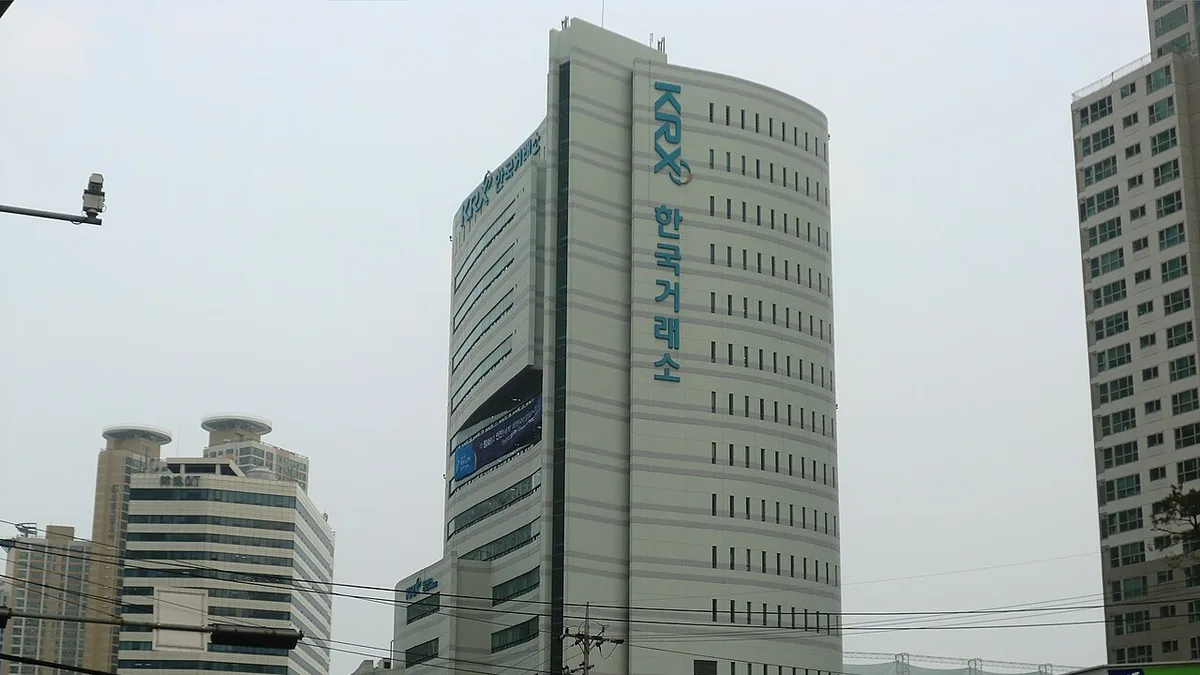
The Kospi, the main index of the Seoul stock exchange, closed on Tuesday, October 13, 2026, at 6,035.35 points, a drop of 5.46%, Korea Herald reported. The index briefly fell below 6,000 points during the day and recovered part of its losses only in the afternoon.
The two largest memory chip makers bore the brunt of the selloff. Shares of Samsung Electronics ended the day down 7.39%, and SK hynix closed 10.09% lower.
What happened during trading?
According to figures B92 takes from the Associated Press, the index lost as much as 7.4% at one point and fell to 5,914.35 points, its lowest level since the end of July. The gap against the official close of 6,035.35 is not a contradiction: the first number is an intraday reading, the second is the end-of-day level after the afternoon recovery. The same applies to the stocks. AP recorded intraday losses of 7.7% for Samsung and 8.8% for SK hynix, while the close brought 7.39% and 10.09%.
At 9:47 a.m. local time, the exchange halted automated sell orders for five minutes. The mechanism, known as a sidecar, is triggered when the KOSPI 200 futures index falls 5.08%. Korea Herald reported that it was the first such measure in almost two months.
The immediate trigger was a report about CXMT, a Chinese memory chip maker. The company is reportedly planning server DDR5 chips with a more compact cell by the end of the year, which would lower its production costs. That progress could threaten Samsung, SK hynix and the US company Micron, the world’s largest memory producers. The night before on Wall Street, Nvidia lost 1.3%, AMD 2.3% and Micron 3.9%, while the Philadelphia Semiconductor Index fell 2.67%.
How much did the market lose in five sessions?
Over the last five trading days the Kospi lost more than 1,000 points, from a level above 7,000. In June it reached a record high above 9,000 points. According to Korea Herald, the decline wiped out more than 800,000 billion won in market capitalization ($595.5 billion), pushing the total market value below 5,000,000 billion won.
The selloff spread across the region:
- Japan’s Nikkei 225: down 2.5%, with Tokyo Electron down 6.6% and SoftBank Group down 8%
- Hong Kong’s Hang Seng: down 1%
- Shanghai Composite: down 1.1%
- Taiwan’s Taiex: down 1.9%
Brent crude fell 1.4% the same morning, to $105.20 a barrel. That is still well above the roughly $72 level of late February, before the war in Iran.
Why are foreign investors selling?
Foreign investors were net sellers of 2,200 billion won in shares on Tuesday. Net selling since the start of October stands at almost 8,000 billion, and since the start of the year at 199,000 billion won, about 177,000 billion of which came in the first six months. Outflows calmed in July and August, then accelerated in September, when they reached 21,500 billion won.
For that reason, the analysts Korea Herald cites see the main risk in capital flows rather than in the chipmakers’ business. Heo Jae-hwan of Eugene Investment & Securities said that selling pressure from foreign investors in Korea, relative to the size of the market, is more than three times stronger than in Taiwan. The Taiwanese market has risen more than 70% since the start of the year, and the Kospi 51%, calculated through Monday’s close. Heo said:
The outflows are too large to be attributed solely to portfolio restructuring after the market’s rally.
Domestic investors, according to the same analyst, would have to absorb the selling, and that will not be easy: retail investors remain cautious after the July drop, while institutions, including the National Pension Service, have limited room to add more shares.
Lee Jae-won of Yuanta Securities assessed that foreign capital flows have become a bigger concern than earnings in the chip sector:
Samsung Electronics’ third-quarter operating profit exceeded market expectations, and memory prices and AI infrastructure investment remain solid. Even so, persistent selling by foreign investors is weighing on the Kospi’s performance relative to other markets.
Korea Herald adds that higher interest rates, more expensive oil and geopolitical uncertainty are increasing the pressure, but that, in the analysts’ view, these factors alone do not explain the steady outflow. The South Korean market is also structurally more vulnerable: it depends heavily on memory makers, while US and Taiwanese exchanges have broader exposure to AI services, infrastructure and advanced chip manufacturing.
Is a rebound possible?
Han Ji-young of Kiwoom Securities said that worries over CXMT and weakness in US chip stocks are amplifying volatility. She singles out the Kospi’s 200-day moving average as the key technical support. She said:
Because the Kospi has fallen almost 9 percent over the last four sessions and the expected price-to-earnings ratio has dropped below five, a short-term technical rebound is possible.