Pancevo Refinery Goes Fifth Day Without JANAF Oil
Crude transport through the Adriatic pipeline has been halted since November 6. JANAF gives no date, NIS says it has stocks, and an expert estimates repairs at five to ten days.
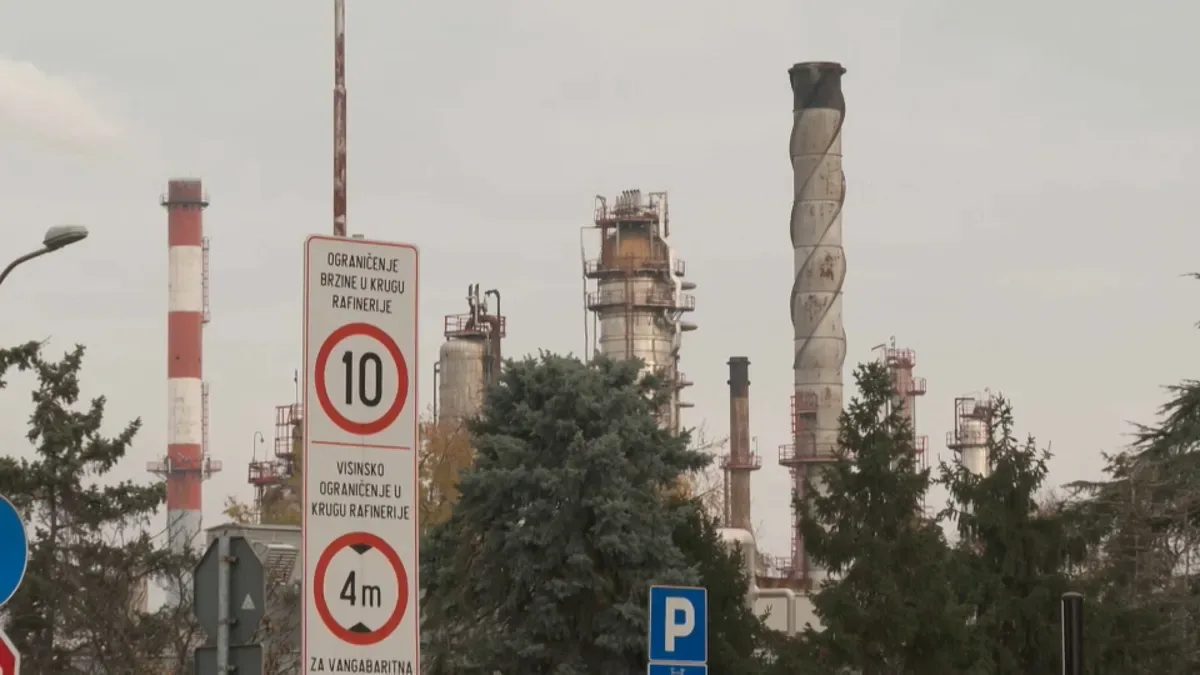
Crude oil has not reached the Pancevo Refinery through the Adriatic pipeline since November 6, and the Croatian operator JANAF had not said by Tuesday, November 10, when transport will resume. The fault is on the section between Sisak and Slavonski Brod, where JANAF estimates about 500,000 liters of oil leaked.
What happened to the pipeline?
JANAF closed the valves immediately, then said all the spilled oil had been collected, trucked by tanker to JANAF terminals and returned to the pipeline system. The company told N1:
“Work is under way to repair the damage to the pipeline and to clean up the contaminated area”
Sources differ on the cause. According to RTS and Danas, part of a machine fell onto the pipes during revitalization work and damaged them. Biznis.rs reports that JANAF said the fault was caused by work carried out by an outside contractor, while N1 says only that the pipeline was damaged during works. The newsroom reported on an earlier closure of the pipeline after a leak, but what is new is that the stoppage has now dragged into a fifth day.
When will the pipeline work again?
JANAF has given no date, and N1 asked how long the repair would take and when transport would restart, without an answer. Ivan Cvitanovic, director of the Security and Protection Sector at JANAF, told RTS:
“I hope we will have this repaired in the next few days”
He added that JANAF has a contract with the Petroleum Industry of Serbia (NIS) and that “they are eagerly awaiting the repair”.
Energy expert Zeljko Markovic gave a more concrete estimate on RTS’s Morning Program:
“Judging by the description of the damage, this is something that should be repaired within five to ten days.”
The deadline is conditional, because hidden damage at the point where the pipe burst could extend the work. Markovic also stresses that repairing the pipeline and cleaning up the soil are two separate jobs, and the soil cleanup can take longer.
Is there enough fuel?
NIS said in a statement that the market is supplied, and said the same in response to N1:
“At this moment NIS has sufficient fuel stocks and the market is properly supplied with all types of petroleum products”
The company adds that “current circumstances do not for now reduce the volume of crude processing” in Pancevo, and that it will keep “monitoring developments closely”. In its report, RTS notes that if the stoppage drags on, NIS will have to draw on its reserves, and Markovic recalls that during the sanctions period and the supply interruption the refinery ran on reserves for almost a month. He sees the limit at that length:
“If they could not fix the fault within a month, then potential problems could arise.”
The dependence on imports is large: according to Markovic, about 80% of the crude processed in Serbia is imported, while domestic production covers about 20%. The Adriatic pipeline is the main route, and with the Danube at a low water level there is little room to bring oil in by river either.
How does this spill over into electricity?
The same expert points to a second problem, in the electricity market. Serbia imported about 26% of the power it consumed in October, and a similar share continued into early November, while EPS production covers about 75% of needs. The causes are drought, lower hydropower output, weaker domestic coal and frequent outages at aging thermal units. Coal imports by barge from Constanta, Markovic says, have largely stopped.
- electricity price on exchanges the previous day: about 350 euros per MWh on average
- price in the evening hours: up to 600 euros per MWh
- estimated daily cost of imports: 8 to 9 million euros
Markovic explained to RTS:
“Yesterday’s prices on our exchange, and on exchanges in Europe too, averaged around 350 euros per megawatt-hour, and in the evening hours they went as high as 600”
In his words, the prices at which EPS contracted power do not cover those needs:
“The prices at which the power utility contracted electricity are not enough to meet those import needs.”
Asked whether Serbia will have enough electricity this winter, he answered: “If we rely on imports and if there is money, we will.”
What comes next?
RTS recalls that both licenses from the American administration, one allowing NIS to operate and one allowing JANAF to deliver oil through the Adriatic pipeline, expire on December 11. By Markovic’s estimate the repair should be finished well before that date, and neither JANAF nor NIS has so far given a date for restarting transport.