Father and son drawing a building: a Slovenian architectural continuity in Belgrade
The SANU Gallery of Science and Technology hosts an exhibition of drawings by Marjan and Marko Music, two Slovenian architects, father and son, whose draftsmanship reveals a method that holds across a full century of practice.

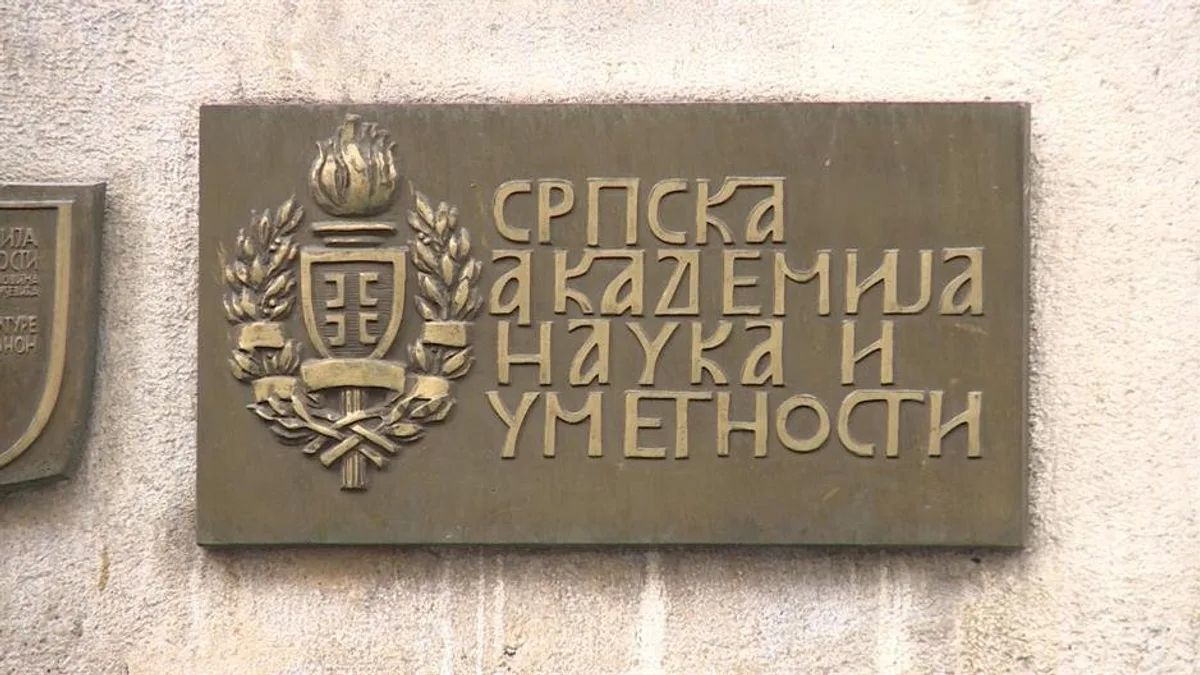
The chronology is reversed. A visitor entering from the south side of the hall at the Serbian Academy of Sciences and Arts Gallery of Science and Technology at Djure Jaksica 2 first encounters the work of the son, Marko Music, an architect active in Slovenia since the 1980s, with the Maribor monument to fallen fighters and the chapel at Breg.
Only at the back of the room, on the wall facing the window, do the works of the father appear, Marjan Music (1904 to 1984), who designed the Slovenian parliament, planned the redevelopment of several historic urban cores, and wrote about architectural heritage in a way no Slovenian architect after him quite has.
The exhibition “Marjan and Marko Music: The Art of the Architectural Drawing” runs until May 30. It is organised by the Slovenian Academy of Sciences and Arts (SAZU) in coproduction with SANU, and is being shown in Belgrade for the first time. The selection was made by SAZU curator Mateja Petrovic and adapted for Belgrade by Jelena Pavlovic, curator at SANU. SANU President Vladimir Kostic opened the exhibition on May 6.
What the hall shows
Seventy-eight original drawings, organised into two blocks of about sixty each.
Marjan Music drew in a technical-architectural mode. Pencil and ink. The precise geometric figurations that, in the 1930s and 1940s, were the working standard of the Slovenian architectural studio. His plans for the redevelopment of Ptuj are arranged not strictly as a display, but almost as a narrative, with intermediate layers showing how the project changed shape across two decades of work.
Marko Music, whose best-known work is the Maribor memorial complex of 1985, draws differently:
- early sketches in fine pencil, almost graphic in quality
- a shift to heavier lines through the 1990s
- the use of Chinese ink and watercolour
What is most interesting is not the difference but the similarity. Both architects use the same paper format, the same arrangement of views, the same approach to working out facades from the entrance. That suggests a method holding across a generation, which in modern architectural culture is rare.
A Slovenian show in a Belgrade gallery
Mounting a Slovenian architectural exhibition in a central Belgrade science gallery is not a courtesy exchange. The Slovenian architectural school maintained, through the 20th century, a continuity Serbia did not, because of wars, interruptions, ideological turns. The Music duo is one of the few examples of two-generation authorial work that can be traced from the 1930s to the present.
That is the kind of architectural tradition a small country like Slovenia can sustain. In Serbia such dynastic practices have been few, and most of those that did exist were broken off.
The exhibition arrives in Belgrade at a moment when the debate over the city’s architectural fate, and over the competence of the practices reshaping its face, is on the table. The fact that SANU opened its doors to an exhibition of Slovenian architecture is an example of institutional cooperation that carries weight beyond ceremony. The Music drawings speak to what an architectural culture actually is, a subject Serbian public life rarely opens up outside academic gatherings.
What this exhibition is not
It is worth saying what the show is not, because visiting foreign exhibitions at SANU have in the past often been mounted with too little curatorial conviction.
“The Art of the Architectural Drawing” is not a retrospective. It is not a monographic presentation of a career. It does not present the final picture of the Music projects built across five decades. It stays with the part of architectural work that usually remains invisible: the drawing as a poetic working stage. The drawing, for an architect, is part of thinking, not part of the finished product, and the exhibition through its selection makes that very clear.
That is at the same time a double critique of how architectural culture is normally presented. Most architectural exhibitions show models, photographs of built objects, plans. The drawing remains at the edge as technical documentation. The Music show makes the opposite choice and demonstrates that drawing is often the most authentic authorial expression an architect produces, because in it there is no compromise with the client, with the building system, or with regulatory constraints.
Why this should be seen before May 30
Practical notes:
- admission is free
- opening hours: Monday to Friday, 10 a.m. to 9 p.m.
- closed weekends
- recommended: Friday after work, when the gallery around 7 p.m. is nearly empty
- bring time: at least an hour for a first pass
A short break with the catalogue is essentially required. The catalogue is published by SAZU in a bilingual Slovenian and English edition. It contains an essay by the architect Boris Hubag, the first systematic analysis of the two-generation Music body of work.
Can an architectural method be passed down across generations?
The question the exhibition poses, even if not always explicitly, is not sentimental. The Musics have demonstrated that father and son can work in the same field with the same tools but with different voices. In contemporary family poetics, that is rare.
This is an exhibition worth visiting even for non-architects, because it shows what a creative tradition can be when it is not broken. The constancy of method is not conservatism. It is a form of discipline that allows each new work to lean its back against something already standing.
What do you think: is two-generation work in the same artistic field a constraint or a freedom for the second generation?