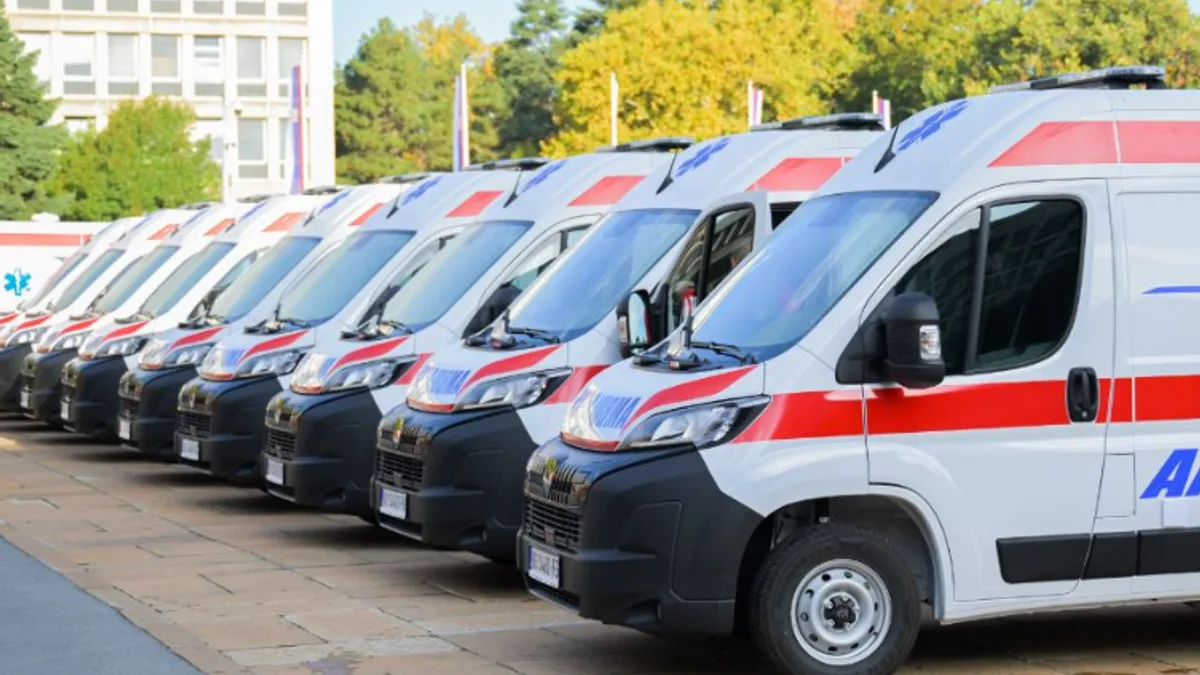
Mobile Pharmacy Now Reaches Villages in Southern Serbia
Since August 24, a truck delivers prescription medicine instead of patients traveling to town. Here are the five districts it covers and who works inside the vehicle.

Do you have to drive kilometers to the nearest pharmacy every time you need a prescription filled? For part of Serbia, that changes this week. The Republic Fund for Health Insurance (RFZO) launched a project called “Mobile Pharmacy” on August 24, a truck that now brings prescription medicine straight to villages.
Which villages are covered?
The project covers five districts in southern Serbia:
- Nisava District
- Jablanica District
- Toplica District
- Pirot District
- Pcinja District
The mobile pharmacy is meant strictly for people living in villages, in rural areas where the trip to the nearest pharmacy is often long and difficult. RFZO’s acting director, Sanja Radojevic Skodric, spoke to the media about the project.
“This project applies exclusively to residents who live in villages, in rural, truly rural areas, so that they don’t have to travel to the nearest pharmacy,” Radojevic Skodric said.
Who works in the mobile pharmacy?
From the outside, it’s an ordinary truck. Inside, according to RFZO’s director, it’s set up exactly like any other pharmacy. Pharmacy technicians staff the vehicle and can offer patients advice along with their medicine.
“It’s like any other pharmacy. From the outside it’s just a truck. Once you step inside, it looks exactly like any other pharmacy,” Radojevic Skodric explained.
Medicine in the mobile pharmacy is dispensed strictly against a doctor’s prescription, the same as in any brick and mortar pharmacy. What RFZO has not disclosed so far is how many vehicles are involved in the project and on what schedule, meaning which days and hours the truck stops in each village. For a patient planning a visit, that’s a missing piece of information, and it remains to be seen whether the Fund will publish it later, broken down by municipality.
Why is RFZO expanding its pharmacy network now?
The mobile pharmacy isn’t the only change in this area this summer. The Fund lowered prices on 769 medicines from List A1 starting August 1, and since August 17, a lower co-payment has applied to 16 blood-thinning medicines and two heart failure medicines.
For blood thinners, which prevent deep vein thrombosis, stroke and pulmonary embolism, the state now covers 70 percent of the price, with the patient paying the rest. The price dropped from a range of 1,600 to 6,000 dinars (about 13.6 to 51.2 euros) down to 600 to 1,100 dinars (about 5.1 to 9.4 euros). For the two heart failure medicines, patients now pay 50 percent of the price.
Pharmacist Sonja Stoiljkovic of the Serbian Pharmaceutical Chamber explains that this isn’t really a straightforward price cut.
“The medicines themselves haven’t gotten cheaper. What happened is that some medicines that weren’t on RFZO’s positive list before have now been added to it, and for some other medicines the co-payment has been reduced. That means patients who used to pay a co-payment of, say, 300 dinars for certain medicines might now pay 100 or 70, but that varies a great deal from medicine to medicine,” Stoiljkovic said.
Converted into money, that’s the difference between a co-payment of about 2.6 euros and one of 0.6 to 0.85 euros, depending on the medicine. One more thing to know: a lower-priced medicine can’t be picked up without a prescription from a chosen physician at a state health institution. A prescription from a private practice doesn’t count, the same rule that applies to medicine dispensed from the mobile pharmacy.
For villages in southern Serbia, the two measures work together, cheaper medicine and a pharmacy that comes to the village itself, instead of elderly or immobile residents traveling kilometers to town. Whether the mobile pharmacy network will expand beyond the south to other parts of the country is something RFZO has not yet announced.