Belgrade respiratory infections: decline slows to 1.2%
Belgrade's public health institute reports 10,286 respiratory infection cases and 511 flu-like illnesses in week 43, with a slower decline than last week.
Is the number of sick people in Belgrade really falling? Yes, but more and more slowly. The City Institute of Public Health has released its report for week 43, October 19 to 25, 2026, and the figures show a second decline in a row, only a much milder one than the last.
How many people are sick, and how much has the decline slowed?
The data comes from health centers and primary care facilities across Belgrade. For the week, the report records:
- 10,286 cases of acute respiratory infections, a rate of 611.3 new cases per 100,000 residents
- 511 cases of influenza-like illness, a rate of 30.4 per 100,000 residents
The week before, October 12 to 18, there were 10,415 cases of respiratory infections and 538 of influenza-like illness. The difference is 1.2 percent for the former and 5.0 percent for the latter.
This continues a story we followed last week, when the number of cases fell to 10,415. The drop was far larger then: 8.9 percent for respiratory infections (from 11,431 cases) and 7.1 percent for influenza-like illness (from 579). This time respiratory infections slipped only 1.2 percent, while influenza-like illness eased somewhat more.
Who gets sick the most?
Among respiratory infections, school-age children and middle-aged adults make up the largest shares:
- Ages 5 to 19: 31.6 percent
- Ages 30 to 64: 30.0 percent
- Up to age 4: 19.8 percent
- Ages 65 and over: 9.8 percent
- Ages 20 to 29: 8.8 percent
By rate, the youngest are in first place. Children up to age four have an incidence of 2,386.4 per 100,000, down from 2,430.9 a week earlier.
For influenza-like illness the picture is different. Adults aged 20 to 64 are the largest group, 278 people, or 54.4 percent. They are followed by ages 5 to 19 (93 people, 18.2 percent), those over 65 (73 people, 14.2 percent) and children up to age four (67 people, 13.1 percent). Even so, the incidence is highest among children up to age four here too, at 78.5 per 100,000, compared with 90.2 a week earlier.
The report does not name any laboratory-confirmed virus, so it does not show whether the numbers reflect flu or some other cause.
What is happening in the rest of Serbia?
For the whole country, the picture is different. According to the Dr Milan Jovanovic Batut Institute of Public Health of Serbia, 7,035 cases of influenza-like illness and 13,579 acute respiratory infections were registered in the week of October 12 to 18. Batut records an increase, noting that flu virus activity remains below the epidemic threshold. Since the start of the surveillance season on September 28, seven cases of flu have been confirmed in the laboratory.
Some caution is needed here: Batut’s data covers all of Serbia and a week earlier than the latest Belgrade report, so the two sets of figures cannot be compared directly.
Dr. Biserka Obradovic explained earlier why many people feel that their illness keeps coming back:
The problem arises because people only come to us once secondary viral or bacterial infections have set in. Flu and similar viruses have two phases. The first is the acute phase, which comes with a very high temperature of up to 40 degrees, muscle pain, headache and pain in the eyeballs.
As she put it, people usually say, “The flu came back on me again,” but “that is not what happened, a secondary infection set in.”
Which vaccines are in use in Belgrade this season?
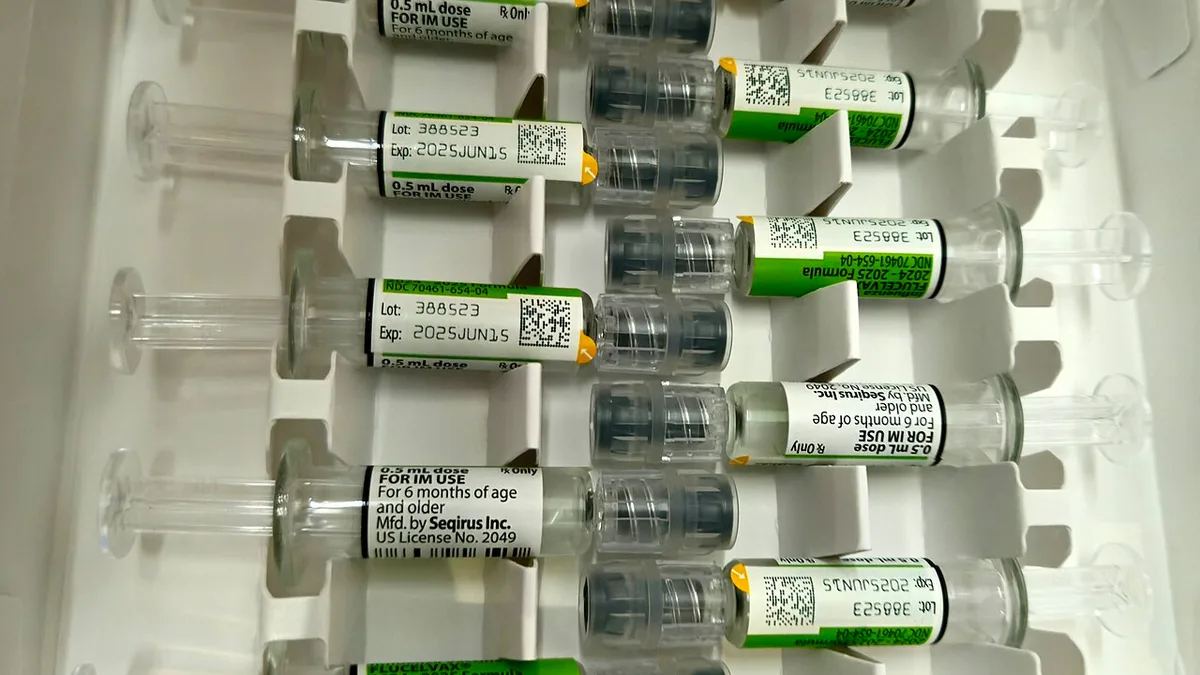
For the 2026/2027 season, two trivalent vaccines are used in Belgrade:
- Tor Vax Flu for adults over 18, a single 0.5 ml dose
- Vaxigrip for pregnant women and children from 6 months to 18 years
Children from 6 months to 9 years who are being vaccinated against flu for the first time receive two doses four weeks apart. Both vaccines contain the strains A/Missouri/11/2025 (H1N1), A/Darwin/1454/2025 (H3N2) and B/Tokyo/EIS13-175/2025.
The institute says protection develops two to three weeks after vaccination and that the vaccine can be given throughout the season, even when the virus is already circulating. Before you go, you can check the details with the City Institute of Public Health, Bulevar despota Stefana 54a, by phone at 2078-600 and 3237-351.