Two cities, one calendar: Beijing and Slavija on the same day
While President Vucic was signing 23 agreements with China in Beijing, the rally at Slavija in Belgrade drew, by the highest estimates, more than 100,000 people. A coincidence? Not quite.

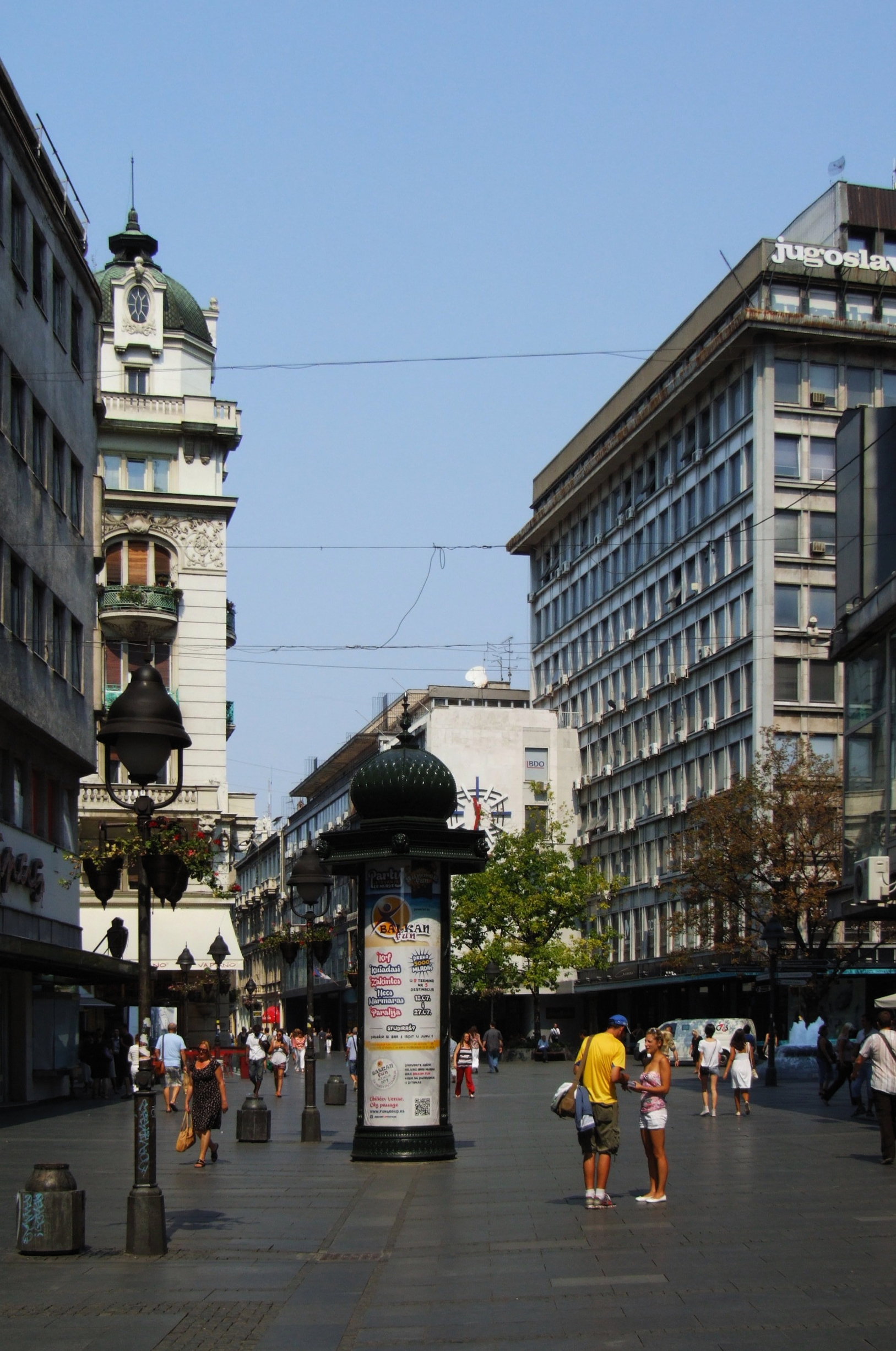
A cousin of mine, a driver in a logistics firm in Zemun, was sending me messages from Slavija on Saturday evening: first a selfie with the column near the Slavija hotel, then a photo from the crowd, then, around 21:30, a single sentence: “Mile, if China interests you, send me that translation; this here is going to be long.” My cousin is otherwise active in his trade union, goes to protests occasionally, rarely reacts emotionally. That last sentence intrigued me more than all the others.
On the same day, 24 May, although Beijing’s time zone runs six hours ahead of Belgrade, President Aleksandar Vucic was speaking from the capital of the People’s Republic of China, announcing the signing of 23 bilateral agreements and two joint declarations in the presence of President Xi Jinping. The paper Pravda Balkan reported that the president had highlighted a rise in Serbian exports to China of 85 per cent in the first four months of 2026 compared with the same period of the previous year. From Belgrade, the paper Danas carried an excerpt from Russia’s Kommersant, which wrote that the city had seen the president off with “mass protests”.
The parallelism of two calendars is too sharp to be a coincidence. Had the Beijing visit been planned for some other Saturday, or had the student rally been called for some other date, the two events would not have rhymed. State visits of that level are planned months in advance, the rally of 23 May was likewise announced months earlier, as the climax of the spring wave before the autumn elections. If the two calendars ended up on the same day, that is the consequence of a decision by one of the sides not to adjust its position. Who made the decision not to adjust, is clear. The question is why.
The answer lies in what political scientists (I am thinking here especially of Florian Bieber’s work and his studies of “stabilitocracy” in the Western Balkans, published in the volume “The Rise of Authoritarianism in the Western Balkans”, Palgrave Macmillan, 2019) call narrative control. In a system in which the legitimacy of power is built on a media display, not on institutional consensus, a president who at the same time signs 23 agreements with China and is absent from a rally of more than 100,000 people is not making a mistake. He is formulating a statement. The statement reads: while some protest, others work. The picture with Xi Jinping is the answer to the picture from Slavija. It is not about who has the larger crowd, but about whose picture is globally large enough to overshadow the domestic one.
Here I must bring in a counter-argument, because this can seem too cynical. There is a reading according to which China is, objectively, the largest single investor in Serbia, the largest trading partner outside the EU, and the president’s visit is a logical diplomatic move that would have happened regardless of the domestic agenda. Investments by Linglong, HBIS, Mei Ta, the “Belt and Road” infrastructure, all of these are real economic flows, not PR staging. There is also the argument that postponing the visit because of a domestic demonstration would have signalled to Beijing that Serbian politics is susceptible to the street, which in the Chinese understanding of the state is unacceptable. All of this is true. But the truth of each of these three claims does not change the fact that the schedule produced a parallelism, and that the parallelism produced a message.
There is one thing that remains behind it all, sociologically particularly interesting. The Serbian clientelistic structure, as described as early as 1994 by Mladen Lazic in the volume “The Disintegration of Society” (Filip Visnjic), operates on the promise that the centre of power will secure the distribution of resources through personal networks. Agreements with China are a typical resource of this kind: there is no public competition, no parliamentary debate, just two presidents signing in the presence of cameras, after which the state and the media take over the distribution of news, contracts and, later, subcontracts. Slavija, on the other hand, demands the opposite: depersonalised state conduct, public publication of documentation, criminal accountability under rules valid for everyone. The difference between these two systems is the difference between politics as a network and politics as a norm.
I return to my cousin from Zemun. Around midnight he sent another message, from the bus on the way back to Vojvodina: “There were a lot of us. But Vucic is on tomorrow’s news with China. Both will be visible, but only the one in gloves who is signing will be remembered.” That sentence is politically more naive than it sounds, because responsibility for “what is remembered” is borne not by the one who does not attend, but by the one who chooses not to come. But it is sociologically accurate. In the landscape of media sociology, the picture is light, and the text is only commentary. Whoever has the picture has the memory.
In the months until the elections, which the president has announced for some time between September and November 2026, this parallel broadcasting will be repeated. Every time there is a rally at Slavija or Republic Square, there will also be some official visit, a factory opening, a meeting with a foreign head of state. Not because it is by chance, but because it is the principle of narrative control. The question for the public sphere in Serbia is no longer “how to prevent the parallelism”, because that is not possible. The question is “how to learn to read it without naivety”. My cousin from Zemun took, on Saturday, a sociological step in that direction. The rest of society has yet to take that step.
One more observation should be added, which has nothing to do with Beijing, but everything to do with what makes the parallel calendar functional in the Serbian context. Most domestic media cover the China visit as a “success” and the Slavija rally as an “incident”. The distinction is not neutral. Success is reported by enumeration (23 agreements, two declarations, one billion euros of investment). An incident is reported by personalities (those detained, the injured gendarmes, the burning containers). Thus an event with more than 100,000 participants is reduced to the names of a few dozen people, while an event with two signatories is raised to the level of strategy. That difference in language is not accidental, it is the grammar of narrative control I wrote about earlier. Whoever chooses the language chooses the memory.