ESA and the Chinese Academy of Sciences launch the Smile mission from French Guiana
The Smile probe lifted off on 19 May aboard a Vega-C rocket and headed into an elliptical orbit from which, for the first time, X-ray sensors will observe the interaction between the solar wind and Earth's magnetic shield.

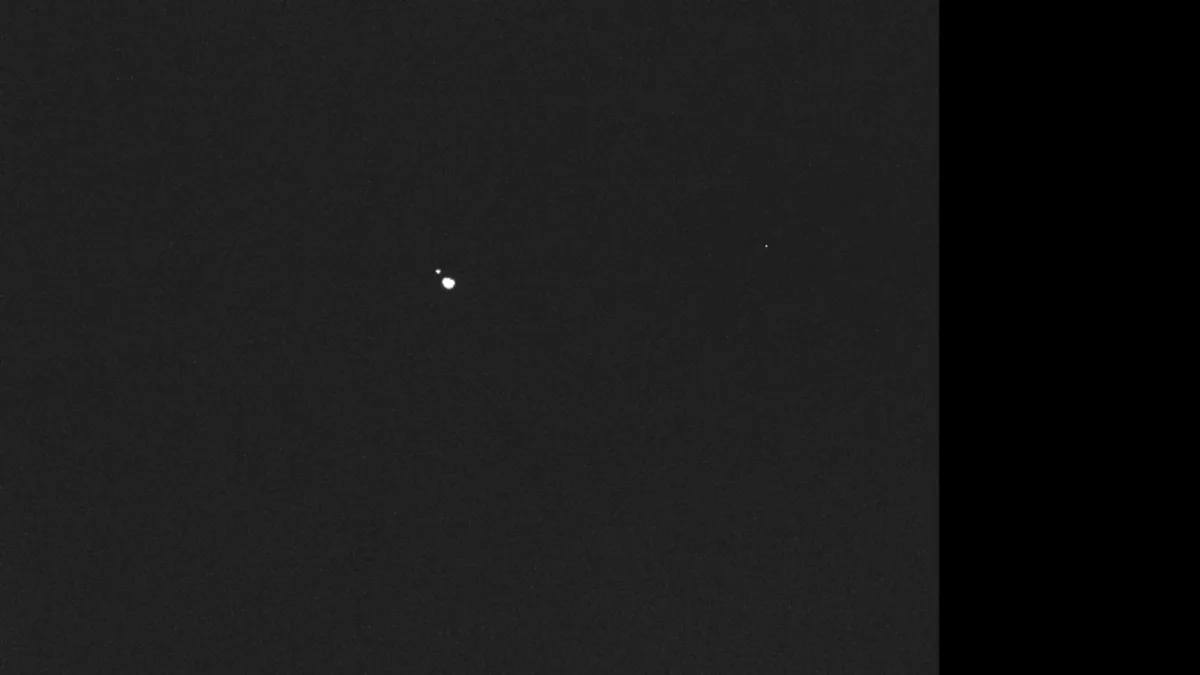
The European Space Agency (ESA) and the Chinese Academy of Sciences (CAS) launched their joint scientific probe Smile from the spaceport at Kourou in French Guiana on 19 May 2026, ESA announced in an official statement the same day. The Vega-C rocket lifted off at 05.52 Central European Time, the first signal from the probe was received at 06.48 from ESA’s New Norcia ground station in Australia, and the solar panels were deployed a few minutes later. The mission matters because it is to deliver the first continuous X-ray image of Earth’s magnetosphere, the part of the atmosphere that deflects most of the solar wind and cosmic radiation.
Smile, an acronym for Solar wind Magnetosphere Ionosphere Link Explorer, follows on from the European Cluster (launched 2000) and Swarm (2013) missions and the Japanese Geotail mission (1992). Unlike earlier probes, which measured local plasma conditions point by point, Smile carries an X-ray imager (SXI) and an ultraviolet imager (UVI) intended to capture the entire interaction between the solar wind and the magnetosphere as a complex three-dimensional structure in real time. That is a methodological shift, given that the dynamics of the magnetic shield have until now mostly been modelled from indirect data.
According to ESA, the probe weighs around 2,200 kilograms, and over the next month it will perform 11 apogee-raising manoeuvres to reach its operational orbit. The final orbit is highly elliptical and reaches out to 121,000 kilometres above the northern pole, where the probe will spend most of its observing time, before descending to 5,000 kilometres above the southern pole, from which it will more efficiently send data back to Earth. The scientific instruments are split between European and Chinese institutions: the X-ray imager was developed by the University of Leicester in Britain, while two further instruments were supplied by CAS. The mission is planned for three years of in-orbit operations, with the option of an extension.
What scientific value the mission carries
The stated scientific goal is to understand geomagnetic storms, events triggered when a burst of solar wind disrupts Earth’s magnetic field and can knock out the power grid, satellite navigation and radio communications. According to the United States National Oceanic and Atmospheric Administration (NOAA), the number of geomagnetic storms of class G3 and above recorded in 2024 and 2025 was above the multi-decade average, which is linked to the maximum of the 25th solar cycle. Smile should make it possible to pair orbital observations with ground-based measurements, allowing a more precise reading of which features of the solar wind drive the strongest effects.
ESA Director General Josef Aschbacher said in a press statement on 19 May that the mission would “for the first time show Earth’s invisible shield in action”, while project manager David Agnolon stressed that Smile is the first mission ESA and CAS have jointly selected, designed, implemented, launched and operated, an institutional precedent for European-Chinese scientific cooperation.
The mission has limits. Smile images processes at the entry of the solar wind into the magnetosphere, but it does not directly measure physical conditions in the ionosphere and cannot forecast geomagnetic storms days in advance. Before any scientific calibration, data from the SXI and UVI instruments will have to be cross-checked against missions already in operation, above all ESA’s Solar Orbiter and NASA’s Parker Solar Probe. The first scientific announcements are expected at the end of 2026, after the instrument commissioning phase wraps up.