Solar Orbiter finds origin of Sun's magnetic switchback
The European probe sampled plasma inside an S-shaped kink in the solar wind's magnetic field and found a particle mix that leads back to hot loops on the Sun's surface.
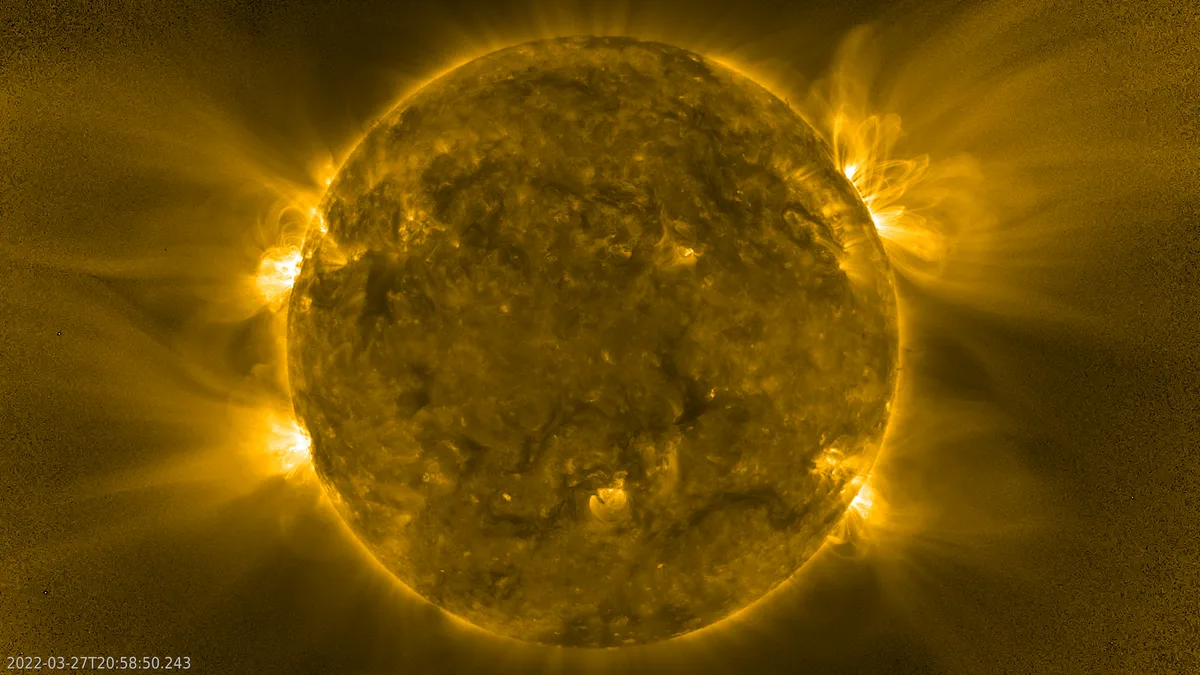
The European Space Agency (ESA) announced on October 8, 2026 that its Solar Orbiter spacecraft flew through a magnetic switchback, an S-shaped kink in the magnetic field carried by the solar wind, and that the particles inside it show where it formed: in hot, closed loops of magnetic field on the Sun’s surface. The paper was published the same day in the journal Nature Astronomy.
What is a magnetic switchback in the solar wind?
The solar wind is a stream of hot charged particles, or plasma, that flows constantly from the Sun into space and drags the Sun’s magnetic field along with it. On its way through the solar system, the field lines can twist, snap or fold back on themselves. A switchback is a stretch where a field line bends into an S.
Switchbacks are often recorded close to the Sun, and researchers still debate how they form. In 2022 ESA reported that Solar Orbiter had spotted one and confirmed its S shape, something scientists had predicted but never observed directly.
How the particles gave away the origin
The new paper follows one switchback back to its source. The team used the Solar Wind Analyser (SWA) on the spacecraft, which sampled the plasma inside the switchback. At that moment Solar Orbiter was roughly halfway between Earth and the Sun. The instrument recorded a mix of charged oxygen and carbon particles that, according to the authors, can only form in hot closed loops of magnetic field on the Sun’s surface.
The paper’s first author, Jesse Coburn of CNRS/LPP in France, explained why this switchback was so useful:
“Solar Orbiter flew through a very large switchback. Thanks to that, we were able to sample rarely seen particles that carry a clear imprint of their origin.”
Coburn added that there are two main theories about how a switchback, and with it the solar wind, comes about, and that the observed particle mix is a “crucial clue” for a process called interchange reconnection.
How does interchange reconnection release plasma?
It happens when parts of the Sun with different magnetic properties touch. Open regions have field lines that stretch out into space like highways, so material can follow them outward. Closed regions have lines that rise, then return to the Sun and form loops. When an open region meets a closed one, the lines squeeze together, snap and reconnect in a different arrangement, and plasma that was trapped in the loop escapes into space.
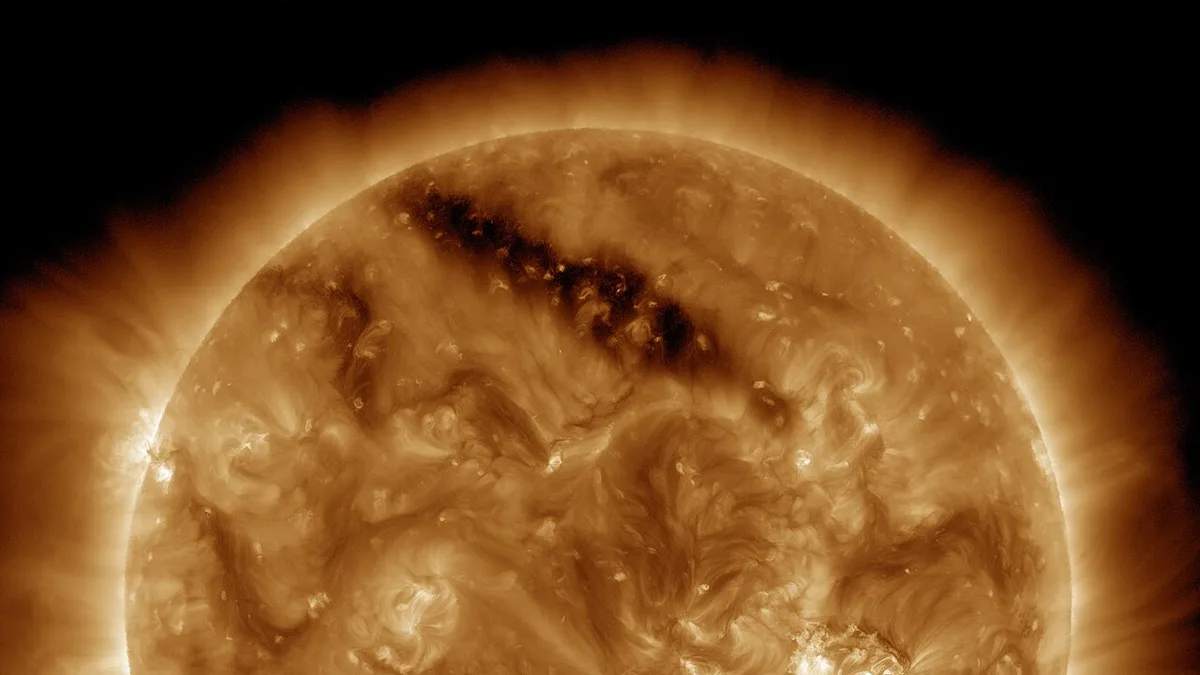
The switchback’s source on the Sun was pinned down with a new model that links Solar Orbiter’s measurements with data from NASA’s Solar Dynamics Observatory. The team also used images of the solar disk and models of the magnetic field of the Sun and the space around it. The paper is titled “On the Coronal Origin of Magnetic Switchbacks in the Solar Wind” (DOI 10.1038/s41550-026-02928-0), and its co-author is Stephanie Jardine of the University of Northumbria in the United Kingdom.
Two theories, one switchback
The rival theory explains switchbacks through waves and turbulence. The paper does not dismiss it. Jardine says traces of those processes were seen too, but probably only after the switchback had left the Sun:
“Once the switchback leaves the Sun, waves and turbulence take over and determine how it moves. Our finding reconciles them and shows that they simply act at different stages of a switchback’s life.”
According to ESA, the finding also bears on how the Sun heats its atmosphere and accelerates the particles of the wind, and it could offer a way to read the history of solar plasma far from the Sun. Daniel Muller, the Solar Orbiter project scientist at ESA, tied it to space weather:
“Like people on Earth, but also in space, our lives are entangled with what happens on our star.”
What this paper does not prove
The quotes in this article are translated from the English original in the ESA announcement. The paper analyzes a single switchback, albeit a very large one, so it does not follow that all switchbacks form through interchange reconnection. The conclusion that the two theories complement each other is the authors’ position, not a documented consensus of the field. The announcement does not say how many similar switchbacks in the spacecraft’s data are comparable to this one, so how common such a case is remains an open question.