Roman tomb at Al-Bahnasa yields gold tongues and a papyrus of Homer's Iliad
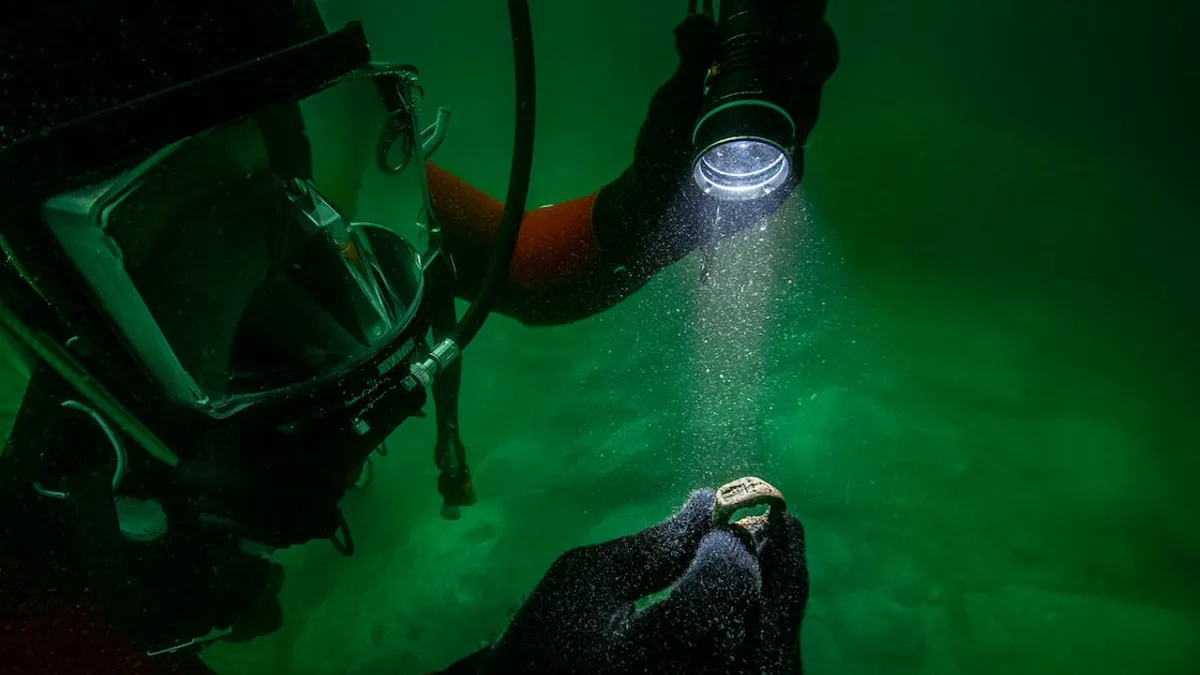
A joint mission of the University of Barcelona and Egypt's Supreme Council of Antiquities has uncovered several decorated mummies, three gold and one copper tongue, and a papyrus with Book Two of Homer's Iliad in the necropolis of ancient Oxyrhynchus.

A joint archaeological mission of the University of Barcelona and Egypt’s Supreme Council of Antiquities, led by Maite Mascort and Esther Pons, announced on 21 April 2026 that, in the necropolis at Al-Bahnasa, the ancient Oxyrhynchus in Upper Egypt in the Minya governorate, a Roman tomb had been uncovered containing several decorated and linen-wrapped mummies, three gold and one copper tongues, and a papyrus with verses from Book Two of Homer’s Iliad, the so-called Catalogue of Ships. The find was announced through a press statement by the Egyptian ministry, with the first report on stratigraphy and dating due to appear in the journal Egyptian Archaeology in the autumn of 2026.
In the Roman period, between the 1st and 4th centuries AD, Oxyrhynchus was one of the most important administrative and cultural centres of Upper Egypt. In modern archaeology, the site is best known for the Oxyrhynchus Papyri, a vast collection of several hundred thousand fragments written in Greek and Coptic, excavated between 1896 and 1907 by the British archaeologists Bernard P. Grenfell and Arthur S. Hunt of the University of Oxford. The discovery of a new papyrus with a Homeric text marks a continuity with that tradition and confirms that Oxyrhynchus still holds undocumented literary pieces from antiquity.
In anthropological terms, the find of three gold and one copper tongues represents an intriguing funerary custom of Roman Egypt. According to documented earlier cases, metal tongues were placed in the mouths of the dead so that they could converse with the gods of the underworld, above all Osiris. The practice in Egypt is attested from the Hellenistic period through into the Roman period, and Al-Bahnasa is not the first site at which such tongues have been found, but it joins a small number of tombs in which more than one has been found in the same context. Alongside the gold tongues, the team has documented three limestone burial chambers, the cremated remains of an adult in a large ceramic vessel, and the bones of an infant and of cat heads in further vessels.
What the find does NOT confirm
Before drawing wider cultural conclusions, some limits should be highlighted. First, the papyrus with verses from Homer’s Iliad is not complete. It consists of fragments whose conservation and transcription will take several months in the laboratory of the Bibliotheca Alexandrina, after which it will be possible to say whether the content deviates from the standard text known from mediaeval manuscripts. Without a full transcription, it is not possible to claim that the papyrus delivers new or lost verses; it only confirms that Homer was widely read in Roman Egypt.
Second, the identity of the deceased buried in the tomb is for the moment unknown. They are not emperors or members of a documented local aristocracy, and no hieroglyphic or Greek inscription that would reveal their names has been found. According to the mission’s preliminary findings, this is a family mausoleum used across several generations, a standard practice in Roman Egypt for members of the middle layer of society, traders and local officials. Without such inscriptions, it is not possible to specify further who was buried in the tomb or which social class they belonged to.
Third, the dating of the tomb to the Roman period currently rests on the style of the sarcophagi’s decoration and the contextual analysis of the pottery, not on radiocarbon dating. Before any definitive conclusions, dating of samples of linen from the mummies will be carried out, which will more precisely fix the burial period within the roughly 300 years of Roman rule in Egypt. The University of Barcelona mission is planning to resume excavation in the autumn of 2026, when further contextual finds may emerge to complete the picture of this part of the necropolis.
In the history of the Oxyrhynchus Papyri, this find fits into a larger picture. From the end of the 19th century until today, the Oxyrhynchus Papyri have made it possible to reconstruct significant pieces of lost Greek literature, including fragments of Sappho, Pindar, Menander and Aeschylus. The Sackler Library at the University of Oxford estimates that around 5,000 papyri have so far been published, while several hundred thousand still await transcription and editorial treatment. The find within a tomb, not in rubbish dumps or abandoned buildings where most earlier papyri came to light, provides another valuable piece of contextual information, because it shows that members of the middle classes at Oxyrhynchus were buried with literary texts as part of the funerary inventory, a documented practice, if not a common one. If analysis shows that the papyrus contains variants of Book Two of the Iliad that are rare or unknown in the manuscript tradition, the find will become important for the philology of Homer’s epic tradition as well.