Alexandria Divers Find Signet Ring Showing the Lighthouse
The European Institute for Underwater Archaeology and Egypt's ministry announced a find they describe as the first known depiction of the lighthouse on a signet ring.
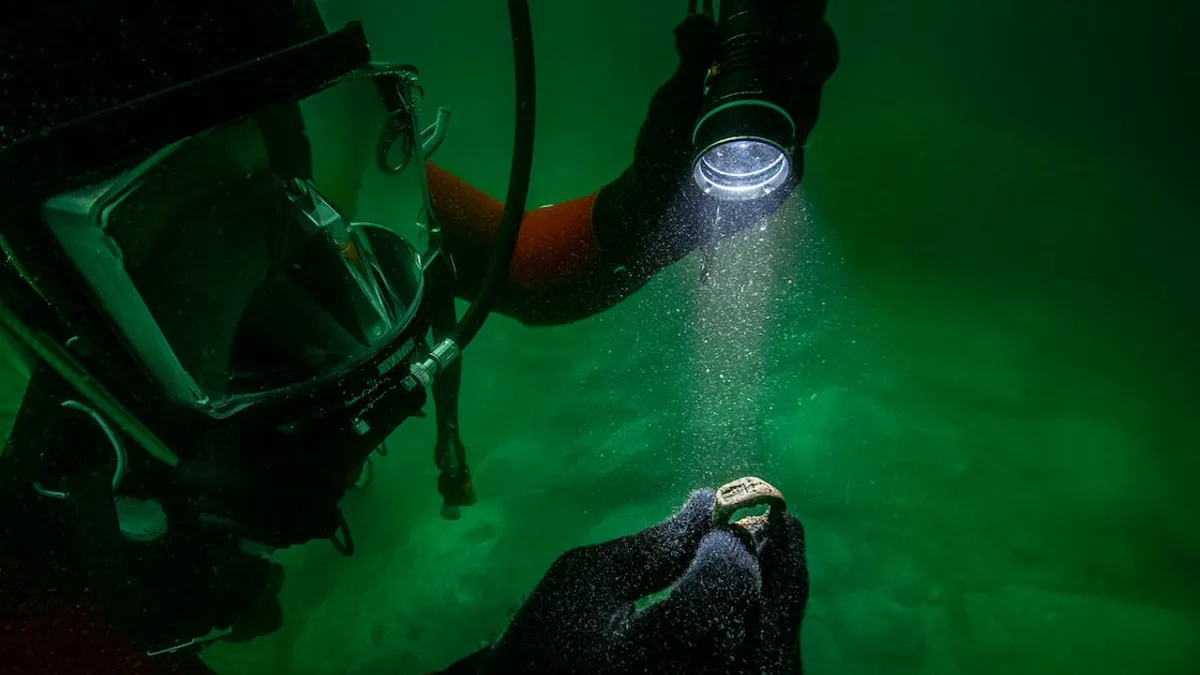
Underwater archaeologists from the European Institute for Underwater Archaeology (IEASM) have recovered a bronze signet ring with a relief of the Alexandria Lighthouse from a sunken palace in Alexandria. The institute announced the find on Wednesday, October 7, 2026, and Egypt’s Ministry of Tourism and Antiquities described it as the first known depiction of the lighthouse engraved on a signet ring.
Where was the ring found?
The ring was discovered on the island of Antirhodos, once part of the royal quarter in Alexandria’s Portus Magnus harbor and now under water. The excavations are led by French underwater archaeologist Frank Godio and have been funded since 1996 by the Hilti Foundation, in cooperation with the Egyptian ministry.
Sherif Fathy, the minister of tourism and antiquities, visited the research vessel on Monday, October 5, together with his aide Ahmed Rehem. They watched the dives and examined the ring. According to the institute, remains of structures covering several thousand square meters have been found on Antirhodos, and they have not yet been fully examined.
What does Godio say about the find?
Godio ties the ring’s significance to the place where it was found. The institute’s statement carries his words:
“The discovery of the signet ring is even more important because it was excavated in the legendary palace on the island of Antirhodos, which was once a center of power.”
The quote is translated from the English original. From the find, the institute concludes that the palace, which the Greek geographer Strabo saw during his stay in Egypt between 29 and 25 BC, at some point housed offices for administrative work, including management of the lighthouse. That is the institute’s inference, not direct evidence written on the ring itself.
Serbian broadcaster RTS attributes a somewhat different sentence to Godio, about administrative offices directly linked to the lighthouse. RTS also quotes Hisham el-Leithy, secretary general of Egypt’s Supreme Council of Antiquities:
“The find is truly exceptional, since until now we have never identified an image of the ancient lighthouse on a signet ring.”
What do the sources not say?
The institute has not released the depth at which the ring was found, its dimensions or the date it was recovered. No firm date for the ring itself has been given: the lighthouse image resembles the one on Alexandrian coins from the second century AD, and the institute did not say who might have owned it. RTS writes that the ring is almost two thousand years old, a claim the institute does not make in its statement.
The lighthouse that vanished
The lighthouse on the island of Pharos was completed around 280 BC, under Ptolemy II, and is estimated to have stood more than 100 meters tall. Earthquakes brought it down in the Middle Ages, and in the late 15th century the Mamluk sultan Qaitbay built a fortress on the site, using stone from the ruins.
This season the team is investigating four sites in the Eastern Harbor: the Temple of Isis, the palace and the western mound on Antirhodos, the remains of an obelisk, and Timonium, a palace linked to Mark Antony. The mission then moves to Abu Qir Bay, where Godio’s team found the sunken city of Thonis-Heracleion in 2000. Monumental statues, inscriptions and dozens of ancient vessels come from there, and it has also been reported that in 2021 divers found 2,400-year-old woven baskets of doum palm fruit and grape seeds among funerary offerings, along with a Ptolemaic galley about 25 meters long.