

Houston physicists break superconductivity record at 280 kelvin under ambient pressure
A team led by Paul Chu at the University of Houston reports in Nature that a new nickel-copper material reached superconductivity at 280 kelvin under normal atmospheric pressure, beating the previous record of about 250 kelvin set with high-pressure hydrides.
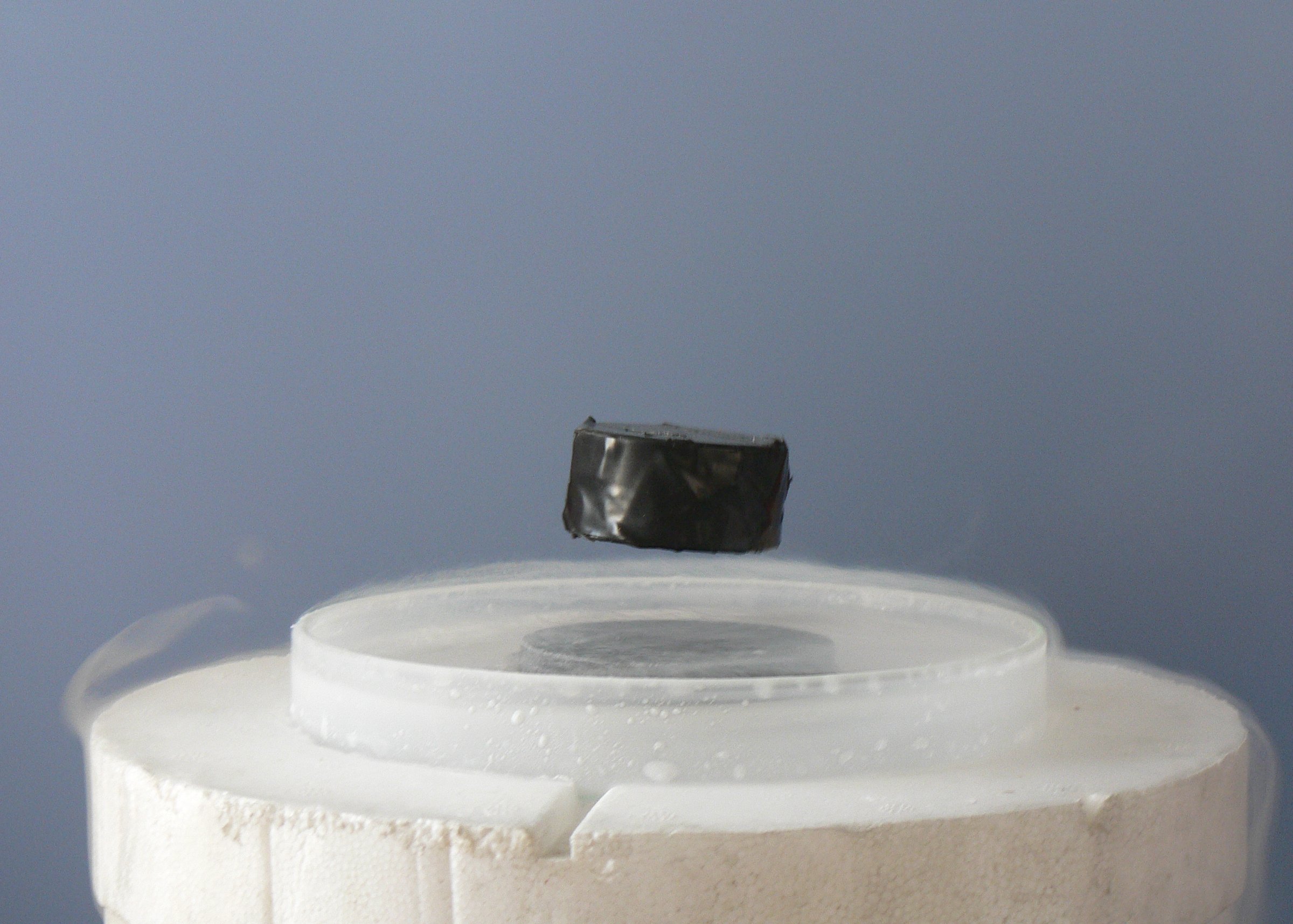
A team of physicists at the Texas Center for Superconductivity at the University of Houston, led by Paul C. W. Chu, reported on May 21, 2026 in Nature that a new material based on nickel, copper and fluorine has reached superconductivity at 280 kelvin, equivalent to about 7 degrees Celsius, under normal atmospheric pressure.
If the result is independently confirmed, it is the highest critical temperature for superconductivity ever measured at ambient pressure. The previous record of about 250 kelvin was set with hydride materials under extreme pressure in 2020.
What superconductivity is
Superconductivity is the state in which electric current flows through a material with zero resistance. No energy is lost as heat. The phenomenon was discovered in 1911 by Dutch physicist Heike Kamerlingh Onnes, who found that mercury loses all resistance near absolute zero.
For decades the central challenge has been to raise the critical temperature. Practical applications require cooling no lower than room temperature, which would open the door to:
- lossless power transmission lines
- ideal magnets for medical imaging
- quantum computers without extreme cooling chambers
Experimental methodology
Chu’s team used a thin-film deposition technique. Atoms of nickel, copper and fluorine are deposited in controlled layers on a sapphire substrate. The material is then exposed to precise thermal processing that allows the crystal lattice to reorganise.
The critical temperature was measured with two complementary methods:
- observation of the Meissner effect, where the superconductor expels magnetic field
- measurement of electrical resistance dropping to zero
Results were confirmed in three independent laboratory setups. Raw data are available to the scientific community for independent reanalysis.
The key point is that the result does not require high pressure, which was the limitation of earlier record materials. The hydride compounds that hit 250 kelvin in 2020 required pressures of about 170 gigapascals, roughly 1.7 million times atmospheric pressure. Such materials cannot be used outside laboratory conditions. Chu’s new material operates at one atmosphere, making it a realistic candidate for use in power grids and medical equipment.
What the discovery does NOT prove
Even with spectacular results, the authors note that industrial application is far off. Current samples are tiny, just a few hundred nanometres thick, and can carry only low currents before the superconducting state collapses. Before the material can be used for power lines or magnets, manufacturing technology must scale to industrial volumes. That typically takes five to fifteen years from the first laboratory proof.
A second limitation, which the community will examine closely, is that the history of superconductivity is full of unverified claims. The most famous case is the 2023 paper by Ranga Dias on room-temperature superconductivity in a lutetium-based material, which several independent teams quickly refuted.
Nature required a more rigorous peer-review process than usual for Chu’s paper. Five independent reviewers were used instead of the standard two or three. Chu’s team explicitly requested this.
Link to Serbian physics
The discovery is interesting because the Vinca Institute has been working on superconducting materials in collaboration with Saint Petersburg and Houston for decades. The Serbian team led by Djordje Stojanovic announced an attempt at independent reproduction of the experiment during summer 2026. This is the standard scientific procedure for confirming record results.
Is room-temperature superconductivity a realistic achievement in the next decade, or just a laboratory curiosity?
Share your view: where do you see the greatest practical benefit of room-temperature superconductivity? Tell us in the comments.


