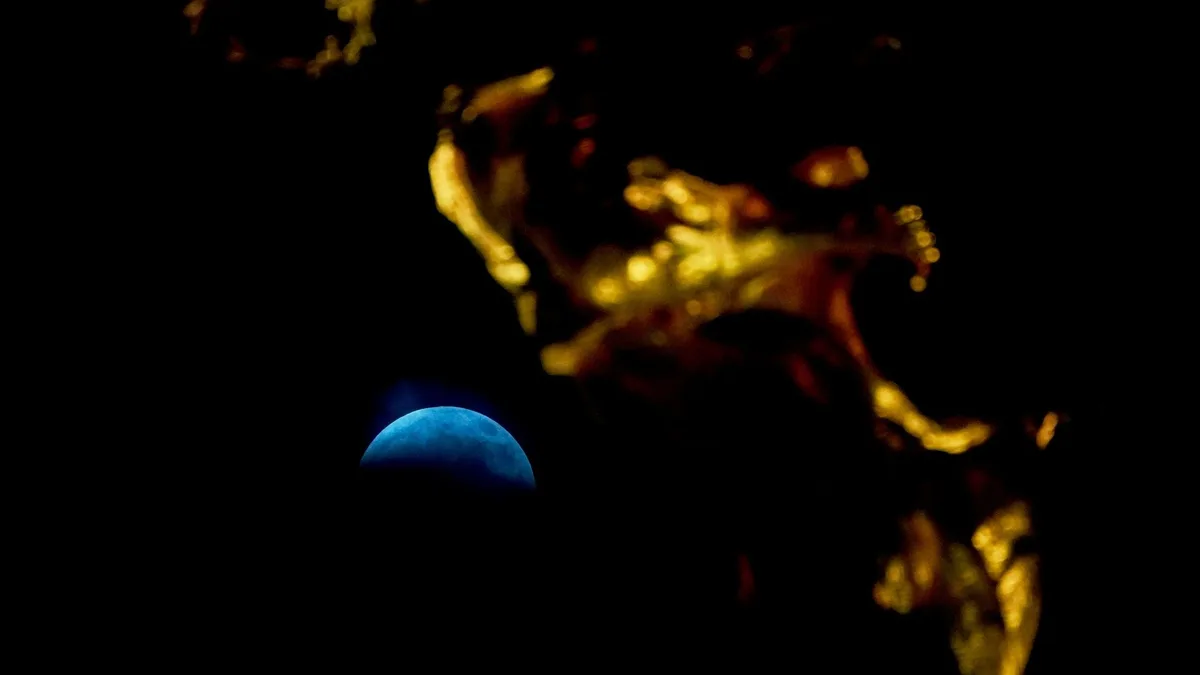
Solar Eclipse August 12: Serbia Sees Only a Sliver at Sunset
The Moon's shadow crosses Greenland, Iceland and northern Spain on August 12. Serbia sees only a partial phase near sunset, with 15 to 20 percent of the disk covered in Vojvodina.

On Wednesday, August 12, 2026, the Moon’s shadow will sweep across northern Russia, Greenland, Iceland, the Atlantic Ocean, northern Spain and a small part of Portugal. From Serbia, that day’s solar eclipse appears only as a partial phase, low over the western horizon and just before sunset, visible only to those who scout out a spot with a clear view west ahead of time.
According to NASA, the shadow covers a path of 8,260 kilometers in roughly an hour and a half. The longest totality lasts 2 minutes and 18 seconds, with the point of maximum duration about 45 kilometers off Iceland’s west coast. By the time the shadow reaches Portugal and Spain, the total phase has shrunk to about one minute. Most observers within the path of totality will see it last less than two minutes, and no more than two and a half minutes near the center of the path.
What Serbia Will Actually See
According to astronomija.org.rs, the Moon will cover roughly 15 to 20 percent of the Sun’s diameter over Vojvodina and northwestern Serbia, which works out to about 14 to 19 percent of the disk’s surface area depending on location. Moving east across the country, the coverage drops to just a few percent.
For Novi Sad and most of Vojvodina, the partial phase begins around 7:25 PM, reaches its maximum around 8:17 PM, and the Sun sets a few minutes after that maximum. The end of the eclipse therefore happens below the horizon and is not visible from here.
The Sun’s height above the horizon in those minutes matters more here than any percentage. A blocked western horizon, whether it’s a row of poplar trees, a building across the street or a hill behind town, means missing the entire event. Getting out of town to a meadow or a rise with a clear view west is, in practice, worth more than any piece of equipment.
Why Barcelona Sees Near Totality While Serbia Gets Barely a Bite Out of the Disk
Coverage of the Sun’s disk grows the closer an observer is to the path of totality. Figures for several cities show how quickly that difference builds:
- Barcelona: 99 percent
- Dublin: 94 percent
- Oslo: 83 percent
- Montreal: 18 percent
- New York: 9 percent
- Detroit: 3 percent
Serbia is far from the path of totality and stays within the penumbra, where the Moon covers only part of the disk. For observers in the penumbra, there is no moment when it’s safe to look at the Sun with the naked eye.
How to Watch Without Damaging Your Eyes
The partial phase should be viewed only through certified eclipse glasses meeting the ISO 12312-2 standard, which are about 100,000 times darker than ordinary sunglasses. What is not safe:
- ordinary sunglasses, no matter how dark they are
- a telescope, binoculars or camera lens without a solar filter mounted on the front of the optics
- looking through a telescope or binoculars while wearing eclipse glasses, since the concentrated light burns through the filter
An indirect method also works safely: projecting the Sun’s image onto a screen behind the eyepiece, or a simple pinhole box that casts the Sun’s image onto the opposite side.
What NASA and ESA Are Measuring That Day
The eclipse isn’t just a spectacle. American student teams are launching more than 60 high altitude balloons from Spain and Iceland to measure atmospheric changes as the cold shadow passes overhead. One NASA aircraft will chase the shadow at about 740 kilometers per hour (460 miles per hour), stretching observation time to nearly three minutes instead of two and a half. NASA is also planning a live broadcast starting at 1:15 PM Eastern time.
The Same Night Brings the Perseids
The Perseid meteor shower peaks between August 12 and 13, with a new moon that won’t interfere with viewing. For anyone staying outside that night, that means two separate events in the same evening: a low crescent of the Sun in the west at dusk, then meteors once it’s dark and eyes stop searching for anything toward the sunset.
The Limits of This Event
A partial eclipse is not a scaled down version of a total one. The corona, the sudden drop in light and the noticeable temperature drop all belong to totality, and none of them will be visible from Serbia on August 12. The times and percentages given here were calculated for specific points, mainly Novi Sad and Vojvodina, and vary from city to city. In the eastern part of the country, where only a few percent of the disk is covered, the change is barely noticeable even through a filter.
The next total eclipse, on August 2, 2027, lasts 6 minutes and 23 seconds, with the path of totality crossing southern Spain and northern Africa. It’s followed by an annular eclipse on January 26, 2028. Anyone stuck behind a blocked horizon on August 12 will have to wait for next year.